
Auction: 7029 - Orders, Decorations, Medals & Militaria
Lot: 7
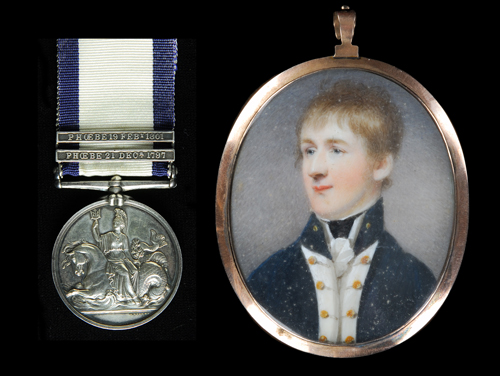
The Superb Two Clasp ´Phoebe´ Naval General Service Medal to Lieutenant C. Prowett Naval General Service 1793-1840, two clasps, Phoebe 21 Decr. 1797, Phoebe 19 Feby. 1801 (C. Prowett, Midshipman), extremely fine, with a fine quality oval miniature portrait on ivory of Lieutenant Prowett in uniform, 73mm x 62mm, contained in a gold glazed frame, with a label on the reverse inscribed ´The Revd. Charles Prowett taken for his mother at the age of 20´; and three related letters, two from Admiral Sir Edward Pellew regarding his service in H.M.S. Caroline, dated 1.6.1807 and 12.11.1807 respectively; and one from a relative of the recipient, dated 28.4.1810 Estimate £ 16,000-18,000 Lieutenant, The Reverend Charles Prowett, (1781-1852), entered the Royal Navy as Midshipman, in H.M.S. Magnanine, 1795; transferred to H.M.S. Aguilon later that year, and to H.M.S. Phoebe, 1796, a newly-launched 36 gun 18-pounder frigate operating in the Channel under the command of Captain Robert Barlow; took part in the capture of the French ship Atalante (16 guns), January 1797, and the privateer Basgue, April 1797. Capture of the Néréide On the 21st December 1797, at 10:00 am, the Phoebe observed a ship standing towards her which by 11:30 am was identified as the French Néréide. Captain Barlow immediately gave chase, came up within gunshot of the enemy ship at 9:00 pm, which commenced firing her stern-chasers into Phoebe, considerably damaging her masts, sails, and rigging. A running fight continued until 10:00 pm when the two ships came fairly alongside each other and, after a close action of 45 minutes, the Néréide received considerable damage in her masts, rigging, and sails, some falling on board the Phoebe. At 10:45 pm, just as the British ship was about to renew the attack, the Néréide hauled down her light and hailed that she had surrendered. The prize was later purchased by the Royal Navy. In September 1798 the Phoebe was grounded upon entering Guernsey, with her guns and masts overboard. She was repaired at Plymouth, and re-entered service at the start of the following year; took part in the capture of the French brig Hazarde, November 1799, and the privateers Baaland (14 guns) and Hereux (22 guns), February and March 1800. Capture of the Africaine On the 19th February 1801, at 7:30 am, the Phoebe discovered the French frigate Africaine near Ceuta on the Barbary shore and brought her to action. The engagement took place within pistol shot of each ship for two hours until the Africaine struck her colours. Almost a wreck, she was nearly unrigged, dead and wounded covered her decks, most of her guns were dismounted, and there was five feet of water in her hold. The French ship, en route for Egypt, was found to be transporting 400 troops, several stand of arms, and a large quantity of ammunition. For his gallantry Captain Barlow received a knighthood, and the Africaine was added to the Royal Navy as the 38-gun frigate Amelia. Charles Prowett was appointed Lieutenant, June 1801, and transferred to H.M.S. Phaeton, serving in China and the East Indies; took part in the capture of the Spanish spice ship Prince of Astoria, valued at half a million pounds; engaged the French frigate Semillante and batteries at St. Jacinta, Philippines, August 1805; appointed Acting Captain, March 1807; transferred to H.M.S. Caroline, May 1807 as Acting Captain; relinquished command to Captain Hart, June 1807, receiving the thanks of Admiral Pellew (letter included with lot refers), and appointed 1st Lieutenant. Capture of the Cheribon ´The Commander in Chief has received with much satisfaction the report of the capture of the Cheribon of 14 guns and 75 men, by the boats of His Majesty´s Ship Caroline commanded by Lieutenant Prowett under circumstances as stated by Captain Hart highly creditable to that officer and those employed under his orders. His Excellency desires Captain Hart will convey to Lieutenant Charles Prowett, Mr. McGowan, Midshipman; Lieutenant Sawers of the Marines, and the other volunteers employed on this service his acknowledgement of their gallant conduct upon this occasion.´ (General Order from Admiral Pellew to Captain Hart, dated 12th November 1807 refers). Served with the squadron that destroyed Dutch warships and batteries at Gressie and Sambelanga, Java, December 1807; returned from the East Indies in Admiral Pellew´s flagship Culloden, and arrived at Plymouth July 1809. Transferred to H.M.S. Ville de Paris for service in the Mediterranean, 1810, taking passage to the Mediterranean in Admiral Sir Charles Cotton´s flagship Lively; he was informed by Lord Mulgrove that he had been recommended to Sir Charles for promotion, and so might soon ´get a step higher´ (letter included with lot refers)- in the event this was not to happen; transferred to H.M.S. Colossus for service off the coast of Lisbon later that year; retired from the Navy 1811, and Ordained Priest by his uncle, the Lord Bishop of Norwich the following year; at his death in 1852 he held the living of Stapleford, Hertfordshire. When the Naval General Service Medal was authorised in 1848, there were only five claimants for Medal with clasp for Phoebe 21 Decr. 1797; and only six claimants for the Medal with clasp for Phoebe 19 Feby. 1801. Four of the claims in each case were for the medal with both clasps.
Sold for
£50,000


Watch, listen and bid as if you were in the room. Now available for auctions worldwide.
Click here to bid live
An exclusive and confidential service for the discerning collector or vendor.
View the Gallery
Download every Spink catalogue on your iPad, iPod or iPhone using free Spink app.
Download From iTunes© 2026 Spink & Son. All rights reserved.