
Auction: 390 - Renaissance Plaquettes and Commemorative Medals featuring the Neil A. Goodman Collection - e-Auction
Lot: 116
FLORENTINE SCHOOL (15th Century)
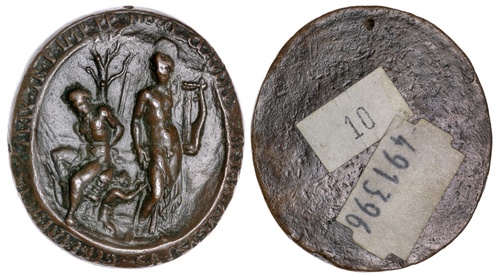
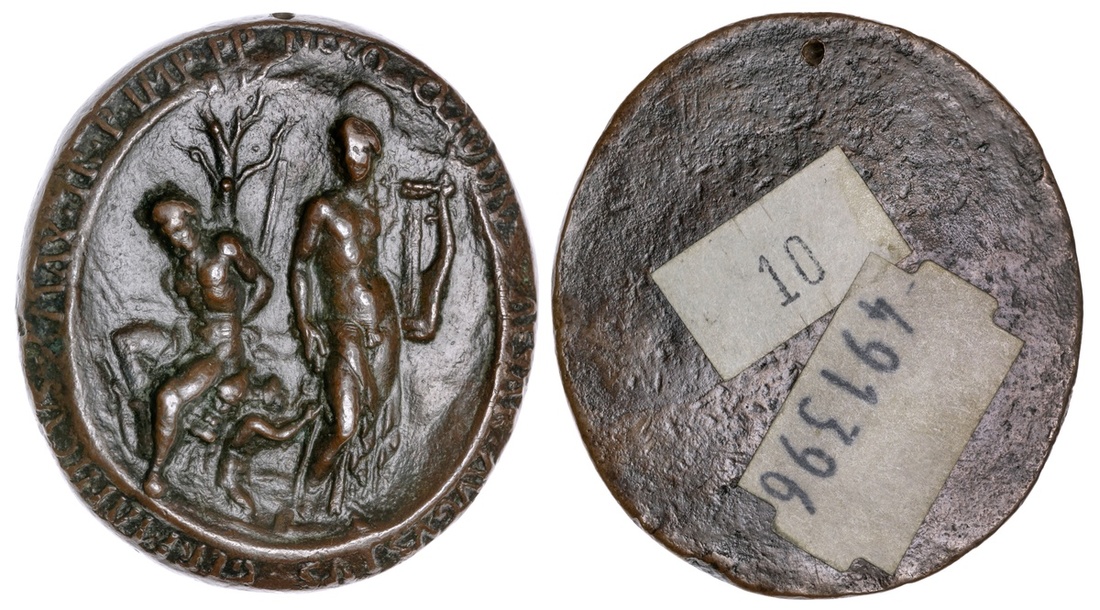
Apollo and Marsyas. Oval plaquette. Bronze, 42 x 46mm. Laureate and mantled Apollo standing at right, holding his lyre and plectrum, his head turned back to look towards Marsyas, seated left on a lion's skin, his hands tied behind his back, resting against a tree from which hangs the double tibia of Silenus; between them Olympos, the flute player, son (or pupil) of Marsyas kneels pleading to Apollo for clemency; legend around. Molinier 2 (with inscription); Bange 66-9 (after the antique); Kress 246-7 (after the antique); Oxford Ashmolean 2; Venice Museo Corner 77; Middledorf 288.
The composition derives from the famous antique carnelian intaglio "about the size of a nut in its shell" once in the collection of Giovanni di Cosimo de'Medici. In 1430, Ghiberti (Commentarii II, 20) set the gem in an elaborate gold mount with an inscription alluding to the legend that it was once the personal seal of Emperor Nero. Tradition has it that the gem was cut by the artist Dioskourides whose work was greatly admired by Augustus. It was listed in the inventory made for Lorenzo II, "Il Magnifico" in 1492, and this gem, or another very similar, inscribed LAVR MED, is now in the Museo Nazionale, Naples, Mosta Medicea Sala XII, n.33 D.
This depiction of the subject remained very popular and influential throughout the Renaissance. It is found on numerous gems (many listed in Pesce loc. cit.) and bronze plaquettes, with and without inscriptions, which are classified by Molinier in five and by Ricci in eight main types (see also the list in the Dreyfus catalogue p.28 ff. to which can be added the15th century silver-gilt plaquette in the Museo Nazionale di Napoli n.25491, also published by Pesce, loc. cit.).
It is found in sculpture, for example the famous late 15th century doorway made by the Rodari brothers for the Palazzo Stanga, Cremona (now the entrance to the Salle Michel Ange in the Louvre), and also in a medallion by Rustici, dated 1511-12, in the courtyard of the Villa Salviati in Florence. It also occurs on one of the medallions on the tomb of G. Brivio in S. Eustorgio in Milan, the work of the brothers Francesco and Tommaso Cazzaniga and Benedetto Briosco, and also on the marble relief in the Liphart collection, formerly at Ratshof in Livonia, attributed erroneously to Michelangelo, which lacks the figure of Olympos (see K. Frey, Michelangelo Buonarotti, Quellen und Forschungen, Berlin 1907, I, p.91 ff and Hans Makowsky, 'Michelangelo's First Sculpture', in The Burlington Magazine, vol.53, no.57, October 1928, pp.164-167 + 169-170).
In miniature the image can be seen in many manuscripts, for example the Eroiche of Filostrato (Vienna Bibl. Naz. cod. Hist. prof.66), the Commentari Rerum Gestarum Francisci Sphortiae of Giovanni Simonetta (Florence, Bibl. Riccardiana, E.R.428), and in bas-relief in two miniatures of Gherardo and Monte de Giovanni which illustrate the frontispieces and incipit of De Spiritu Sancto of Didimo and Cirillo Alessandrini (New York, Pierpont Morgan Library n.396).
The figure of Apollo on the reverse of the medal of Nicholaus Schlifer by Giovanni Boldu, dated 1457, faithfully copies the gem except Apollo holds a scroll in his right hand instead of a plectrum (Hill, Corpus 418), and a similar figure also appears on the reverse of an oval medal by Cristoforo di Geremia dedicated to Pope Paul II, dated 1468.
The gem is also depicted in painting. It appears as a cameo on a gold chain in Ritratto di Fanciulla, the portrait of a woman (Simonetta Vespucci, or Lucrezia Tornabuoni?), attributed to the studio of Botticelli, in the Städelesches Kunstinstitut, Frankfurt. The figure of Apollo appears again in the stucco decoration to the entrance to the Sala dei Chiaroscuri, Logge di Raffaello in the Vatican, and, more importantly, Raphael uses the figure of Apollo prominently in The School of Athens in the Stanza della Segnatura. It was the engraving of this by Marcantonio Raimondi that gave the image its widest popularity. Old labels on back (likely removable). Neat and unusual top to back piercing. A Very Fine old cast preserving the Ghiberti mount (not the doubled inscription variant).
From the Neil A. Goodman Collection
Sold for
$425
Starting price
$280

Watch, listen and bid as if you were in the room. Now available for auctions worldwide.
Click here to bid live
An exclusive and confidential service for the discerning collector or vendor.
View the Gallery
Download every Spink catalogue on your iPad, iPod or iPhone using free Spink app.
Download From iTunes© 2026 Spink & Son. All rights reserved.