
Auction: 26052 - Jewellery & Objets de Vertu
Lot: 26
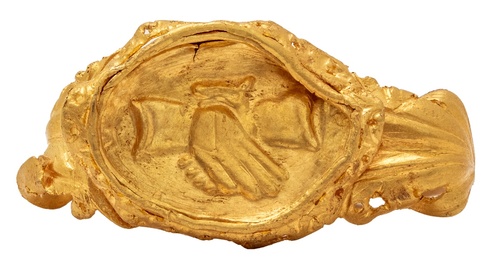
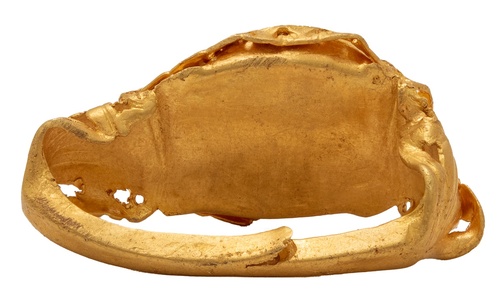
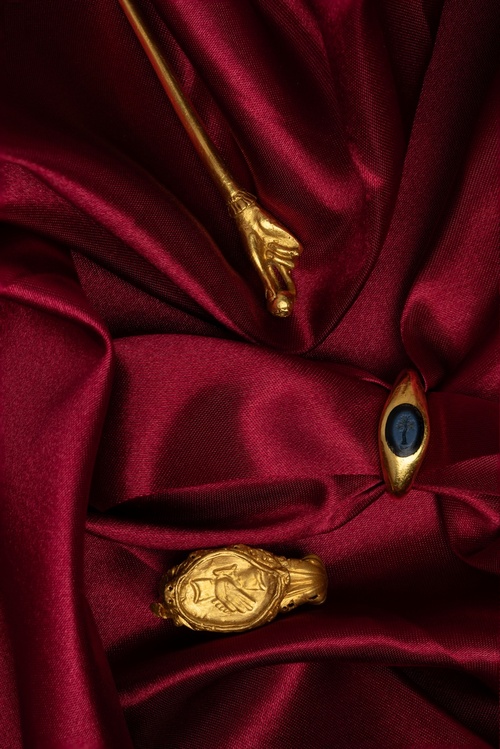
A ROMAN 'CLASPED HANDS' RING
CIRCA 250-300 AD
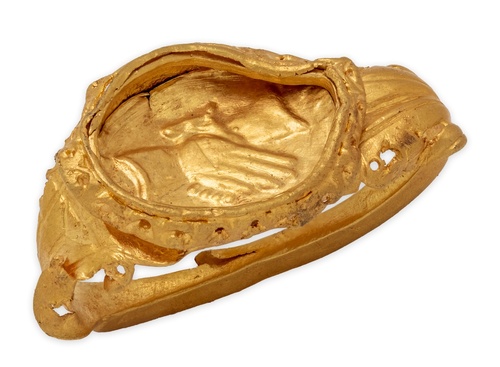
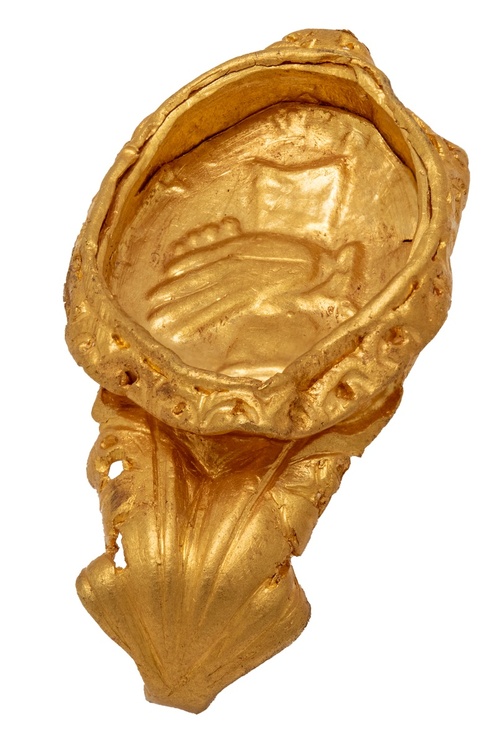
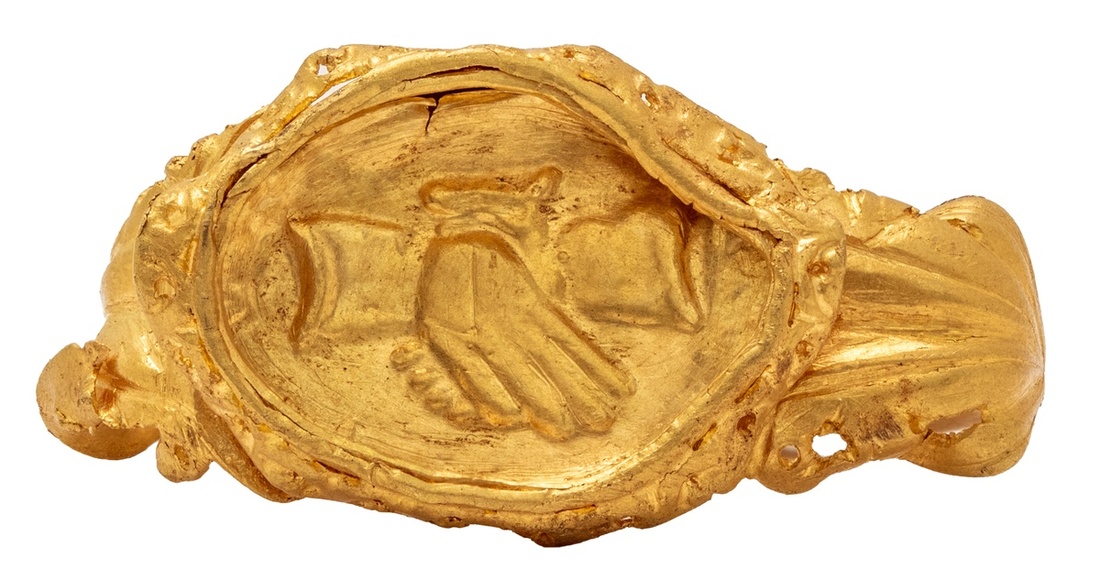
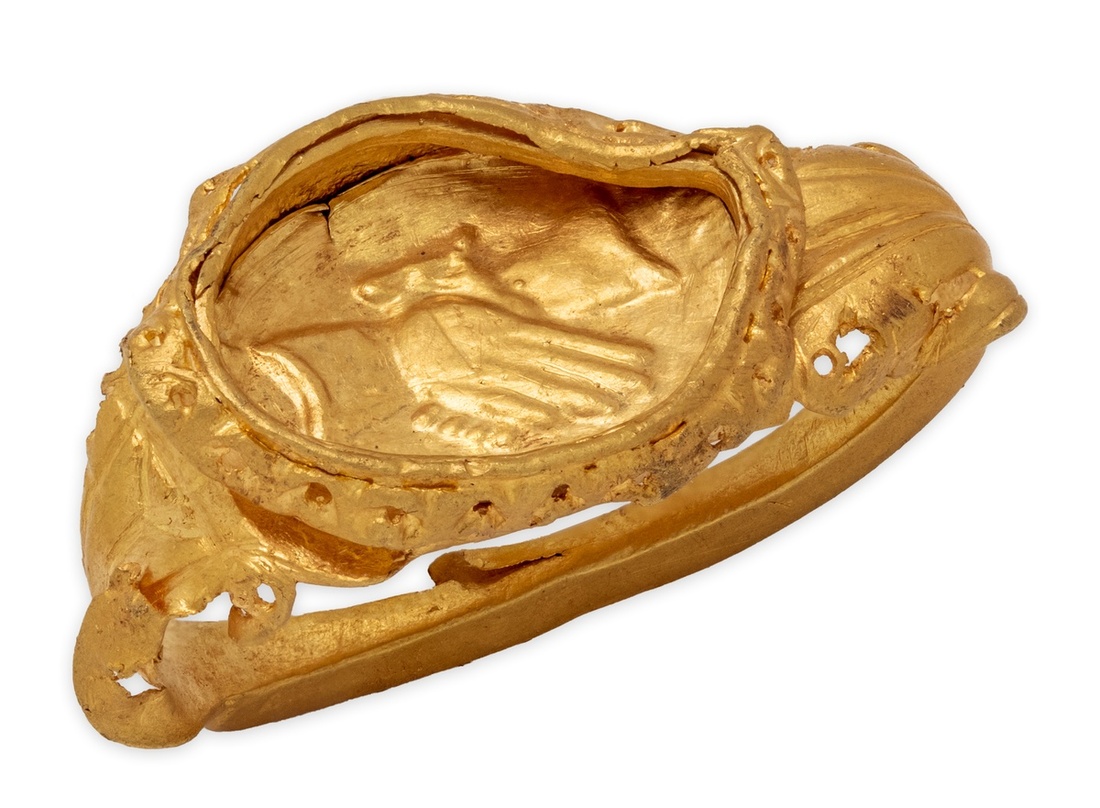
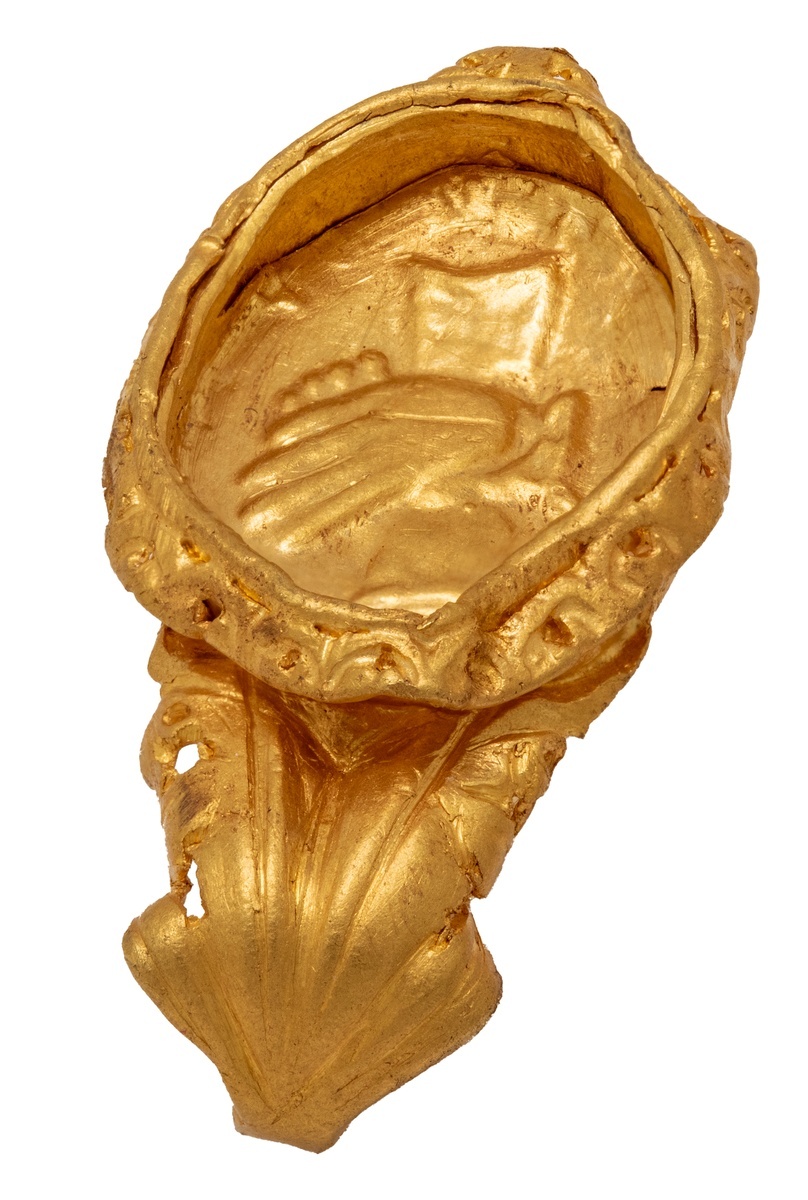
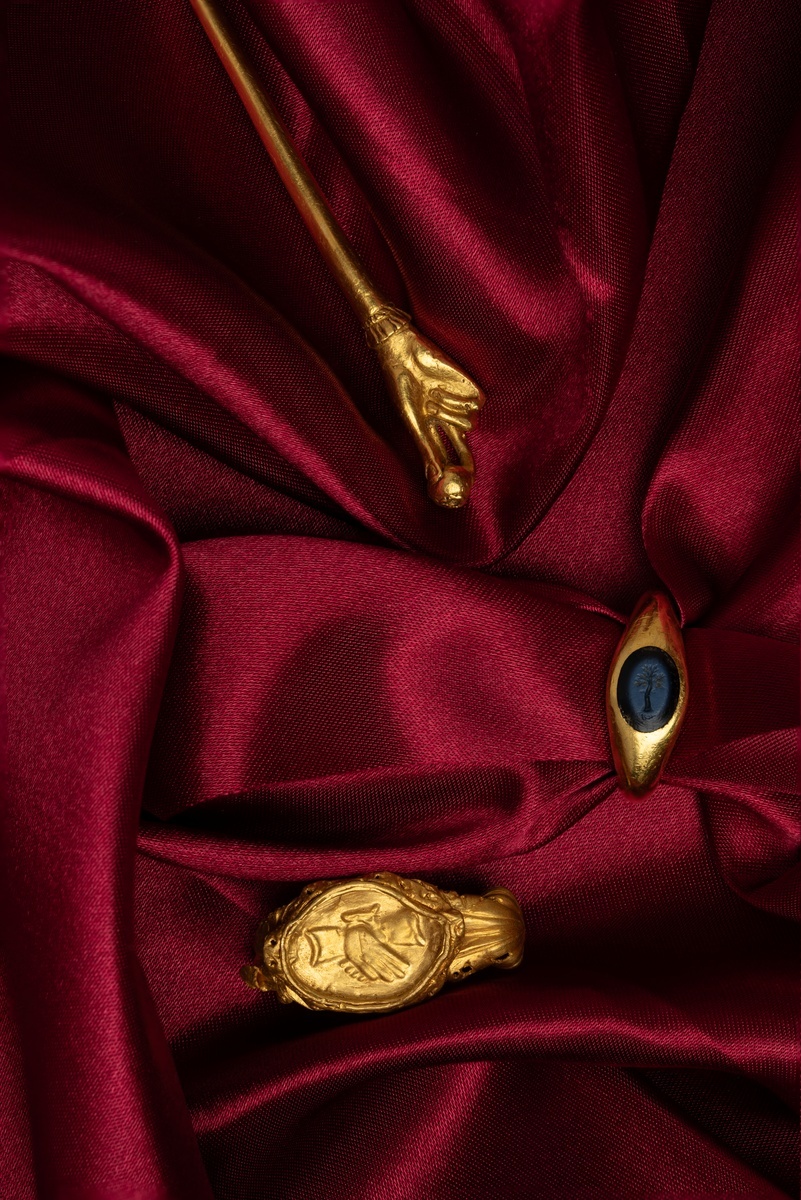
A large late Roman gold finger ring, the longitudinal oval bezel centred with a repoussé clasped-hands motif impressed into thin gold sheet, depicting two right hands with the thumbs raised and the wrists ending in incurved bands, possibly indicating the edges of gloves.
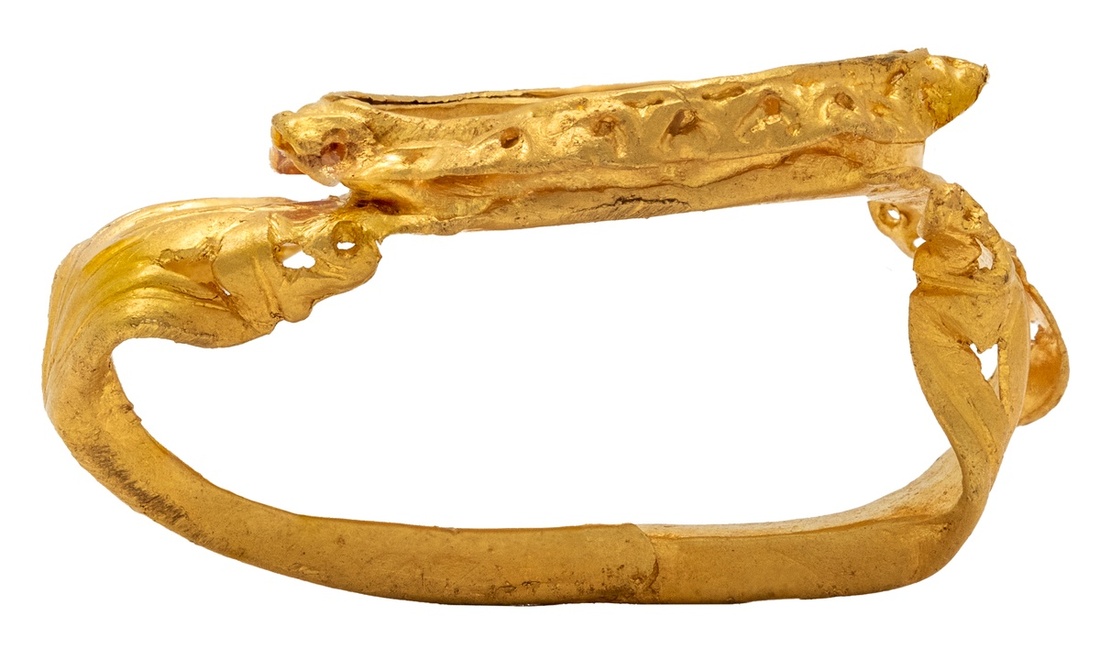
The bezel wall applied with a relief-decorated openwork strip of standing arches, each enclosing a small acanthus leaf or palmette.
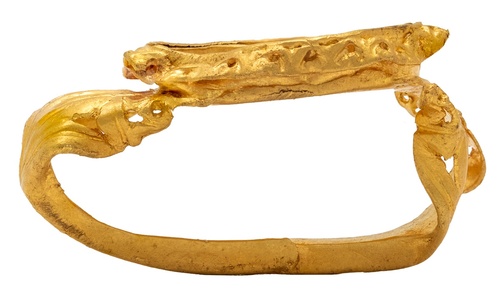
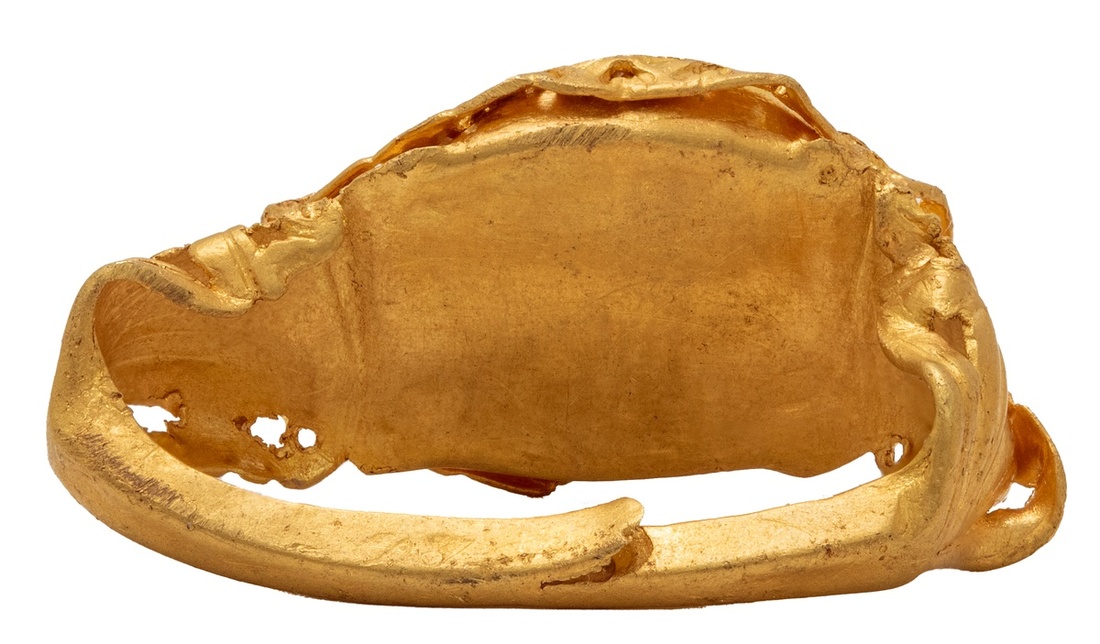
The shoulders decorated with radiating grooved ribs, the outermost curving into bifurcated openwork scrolls, on a hoop of sub-rectangular section.
Analysed as 91.74% gold, 6.89% silver, 1.37% copper
Unmarked
Size/dimensions: 1.50cm long; 2.90cm wide
Gross weight: 6.51g
The ring's band is now crushed but remains complete. There is a split or tear to the back of the hoop, which may be the remains of a scarf joint, and the edge of the bezel is somewhat crumpled, possibly as a result of post-depositional damage. The piece is offered in good condition, commensurate with its age.
Provenance
Found at Great Dunham (Breckland, Norfolk) on 16 January 2025
~ Recorded with the British Museum (ref. PAS-NMS-118D21; Treasure ref. 2025T197) ~
The clasping of right hands, the dextrarum iunctio, is long established in Roman art as an expression of union, agreement and fidelity. On finger rings it is most often associated with betrothal or marriage, and academic Catherine Johns has suggested that it conveyed a bond more formal than friendship alone. On coinage the same gesture could signify concord between individuals or groups, so its meaning entirely depended on context.
Clasped-hands rings vary considerably in construction. Examples in the British Museum from the Thetford Treasure (1981,0201.10) and Richborough (1936,0204.1), and others recorded by the Portable Antiquities Scheme (DOR-29D957, HAMP-FE167A and WILT-DEB017), include many decorated with applied wire filigree that belong to the later fourth century: the Thetford Treasure was probably buried in that century’s final decade, and WILT-DEB017 was found in a hoard with coins of AD 388 or later. The ring offered here instead carries a relief-decorated openwork strip, and the angular junction between its shoulders and hoop suggests an originally keeled form. That type is represented by a silver ring from Grovely Wood, Wiltshire (British Museum 1911,1026.1), which also bears a gold clasped-hands plaque, and by a silver keeled ring set with a gold-foil-wrapped coin of Postumus, made around AD 265-269. Together with the absence of filigree, this points to a confident date in the third century.
Traces of what may be lettering around the edge of the foil raise the possibility that the design was not worked freehand but impressed from a coin. A candidate has been identified in an antoninianus of Marcus Aurelius Marius (RIC 482), whose reverse, CONCORDIA MILITVM, “the concord of the soldiers”, shows clasped hands arranged very similarly to those on the ring. Marius was raised by the army after the murder of Postumus in AD 269 and briefly ruled the breakaway Gallic Empire, including Britain. Later Roman writers claimed he had been a blacksmith who reigned for only two or three days, although his surviving coinage suggests a reign of a few months. If the coin was used as a matrix, the ring could not have been made before about AD 269, and it would provide a rare link between a specific coin issue and a piece of Romano-British jewellery.
Subject to 20% VAT on Buyer’s Premium. For more information please view Terms and Conditions for Buyers.
Estimate
£2,000 to £3,000
Starting price
£1500

Watch, listen and bid as if you were in the room. Now available for auctions worldwide.
Click here to bid live
An exclusive and confidential service for the discerning collector or vendor.
View the Gallery
Download every Spink catalogue on your iPad, iPod or iPhone using free Spink app.
Download From iTunes© 2026 Spink & Son. All rights reserved.