
Auction: 26005 - British and World Coins and Medals: The Martin J Waldron Collection of English Coins
Lot: 708
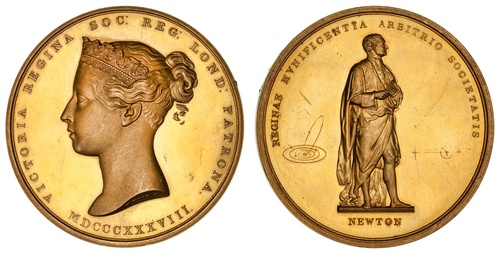
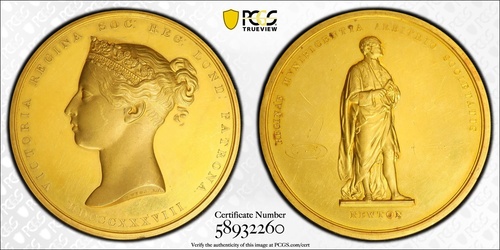
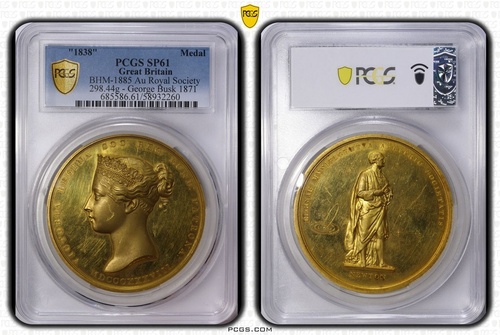
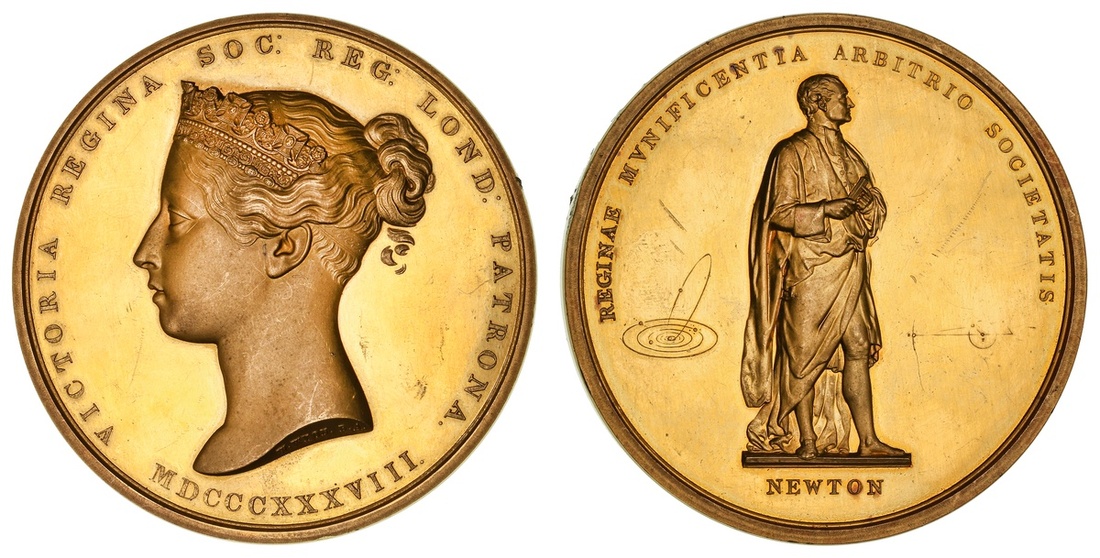
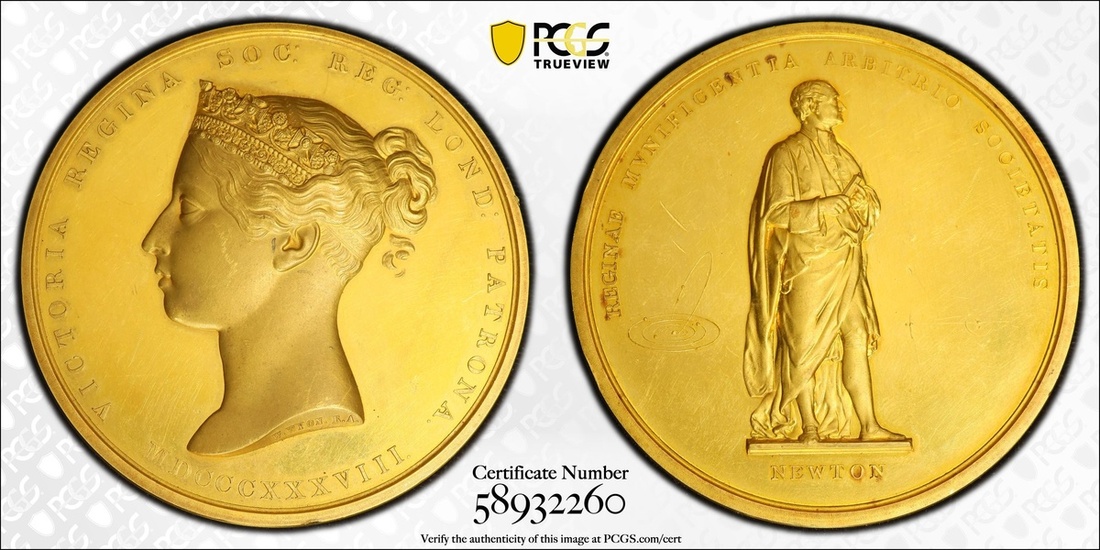
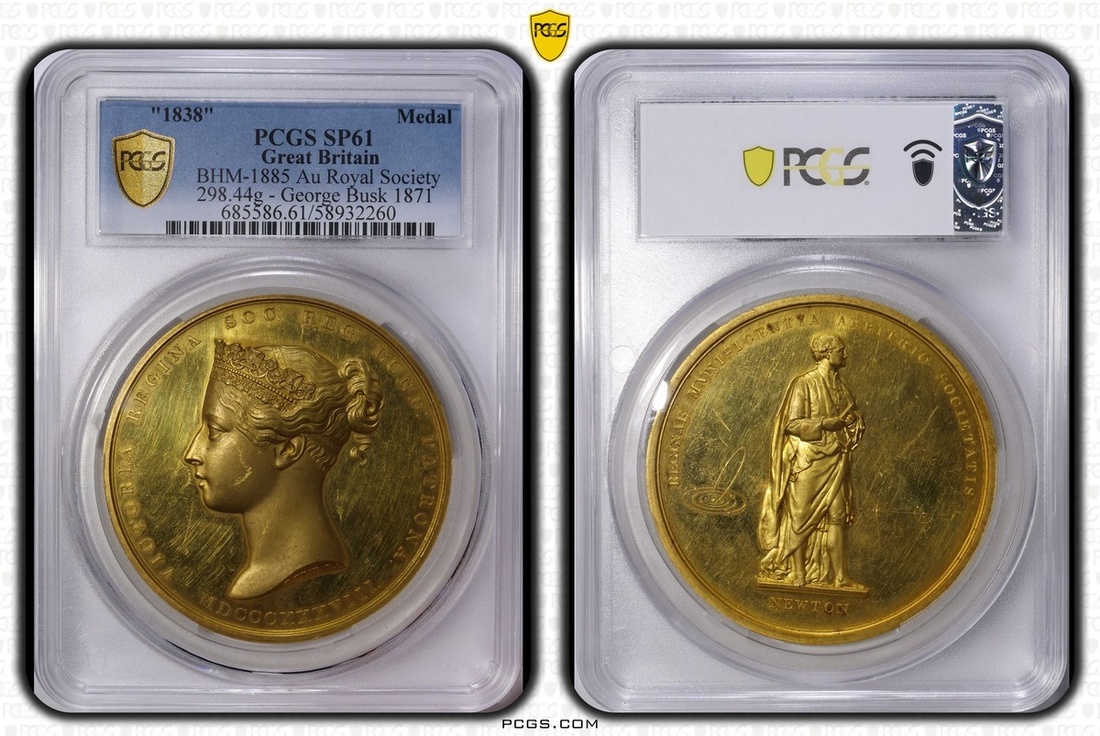
PCGS SP61 | Victoria (1837-1901), The Royal Society, Queen's Gold Medal, 1871, awarded to George Busk FRS FRAI, for his researches in zoology, physiology, and comparative anatomy, by William Wyon, Royal Mint (London), VICTORIA REGINA SOC: REG: LOND: PATRONA., crowned young head left, W. WYON. R. A. in relief on truncation, MDCCCXXXVIII. in exergue, rev. REGINAE MVNIFICENTIA ARBITRIO SOCIETATIS, Sir Isaac Newton, draped, standing right, after the statue by Roubiliac in Trinity college Cambridge, Newton's drawings of his theories of the planetary solar system to left and the 66th proposition of the Principia to right, NEWTON in exergue, officially engraved GEORGE BUSK. 1871. on edge from 9 o'clock, 72mm, 297.80g, 12h [XRF reading: Au 97.96%; Ag 1.79%; Cu 0.247%] (Eimer 1322; BHM 1885), proof-like, some light hairlines and scuffs, an unobtrusive edge knock at 3 o'clock, struck in magnificent high relief, a testament to the skill of the Royal Mint, an exemplary specimen of the iconic Wyon portrait with no loss of detail from high points, with original case of issue, lightly toned and extremely fine, in PCGS holder, graded SPECIMEN 61 (Cert. #58932260)
~A rare opportunity to possess this most exceptional medal, unseen by the public for over 150 years, and awarded to one of Victorian England's most important scientists~
Provenance
Sold by Direct Descent from George Busk
https://www.pcgs.com/cert/58932260
A Man of Many Talents
Among the canon of Victorian innovation and science, George Busk is perhaps the most painfully under-recognised. A doctor by training, Busk practised at Greenwich Hospital, and served aboard the hospital ships HMS Grampus and HMS Dreadnought (converted about twenty years after her service in the Battle of Trafalgar). While his primary scientific research was in Polyzoa, a sort of moss-like aquatic animal, like any great Victorian, Busk was a polymath and was keenly involved in all areas of science. The Royal Society's archives show Busk reviewing hundreds of papers for their journal and signing in support of countless applications for fellowship.
Darwin's Doctor
Unsurprisingly then, Busk was often in contact with Charles Darwin. In a particularly graphic letter, reader be warned, to Darwin c. 27 August 1863, Busk writes the following, "I am very sorry to hear that you are suffering so much…With respect to the flocculent matter you mention as contained in the ejecta I should not be at all surprized to hear that Goodsir detects his Sarcina in it." He goes on to make the very Victorian prescription of "calcined Magnesia, and a little biscuit or dry toast". Beyond treating Darwin's maladies, the two shared a close and supportive academic relationship. In 1864, Busk lobbied his peers and officially nominated Darwin for the Copley medal, awarded indirectly for his controversial Origin of Species, published five years earlier.
The Discovery of Neanderthals
Busk's most notable contribution to science is his work on the recognition of Neanderthals as a distinct species. After a German scientist, Hermann Schaafhausen, had described unusual remains found in Neander valley, Busk took great interest in the discovery, translating and publishing the paper in his journal Natural History Review.
Soon after, Busk travelled to Gibraltar to study the Gibraltar skull, a find not yet recognised as being Neanderthal. Busk brought the skull to England and presented his findings; both Charles Lyell and Thomas Huxley would use Busk's drawings of the skull in their books on prehistoric man. It was thanks to the efforts of Busk that a pattern could be drawn between the two finds, and the argument for a new species instead of scattered individual abnormalities was conclusively made.
The X-Club
True to his talent of connecting and advancing the scientific fields, and of organising, Busk produced a very lengthy CV - President of Greenwich Natural History Society, the Royal College of Surgeons, the Ethnological Society, and the Anthropological Institute; Hunterian Professor of Comparative Anatomy and Physiology; editor of the Quarterly Journal of Microscopical Science and the Natural History Review. Busk also founded a regular scientific dinner, with a name that would perhaps better suit a 1950s comic - 'The X-Club'. The nine members of the club held so much combined scientific prowess and influence, that a contemporary was overheard describing the situation thus, "well they govern scientific affairs, and really, on the whole, they don't do it badly".
Subject to 20% VAT on Buyer’s Premium. For more information please view Terms and Conditions for Buyers.
Estimate
£30,000 to £40,000
Starting price
£30000
Watch, listen and bid as if you were in the room. Now available for auctions worldwide.
Click here to bid live
An exclusive and confidential service for the discerning collector or vendor.
View the Gallery
Download every Spink catalogue on your iPad, iPod or iPhone using free Spink app.
Download From iTunes© 2026 Spink & Son. All rights reserved.