
Auction: 26005 - British and World Coins and Medals: The Martin J Waldron Collection of English Coins
Lot: 447
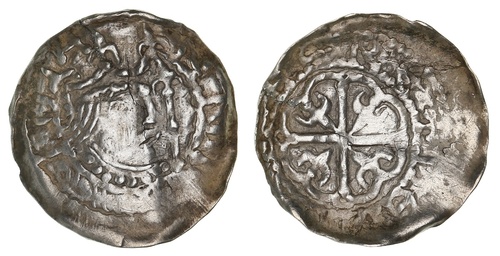
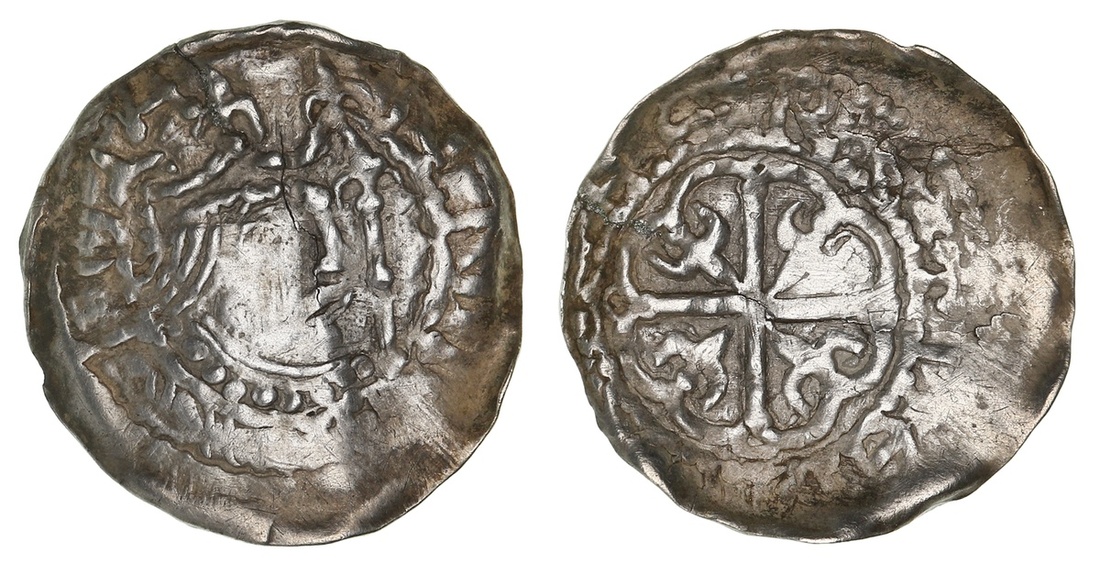
Baronial Issues of the Anarchy, temp. Gilbert de Gant, 1st Earl of Lincoln (fl. 1149-1153), Northern Variants, Phase I, Penny, in the style of the official "Watford" Type, + STIEFNE R• crowned and mantled bust right, lys-tipped sceptre before, rev. + WI[SED].S DE • GDEGANT, barbell S as short-hand for 'sed' DE fully ligate, arcuate quadrilateral, with a pellet at each angle and pellet in annulet centre, over a voided cross with a pellet between two pellets at the end of each limb, 1.385g [27.37grns], 6h [to i.m.] (EMC 2016.0229 same dies; M Allen, NumChron [2016], ‘The York Local Coinage of the Reign of Stephen’ (1135–1554), p. 284, Fig. 1(b) this coin and p. 303, Phase I, dies Aa, no. 1 this coin, Pl. XXXI, 1 this coin; EMC 2015.0394 ["Wisnegota Type"]; North -; S. -), minor flan split at 7 o'clock, otherwise a beautifully full, round and compact striking, strictly very fine, but the discovery specimen and lynch-pin for comprehending the remarkable and cryptic 'Ornamental' issues emanating from the Anarchy, excessively rare thus, with only two specimens known
Provenance
M Roberts [with his ticket, ref. HS-0936C]
Found near Gainsborough (Lincolnshire), before 14 October 2013
~ Recorded with the Fitzwilliam Museum (ref. EMC 2015.0394) ~
Conflicting theories abound for the origins, moneyer and purpose of this issue, that unquestionably was struck at least in support of Stephen of Blois' claim to the English crown.
The first regards 1st Earl of Lincoln (1149-1153), Gilbert de Gant, a baron loyal to Stephen and rendered by the artistic G DE GANT enunciated on the reverse.
The second interpretation proposed by Martin Allen (from illustrations alone) is the reading of the reverse legend is the product of an otherwise unrecorded Flemish moneyer (Wizso or Wizs of Ghent). As Allen opined, not only had this provided a new type for the local or ‘Ornamental’ coinage of York in the reign of Stephen, but the name of the first moneyer of this coinage. The obverse copies Stephen type 1 but the reverse design has an arcuate quadrilateral, with a pellet at each angle and pellet in annulet centre, over a voided cross with a pellet between two pellets at the end of each limb (Fig. 32a). This new reverse type, which can be called the Cross Voided and Quadrilateral type, seems to be copied from William I type 2. The reverse inscription can be read as +WIZ. SDE.GDEGANT, supplying the name of a Flemish moneyer, Wizs(o) of Ghent (de Gant).
What has perhaps been less explored is the incredibly competent workmanship on display, not least in the noteworthy neatness of the layout, as much as in the hitherto unseen full ligation of the D and E to for a 'buckled D'. This has lead the present cataloguer to pay more close attention to what he has described as the 'barbell-S' on exhibition after + WI.... Where Allen saw a Z, Edmund has explored the paleographic records of 12th Century manuscripts. Here he has discovered the cross-barred S as a standardised abbreviation for the latin 'sed', and noted a separate deployment when describing 'soldi'. If such were the intention of die-cutter WI could be equally shorthard for William, leaving only the normal S to be properly explained. Whether such is an appropriate interpretation of the first letters, there remains little doubt as to the reading G DE GANT.
In both scenarios, the Flemish 'Ghent' is applicable, either as a moneyer of that name, or as an allusion to the Gant family, who heralded from the Low Countries at the time of the Norman Conquest.
Gilbert of Ghent arrived in England in 1069, and appears in Domesday Book as a tenant-in-chief of substance, his honours resting on Folkingham in Lincolnshire and Hunmanby in the East Riding of Yorkshire.
Our Gilbert's father, Walter de Gant (d. 1139), founded the Augustinian Priory of Bridlington about 1113, and eventually took the habit at Bardney where he was to be buried. Through his mother Maud, daughter of Stephen, Count of Tréguier, Gilbert was nephew to Alan of Penthièvre, Earl of Richmond, one of the King's most active commanders; his uncle Robert of Ghent served Stephen as chancellor from 1140 until the end of the reign and as dean of York.
The house was bound into the Royal interest, and into the ecclesiastical government of the north, before the present Gilbert had any choice to make. He succeeded his father as a young man, probably not long knighted, and within two years stood in the King's line outside Lincoln on 2 February 1141.
The Royalist cavalry broke and Stephen, now dismounted, fought on foot until he was overwhelmed, and Gilbert was apprehended alongside him. Given his name appears among the list of the capture encapsulates his profile. What however distinguishes his biography, is his subsequent allegiance whilst others sued for peace. Where Ranulf II of Chester and William de Roumare had between them displaced Royal administration altogether, de Gant's unshakeable fealty endured.
The Chesters attempted to redress later that decade, when Gilbert fell into Ranulf's hands, and was thus compelled to marry the Earl's niece Rohese de Clare. A coerced marriage was a cheaper and more durable instrument than a garrison for binding a Lincolnshire magnate. In this instance it failed entirely: Gilbert remained in the King's peace, and his refusal to be absorbed is the immediate context of everything that follows.
When William de Roumare, whom Stephen had earlier recognised as Earl of Lincoln, went over to the Angevins, the King created Gilbert the new Earl in his place. This was a comital title of the wartime kind; in essence a reward for loyalty and a counter-claim to a shire the Crown could no longer properly administer. Between 1149 and 1151, Stephen came close to losing Yorkshire outright, yet still the de Gants were among the very few northern magnates to remain loyal.
The possible dating of this coin would fall within this window, and the coin should be read as an artefact of that isolation: a declaration of standing made at the moment when there was scarcely anyone left in the north to make it alongside him. The legends propels this argument by retaining the regular Royal legend + STIEFNE R on the obverse with Gilbert's name apparently 'displaced' to the position the moneyer's name on the reverse.
This is quite different from the statements made by other Yorkshire magnates. On the known Pennies of Robert III de Stuteville, the baron's name and indeed even his effigy displaces the King's. The distinction is not a matter of engraving convenience. It is perhaps tantamount to a numismatic representation of exactly the position Gilbert occupied; a magnate asserting a newly granted comital authority within the Royal allegiance. Few English coins could state such an urgent wartime political position so economically.
Gilbert died in 1156, aged about thirty, having founded the Cistercian Abbey of Rufford; leaving a single legitimate child, Alice, who married Simon III de Senlis. Henry II did not recognise the Earldom, which lapsed with its holder amid the new King's systematic reversal of the comital creations of the Anarchy, leaving this coin as perhaps the only presently surviving remnant of that remarkable period in English history.
In Summer 2025, a related specimen of the so-called 'Wisegnota' series surfaced in Romney Marsh (Kent) (ref. EMC 2026.0098) that appears to read + WI [SED] S DE GNVTO, providing a further avenue of research worthy of future numismatic exploration.
Subject to 20% VAT on Buyer’s Premium. For more information please view Terms and Conditions for Buyers.
Estimate
£4,000 to £5,000
Starting price
£3600

Watch, listen and bid as if you were in the room. Now available for auctions worldwide.
Click here to bid live
An exclusive and confidential service for the discerning collector or vendor.
View the Gallery
Download every Spink catalogue on your iPad, iPod or iPhone using free Spink app.
Download From iTunes© 2026 Spink & Son. All rights reserved.