Auction: 26003 - Orders, Decorations and Medals
Lot: 396
Sold by Order of the Family
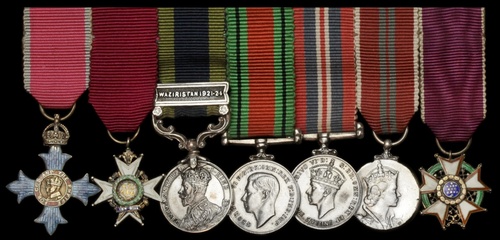
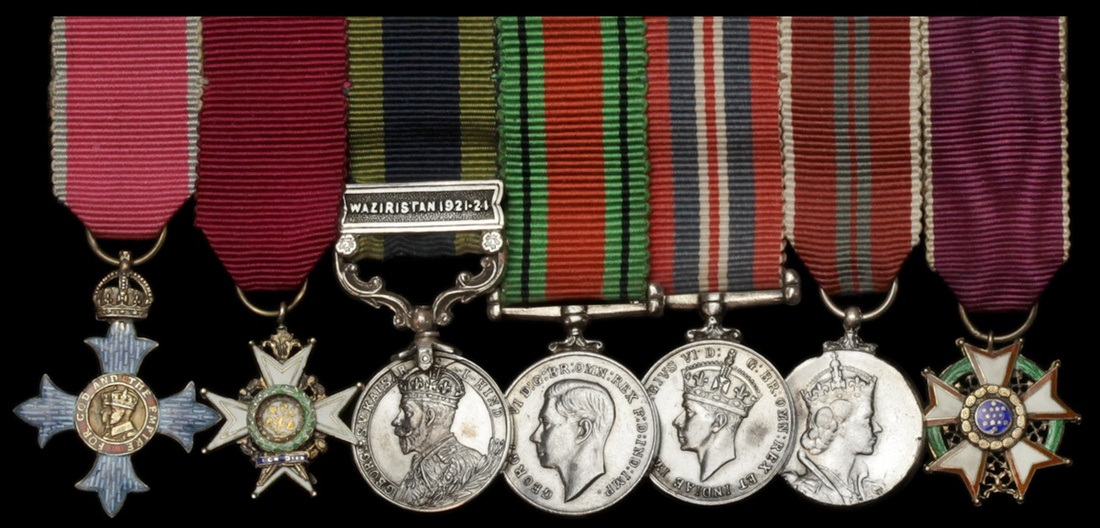
The impressive mounted group of seven miniature dress medals worn by to Lieutenant-General Sir E. I. C. Jacob, G.B.E., C.B., War Cabinet, late Royal Engineers, who served as a close assistant to Winston Churchill during the Second World War, and later became Director-General of the BBC
The Most Excellent Order of the British Empire, Civil Division, G.B.E., Knight Grand Cross, 2nd Type, breast Badge; The Most Honourable Order of the Bath, Military Division, Companion's Badge; India General Service 1908-35, 1 clasp, Waziristan 1921-24; Defence and War Medals 1939-45; Coronation 1953; United States of America, Legion of Merit, Legionnaire's Badge, mounted as worn, minor chipping to enamel, otherwise very fine (7)
Edward Ian Claud Jacob was born in Quetta, British India on 27 September 1899 to parents Field Marshal Sir Claud Jacob, at the time a Captain in the Bombay Infantry, and Clara Pauline Wyatt. Growing up in a military family, he inevitably commissioned into the Royal Engineers in 1918. He did receive some schooling at Wellington College, Berkshire and the Royal Military Academy, Woolwich.
He saw minor service during the 1920s where he took part in the Waziristan campaign. There was little fighting, with the majority of service being focused on road building and preventing rebellion in the North-Western Frontier. After this service, he took a Mechanical Sciences tripos at King's College, Cambridge, graduating with a second-class degree in 1925. In 1924, he married Cecile Treherne, the daughter of Major-General Francis Treherne, having two sons, William and John.
In the 1930s, he served as a commander of a company of Gentlemen Cadets at the Royal Military Academy, Woolwich. This lasted until the outbreak of the Second World War, when Jacob served as the Military Assistant Secretary to the War Cabinet. This was initially against his wishes as in 1940 he repeatedly requested to be returned to his regiment to see action, which was refused every time. He worked very closely with Winston Churchill during this time as he briefed the Prime Minister on emerging situations and crises. He supported Churchill around the world on all 13 of his foreign trips, including the Casablanca Conference with Franklin Roosevelt in January 1943.
Churchill endorsed Jacob's promotion from Colonel to Lieutenant-General over the course of the war. In the 1944 Birthday Honours, he was appointed a Companion in the Military Division of the Order of the Bath. All of these promotions came without Jacob ever commanding troops, and as such, at the end of the war, he saw no prospect of a further military career. His experience in communications afforded him a position at the BBC with the World Service based at Bush House, now the Australian Embassy.
Jacob became the Director of the World Service in 1947, which he maintained until 1951. Churchill had returned to office and in addition to being Prime Minister, he took on the role of Secretary of State for Defence. Jacob was seconded from the BBC and worked with Churchill as the Chief Staff Officer. They only managed one foreign trip together; to the U.S., where Churchill discovered that the excitement of defence during the Second World War was not emulated in peace time, and he relinquished the office soon after. Jacob did not get on well with Churchill's successor, Field Marshal the Earl Alexander, and in June 1952, Jacob took the opportunity to become Director-General of the BBC.
In his time as Director-General, 1952-1959, he saw the rise in television viewership as it began to replace the radio. He put an emphasis on the news, harkening back to his service under Churchill. The most important events under him included; the coronation of Queen Elizabeth II, the introduction of ITV, modernisation of broadcasting, and the creation of a third television channel. Upon his retirement on 31 December 1959, he was appointed a Knight Grand Cross of the Order of the British Empire in the New Year's Honours.
His life after the BBC focused on his work as a trustee of the Imperial War Museum from 1966 to 1973, a stint as County Councillor in Suffolk from 1960-70 and 1974-77. He was also appointed Deputy Lieutenant of Suffolk from 1964 to 1968. He died 24 April 1993, aged 93.
For medals to his Son, Lieutenant William Le Grand Jacob, please see Lot 189.
For medals to his Father, Field Marshal Claud Jacob, please see Lot 395.
For medals to his Father-in-Law, please see Lot 403.
For medals to his 1st Cousin, 3x removed, Sir George Le Grand Jacob, please see Lot 127.
For medals to his 2nd Cousin, 2x removed, Captain Augustus Jacob, please see Lot 119.
Subject to 20% VAT on Buyer’s Premium. For more information please view Terms and Conditions for Buyers.
Estimate
£180 to £220
Starting price
£140
Watch, listen and bid as if you were in the room. Now available for auctions worldwide.
Click here to bid live
An exclusive and confidential service for the discerning collector or vendor.
View the Gallery
Download every Spink catalogue on your iPad, iPod or iPhone using free Spink app.
Download From iTunes© 2026 Spink & Son. All rights reserved.