Auction: 26003 - Orders, Decorations and Medals
Lot: 179
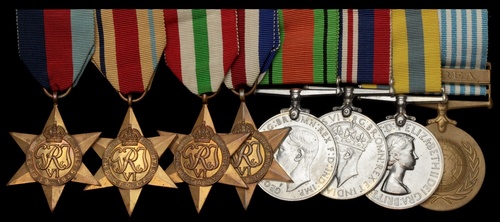
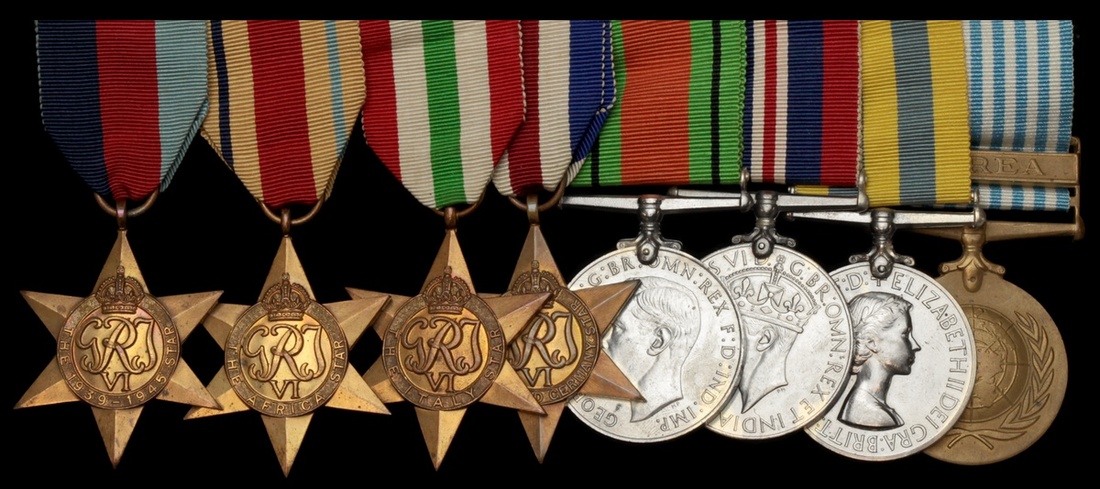
Eight: Trooper S. R. Wirth, 8th (King's Royal Irish) Hussars, late Royal Armoured Corps and 13th/18th Hussars, who was wounded in North West Europe on 22 September 1945
1939-45 Star; Africa Star; Italy Star; France and Germany Star; Defence and War Medals 1939-45; Korea 1950-53 (322187 Tpr. S. R. Wirth 8 H.); United Nations Medal for Korea 1950-54, mounted as worn, very fine (8)
Stanley Robert Wickstead Wirth was born at Battersea on 25 May 1912 and was a Shop Assistant before he attested into the 13th/18th Hussars at Tunbridge Wells, Kent on 27 January 1939, he then served with the Royal Armoured Corps, firstly with 51st Training Brigade and then 44th Bn Royal Tank Regiment. He saw service in the Middle East April 1941-August 1943 and with B.N.A.F. between August 1943-February 1944. He briefly returned Home from February 1944-9 June 1944 and then served in North West Europe from 10 June 1944.
Wirth was wounded in action in North West Europe on 22 September 1944 and was evacuated home on 25 September. He returned to the front on 16 March 1945 and was placed on the Army Reserve on 16 February 1946.
He rejoined the Army, enlisting into the 8th Hussars on 17 August 1950 and sailed for Korea on the Empire Fowey, on 11 October 1950. The 8th Hussars were the first tank regiment to take part in the war and arrived with 39 officers, 689 soldiers, 64 Centurion tanks and six Cromwell tanks.
In spite of the extremely adverse weather conditions they fought their way north to the Yalu River, but were then forced back to the line of the Imjin River. On 21 April, ‘C’ Squadron of the 8th Hussars attempted to drive forward to support the Glosters who had become surrounded by the Chinese. The track was very narrow and on either side was wet paddy fields, which made movement off the track very difficult. The Chinese soon bypassed the Gloster positions and attacked the tanks at very short range. They jumped onto the tanks and tried to prise open the turrets and throw hand grenades inside. The response of the Irish Hussars was to turn the turrets of their tanks towards each other, and ‘hose’ the enemy off with their Besa Machine Guns. On their return to the British lines these tanks were said to have ‘Ran red with the blood of dead Chinese’. Human detritus was also caught up in the tracks as the tanks had run over a number of Chinese and, unfortunately, some British. With the final withdrawal of ‘C’ Squadron the battle was over, the last shots being fired by Major Huth. ‘C’ Squadron then split into two components, one supporting the Northumberland Fusiliers one troop detached to the remaining Glosters and the other in support of the Royal Ulster Rifles. Major Henry Huth commanding ‘C’ Squadron received the D.S.O. for his part in the Imjin battles and for their gallantry in the Battle the 8th Hussars were awarded the Battle Honour ‘IMJIN’.
Returning home by September 1951, Wirth was transferred to the Reserve on 22 November 1951, with his Second World War campaign medals issued in January 1973. He died in Cornwall in 1974.
Subject to 20% VAT on Buyer’s Premium. For more information please view Terms and Conditions for Buyers.
Estimate
£400 to £600
Starting price
£400
Watch, listen and bid as if you were in the room. Now available for auctions worldwide.
Click here to bid live
An exclusive and confidential service for the discerning collector or vendor.
View the Gallery
Download every Spink catalogue on your iPad, iPod or iPhone using free Spink app.
Download From iTunes© 2026 Spink & Son. All rights reserved.