
Auction: 26001 - Orders, Decorations and Medals
Lot: 276
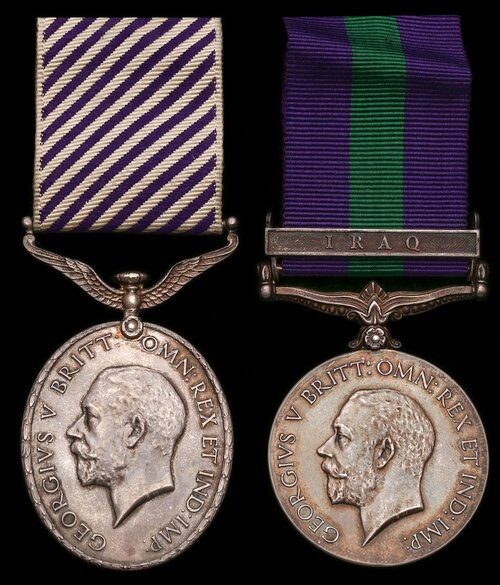
A rare Iraq 1920 D.F.M. pair awarded to Aircraftman Class I P. A. Hughes, Royal Air Force, late Royal Flying Corps, who was further 'mentioned' in 1921
Distinguished Service Medal, G.V.R. (89300 A.C.1. P. A. Hughes. R.A.F.); General Service 1918-62, 1 clasp, Iraq (89300 A.C.1. P. A. Hughes. R.A.F.), good very fine (2)
Just 5 D.F.M.'s awarded in 1922 for the initial outbreak of the revolt in Iraq, a total of 14 awarded for the operations there.
D.F.M. London Gazette 10 October 1922:
'For distinguished services rendered during active service operations in Iraq during 1920-21'
M.I.D. London Gazette 28 October 1921:
'…for distinguished service in a despatch received from Lieutenant-General Sir J. A. L. Haldane, K.C.B., D.S.O General Officer Commanding-in-Chief, Mesopotamian Expeditionary Force.'
Peter Anthony Hughes was born at Cheshunt, Hertfordshire c.1902 and enlisted whilst still only 15 in the rank of Boy with the Royal Flying Corps on 26 July 1917 at Farnborough. Undergoing training Hughes was transferred to the Royal Air Force upon its formation in April 1918, Reaching his majority on 3 August 1919 he was redesignated Aircraftman Class II (Rigger).
Posted to 142 Squadron in Palestine on 27 November 1919 Hughes joined 55 Squadron in February 1920 when the unit was reformed. They were posted first to the Dardanelles as part of Q Force', protecting the region during the negation of the Treaty of Sevres.
The Squadron was posted to Iraq in August 1920, in response to the unrest which began in May of that year to undertake 'Air Policing' duties. As the revolt continued to spiral the number and intensity of the missions being flown spiralled with over 4,000 hours flown in total by the end of the fighting.
'Throughout July - August [1920] the average availability of aircraft was merely six Bristols F2Bs and five RE8s on 6 Squadron, with three DH9As and two RE8s from 30 Squadron, although the RE8s were seldom used and the DH9As fully employed keeping communications open with Samawah. Operations were to continue apace until the end of 1920 by when two more squadrons entered the arena. No. 84 Squadron was reformed at Baghdad with DH9As in August 1920 and commenced operations immediately by relieving 6 Squadron of its task of co-operation with the Samawah garrison from Baghdad, then in the following month moved base to Shaibah which was to become 84's spiritual home for the next two decades. In September 1920 too No. 55 Squadron, reformed at Suez on 1 February 1920 with DH9s and DH9As initially and serving in Turkey by July, moved to Baghdad to replace 84 Squadron. Thus, by December 1920, operations flown by all four squadrons since June amounted to: total hours flown 4,008; total weight of bombs dropped 97 1/2 tons; total rounds SAA fired 183,861.'
(RAF Operations 1918-1938, by C. Bowyer refers)
Hughes remained with the unit for most of the crisis, earning himself a 'mention' to go with his D.FM. in 1921. Towards the end of the year he was posted to Mosul General Hospital in November 1921, remaining there until December It is unclear whether this was the result of illness, injury or wound, he returned to No. 55 Squadron.
He was briefly posted to both No. 30 Squadron and No. 6 Squadron in 1922, both of which had also been involved in supressing the revolt. Posted to Britain with No. 12 Squadron in June 1923 he volunteered for Reserve Training and was approved for this in August 1923. Returning to service with the 'E' class reserve in 1939 it appears that Hughes was never mobilised; sold together with copied service papers and London Gazette extracts.
Subject to 20% VAT on Buyer’s Premium. For more information please view Terms and Conditions for Buyers.
Sold for
£2,600
Starting price
£1400
Watch, listen and bid as if you were in the room. Now available for auctions worldwide.
Click here to bid live
An exclusive and confidential service for the discerning collector or vendor.
View the Gallery
Download every Spink catalogue on your iPad, iPod or iPhone using free Spink app.
Download From iTunes© 2026 Spink & Son. All rights reserved.