
Auction: 26001 - Orders, Decorations and Medals
Lot: 257
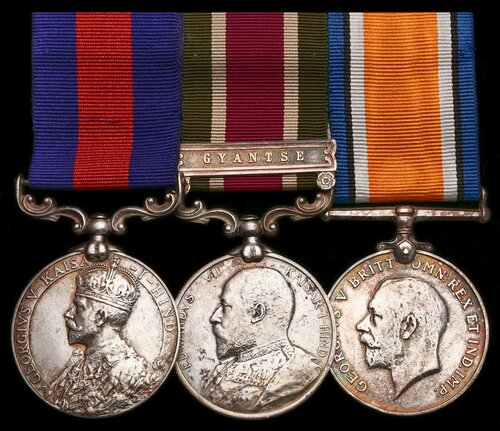
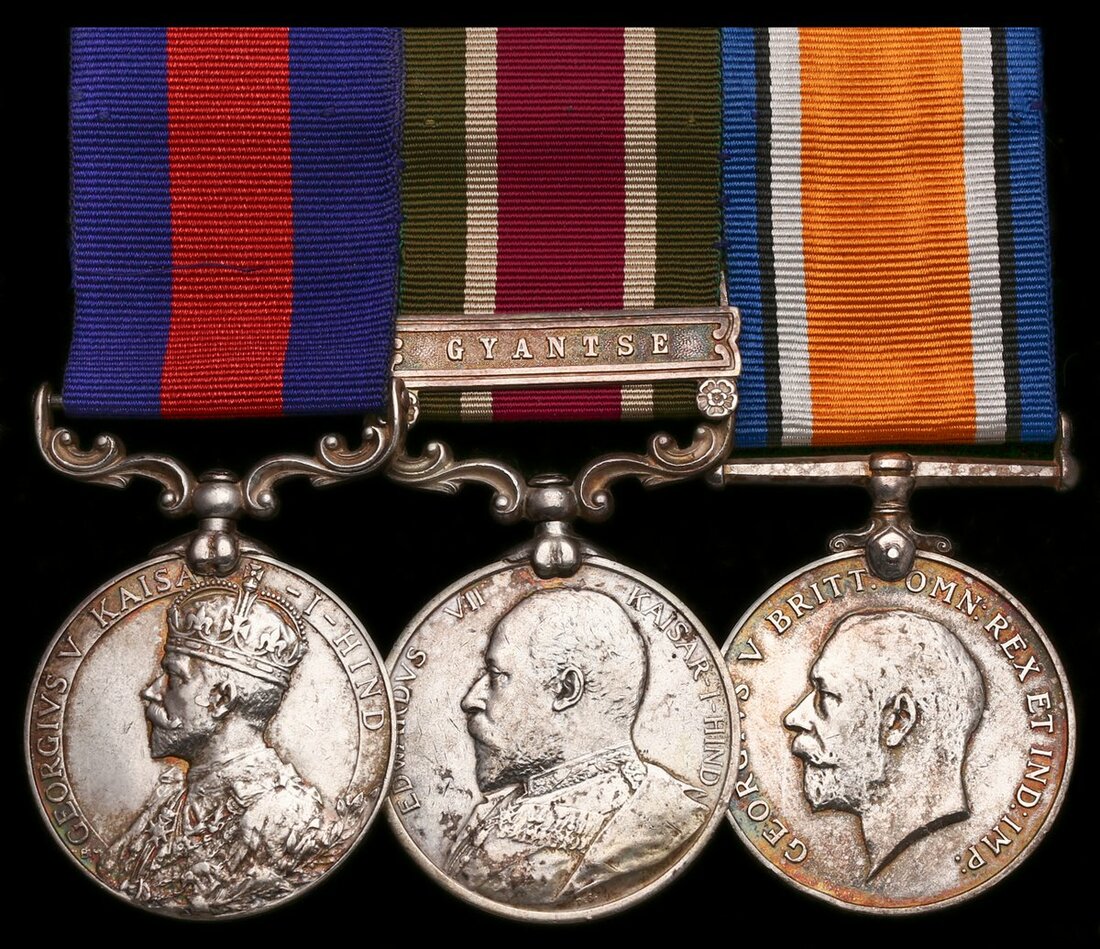
The I.D.S.M. campaign group of three awarded to Subadar S. Singh of the 3/34th Sikh Pioneers
Indian Distinguished Service Medal, G.V.R., 1st issue (Subdr. Sohawa Singh 3/34 Sikh Pnrs.), last two letters of name and battalion number officially corrected; Tibet 1903-04, 1 clasp, Gyantse (3040 Lce. Nk. Sohawa Singh, 32d Sikh Pioneers); British War Medal 1914-20 (Jemdr. Sohawa Singh, 32 Sikh Pnrs.), official corrections to surname, very fine (3)
I.D.S.M. London Gazette 1920.
M.I.D. London Gazette 10 June 1921.
Sohawa Singh was born in circa 1878 and was a practicing Mazhbi Sikh. He enlisted on 4 June 1894 into the 32nd Bengal Infantry, a pioneer regiment. Singh first saw active service at Waziristan in December 1901, a place where he returned to as Subadar nearly 20 years later. In the years following the Frontier uprising of 1897-98, his regiment were responsible for protecting British India from a number of destructive raids from the Mahsuds in the later stages of the campaign. Upon landing at the Frontier, the regiment marched from Darya Khan to Tank, covering 50 miles in 3 days, arriving on 5 December 1901. From the 10 December, they formed part of a column which marched up the Shahur Tangi to Sarwekai. These raids would have involved difficult climbing and piquetting and included the destruction of a Mahsud tower. Leading up to Christmas the column continued to carry out raids and descended on Mahsud villages and seizing prisoners. His time in Waziristan was concluded when the regiment spent Christmas Day at Jandola - by April they had returned to Jhelum.
In 1903, the regiment was sent to Sikkim in March 1903 to work on the roads. By the middle of the year, 500 men from the 32nds were ordered to escort the new Tibetan Commissioner Francis Younghusband through the 17,500m foot pass the Kangra La. Due to various political discrepancies, the regiment withdrew from Khamba Jong in December and when recrossing the Kangra La endured the most frightful of conditions: the temperature fell to -60 degrees and three men from the regiment died.
By the beginning of 1904, the invasion truly began on 31 March. The British force, including the 32nd Gurkha Rifles marched out of Tuna bound for Gysantse. After marching seven miles they encountered a Tibetan army 1500 men strong outside Guru. The armies came to a standstill with no one daring to fire first. Eventually the Lhasa general himself shot one of the Sikhs and battle commenced. The Tibetans, surrounded on three fronts, were massacred with circa 500 killed - not a single individual in the British Army was killed.
When the British forces landed at Gysante, they were situated at 13,000 feet in a Jong, an immensely strong citadel built atop a mountain. After weeks of negotiations, battle finally commenced at Karo La, a mountain pass some 45 miles from Gysantse. The battle took place at 17,000 feet and they successfully drove the enemy out. Undeterred, the Tibetans attacked Younghusband's headquarters and occupied Jong. In retaliation, the Gurkhas stormed the Jong and an officer subsequently was awarded the Victoria Cross.
The week later the British column finally recrossed the Karo La, this time met with less resistance and reached Lhasa. A treaty was signed with the Tibetans a month later and the 32nd Pioneers finally began their journey home to India in late September 1904.
Singh then served in the Abor Campaign in 1911 fought on India's north-eastern frontier. The inhabitants of this region were the Abor tribe whose warfare used bows with poisoned arrows, stone chutes and acquired guns. In March 1911 the Abors murdered the District Officer, his two British companions, and nearly all his party of 40 coolies. The fighting troops in response consisted of two battalions of Gurkhas, the 32nd Sikh Pioneers and 3500 Naga tribesmen as carriers. The government used the expedition for geographical purposes too, in order to verify reports of Chinese or Tibetan activity on the boarder, to mark the permanent border with Tibet and to generally explore and map the region. Once at Abor, there was very little fighting - the killers were thought to have been killed in the fighting and the village was fined. The geographical side of the expedition was equally successful - very little Chinese or Tibetan influence was discovered and the border was clarified.
On 30 November 1914, Singh was promoted to Jemadar and transferred to the 128th Pioneers serving first in Egypt and then Mesopotamia. He was promoted Subadar on 16 September 1917. After the war, Singh was appointed to the 3rd Battalion, 34th Sikh Pioneers was served at Ambala in 1918. The following year, the battalion was mobilised on Afghanistan's border and moved to Landi Kotal where the Afghans were swiftly defeated. By December, there was a battle on the steep hill, Mandanna, where two infantry battalions made an unsuccessful attempt to capture it. The Indian regiments fled back to camp with 95 killed, 140 wounded and having lost 131 rifles and 10 Lewis guns. There was a second attempt at the capture of Mandanna but again the Mahsuds over ran them. Morale was low and stayed low until early 1920. The battalions which had performed badly were replaced and the advance continued. It was around this time that Subadar Sohawa Singh retired and pensioned shortly afterwards.
Singh was further entitled to the India General Service Medal 1895-1902 with one clasp, Waziristan 1901-02, the India General Service Medal 1908-35 with three clasps, Abor 1911-12, Waziristan 1919-21, Mahsud 1919-20, the 1914-15 Star and the Victory Medal 1914-19.
Sold with substantial copied research.
Subject to 20% VAT on Buyer’s Premium. For more information please view Terms and Conditions for Buyers.
Sold for
£1,600
Starting price
£480

Watch, listen and bid as if you were in the room. Now available for auctions worldwide.
Click here to bid live
An exclusive and confidential service for the discerning collector or vendor.
View the Gallery
Download every Spink catalogue on your iPad, iPod or iPhone using free Spink app.
Download From iTunes© 2026 Spink & Son. All rights reserved.