
Auction: 26001 - Orders, Decorations and Medals
Lot: 206
(x) RORKE'S DRIFT - THE GREATEST DEFENCE OF ALL
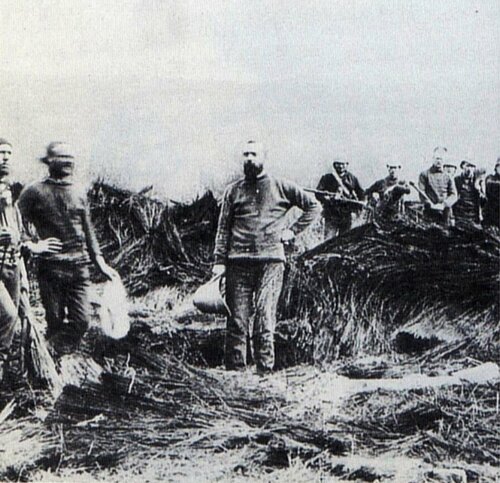
There can surely be no more inspiring tale than that of 'the few' who found themselves at the former mission station of Rorke's Drift near the Buffalo River, Natal Province on 22-23 January 1879. It goes without saying that to date no action in British military history has eclipsed the feats performed, neither in terms numerical disadvantage - at least 40 to 1 - or the level to which the engagement has resonated through the ages.
When dawn broke on 23 January, the scene was of utter desolation, the bodies of at least 351 Zulu warriors littering the ground. What the defenders had faced seems almost impossible to surpass. That they stood firm remains a testament to their accumulated bravery, resilience and presence of mind.
The medallic awards for those present at Rorke's Drift are also worthy of mention, for no fewer than 11 Victoria Crosses (and it might have been 12 - but more of that later) and four Distinguished Conduct Medals were awarded for the actions of that famous day.
In terms of public perceptions the legacy of the defenders was perhaps sealed in history with the reception of Stanley Baker's film 'Zulu', which took millions of transfixed viewers to the scene of battle in a 139-minute epic. I have little doubt that most of us have likewise been transfixed at some point in our lives on a long Sunday afternoon watching that film.
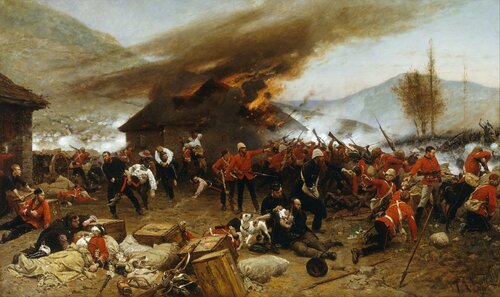
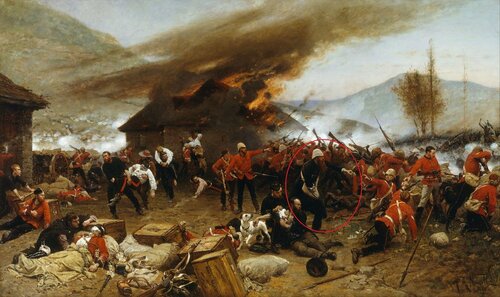
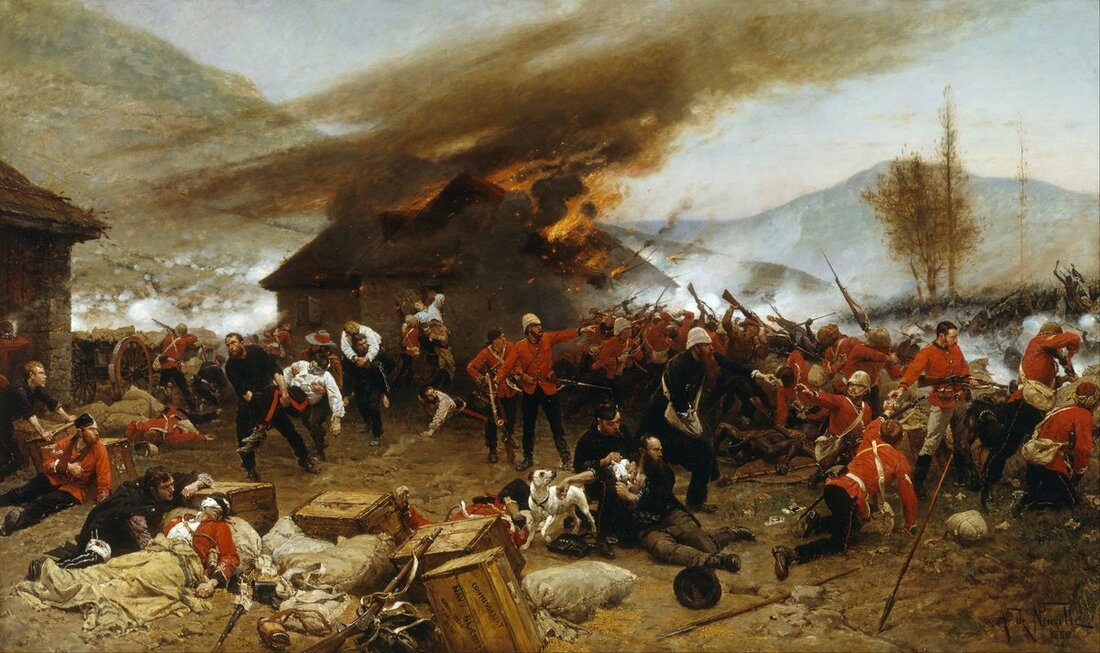
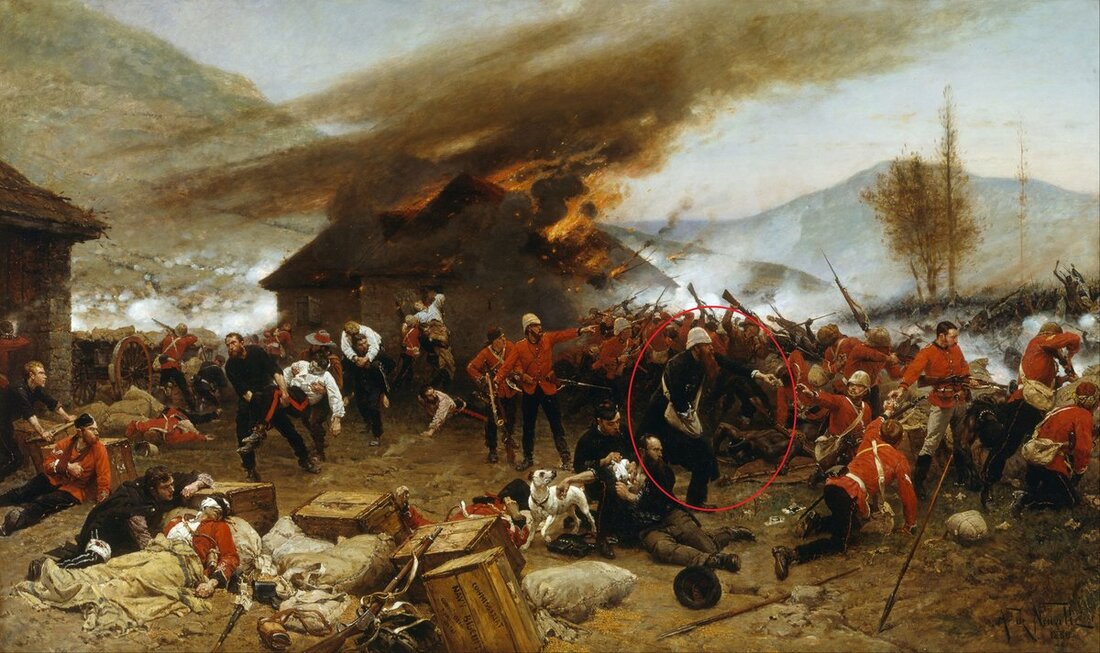
Before the invention of such depictions, the public were stirred and inspired by the epic oils which were commissioned in order that they be transported to the battlefield. Both Lady Butler and Alphonse de Neuville produced vast works of the Defence of Rorke's Drift. The latter is nearly 4m. wide and 3m. high and was purchased in 1882 for the people of New South Wales. It proudly hangs in the public galleries in Sydney to this day and both the cataloguer and the recipient of these Medals made their own pilgrimages to inspect it some century apart from one another. Should you find yourself there, it must be seen to be appreciated. The fact the recipient features front and centre gives some reflection as to his similarly central place in the battle; 'Ammunition Smith' was clearly no shrinking violet.
By the dint of chance - which seems to strike often in this specialist field - in recent years this Department has had the pleasure to handle the awards of two men Smith would have crossed paths with; Gunner A. Howard, 'N' Battery, 5th Brigade, Royal Artillery (one of just four members of the Royal Artillery present at the Defence) and Private Robert Adams, 'D' Company, 2nd Battalion, 24th Foot, who was one of that gallant Band of Brothers who lost his life.
The story of Smith is a remarkable one which in our humble opinion perhaps eclipses them both. I trust you will appreciate reading about his part in this legendary action, for we have enjoyed presenting them to you and telling his story to a wider audience.
Marcus Budgen, March 2026.
Sold by Order of a Direct Descendant
'Chaplain Smith had slung a large haversack filled with loose cartridges about his neck. He circled the perimeter incessantly, filling outthrust hands and expense pouches and replenishing his supply from time to time from the open boxes in front of the storehouse. He exhorted the men with wild Biblical phrases, sternly reproving every blasphemy and obscenity his ear caught.
The din was deafening, and few voices could be distinguished over the continual crash of the rifles and the clanging of assegai blades on barrels and bayonets. The incessant shouts of "uSuthu!" throbbed from thousands of Zulu throats, now gathered in a unified chant, now rising to a shrieking crescendo during the rushes.'
The Washing of the Spears on the work of Chaplain Smith at Rorke's Drift
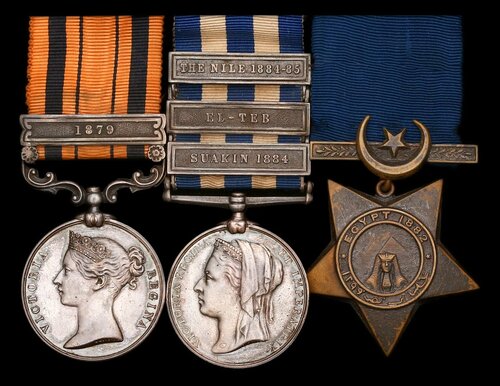
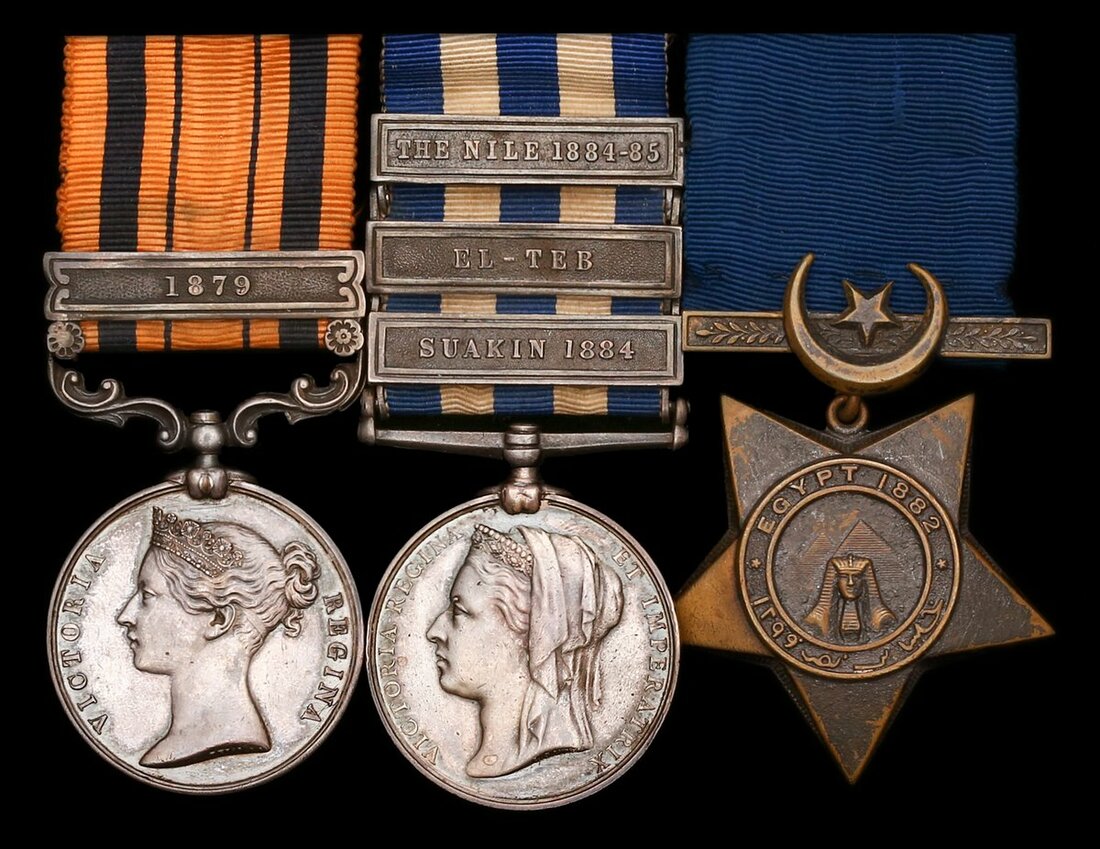
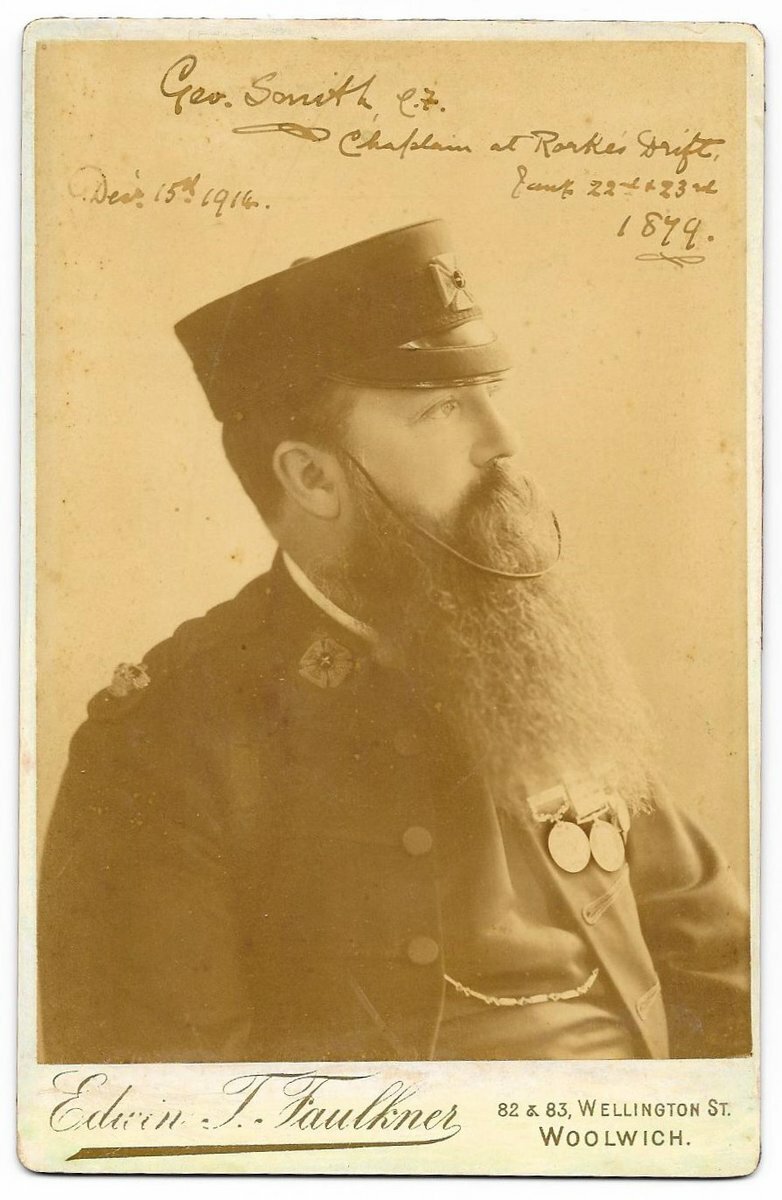
The historically important campaign group of three awarded to Chaplain G. Smith, Army Chaplains' Department, a central figure during the Defence of Rorke's Drift, 22-23 January 1879, who famously first sighted the Zulu hordes descending on that place
South Africa 1877-79, 1 clasp, 1879 (Rev: G. Smith. Acting Chaplain); Egypt & Sudan 1882-89, dated reverse, 3 clasps, Suakin 1884, El-Teb, The Nile 1884-85 (Revd. G. Smith. Chaplain.); Khedive's Star 1882, mounted as worn, good very fine (3)
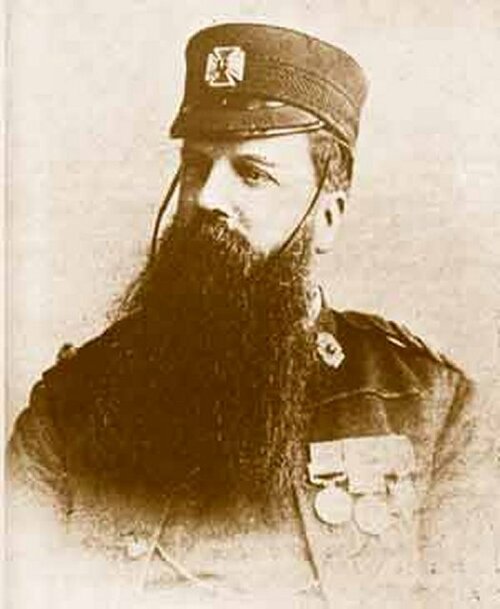
George Smith was born on 8 January 1845 at Docking, Norfolk, the son of a master shoemaker. By 1861 young Smith was working as a railway clerk and living near Kings Lynn. He entered St Augustine’s College, Canterbury, Kent in 1861 to take up Holy Orders. A Missionary in southern Africa, he was appointed Rector of Estcourt, Natal in 1872 and with the outbreak of the Zulu War, was appointed an Assistant Chaplain to the Forces.
So it was that he was to find himself at the centre of one of the most famous events in British military history. We turn to Donald R. Morris in The Washing of the Spears for the first mention of his services in 1873, in assisting Lieutenant-Colonel Durnford:
'Durnford was still unaware of the feeling against him, and still actively campaigning. Two days after his descent from the plateau he rode into Pietermaritzburg and back - fifty miles each way - and a fortnight later he took a force of regular troops up through Bushman's River Pass to see if it was still occupied. It was not.
Durnford buried his five companions, and he also buried and erected a cairn over the two amaHlubi he had shot. The services were conducted by the Reverend George Smith, Minister of St. John's church in Weston. Something of a fire-eater and a rabid High Churchman, he had barricaded his church as a refuge for his parishioners and had then ridden off with the Karkloof Troop.'
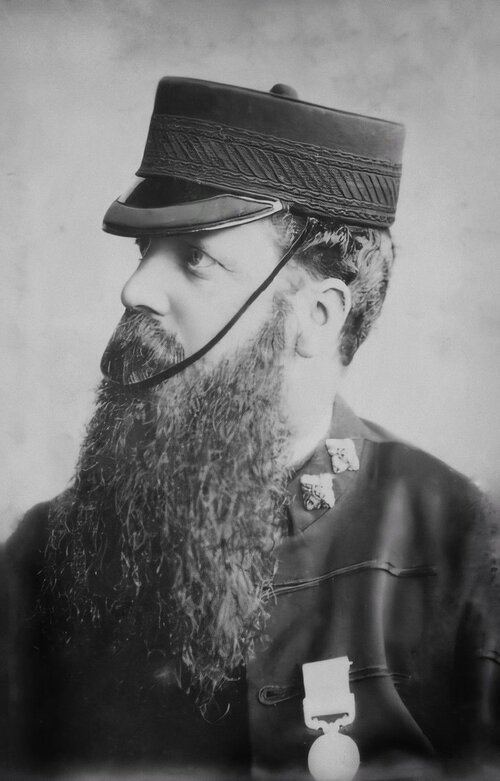
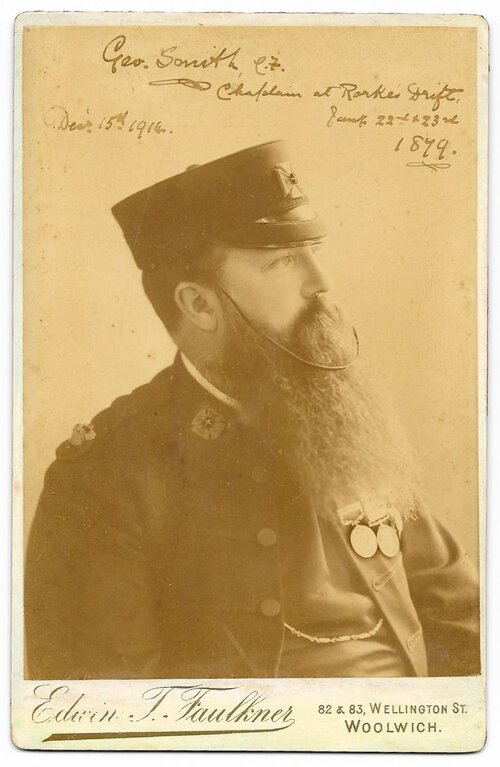
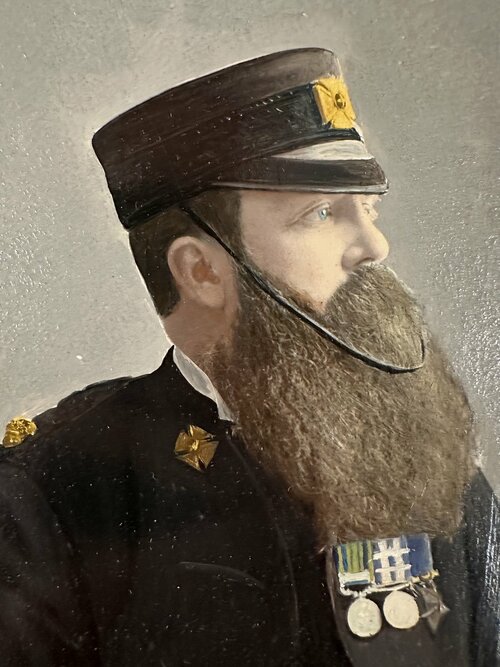
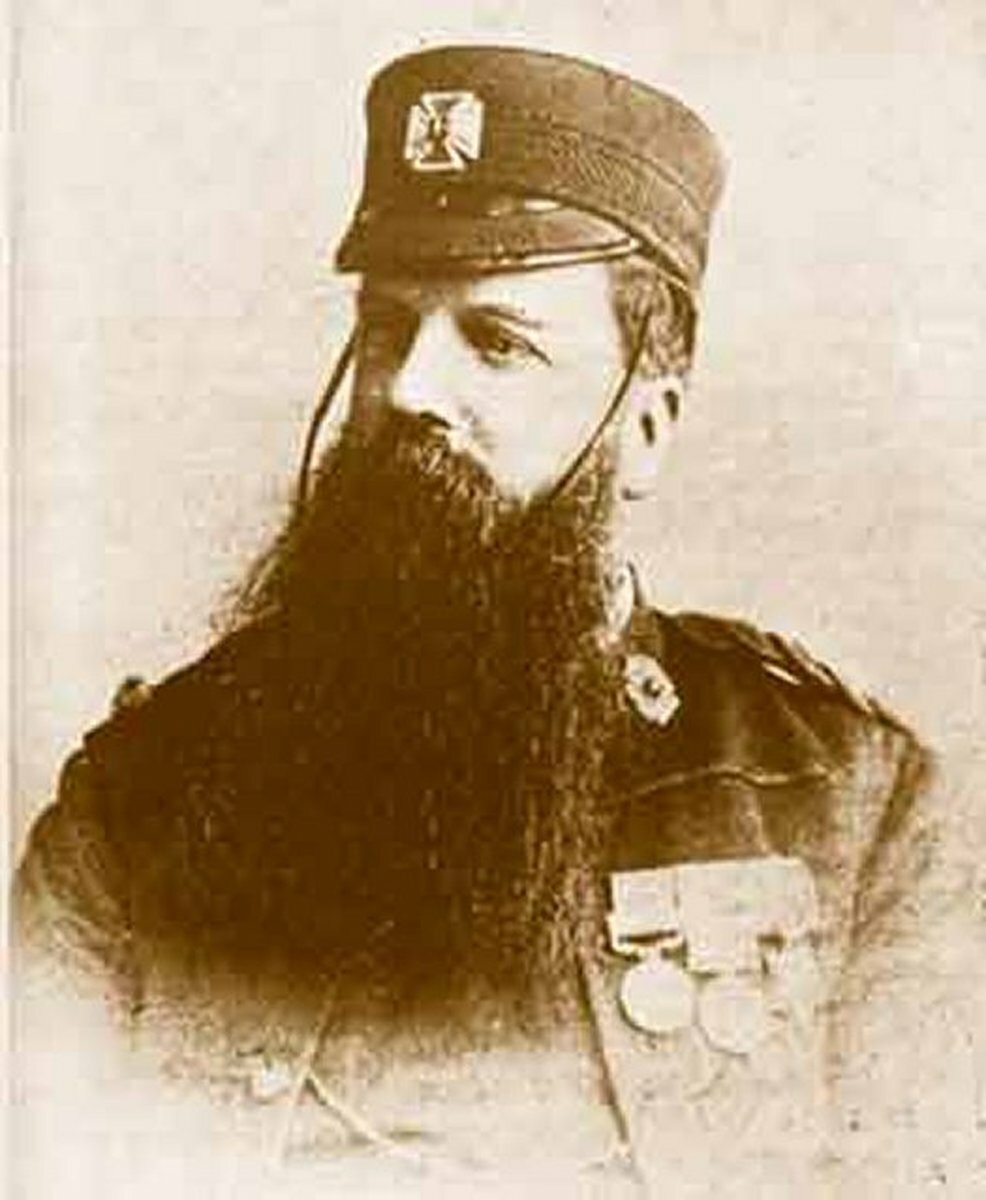
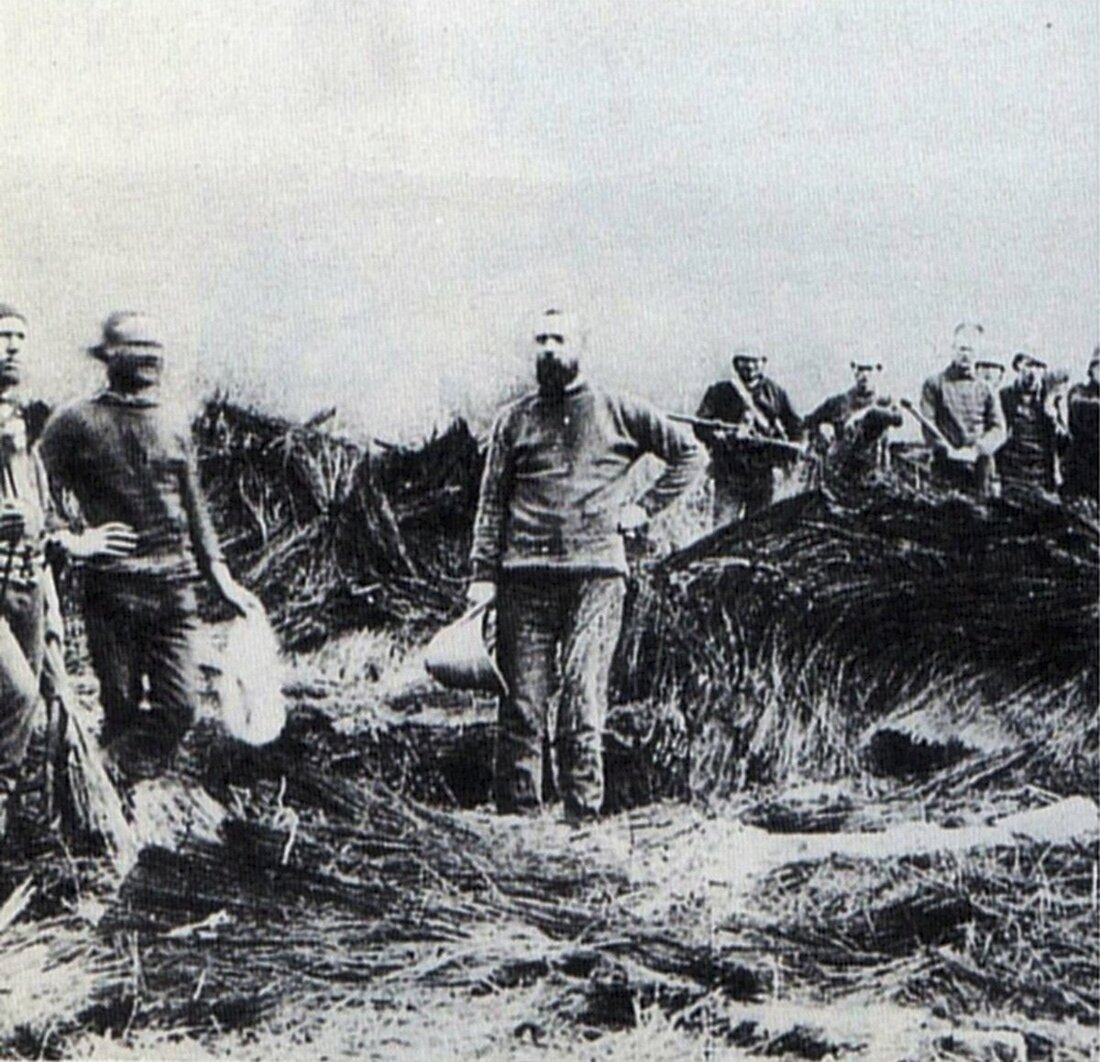
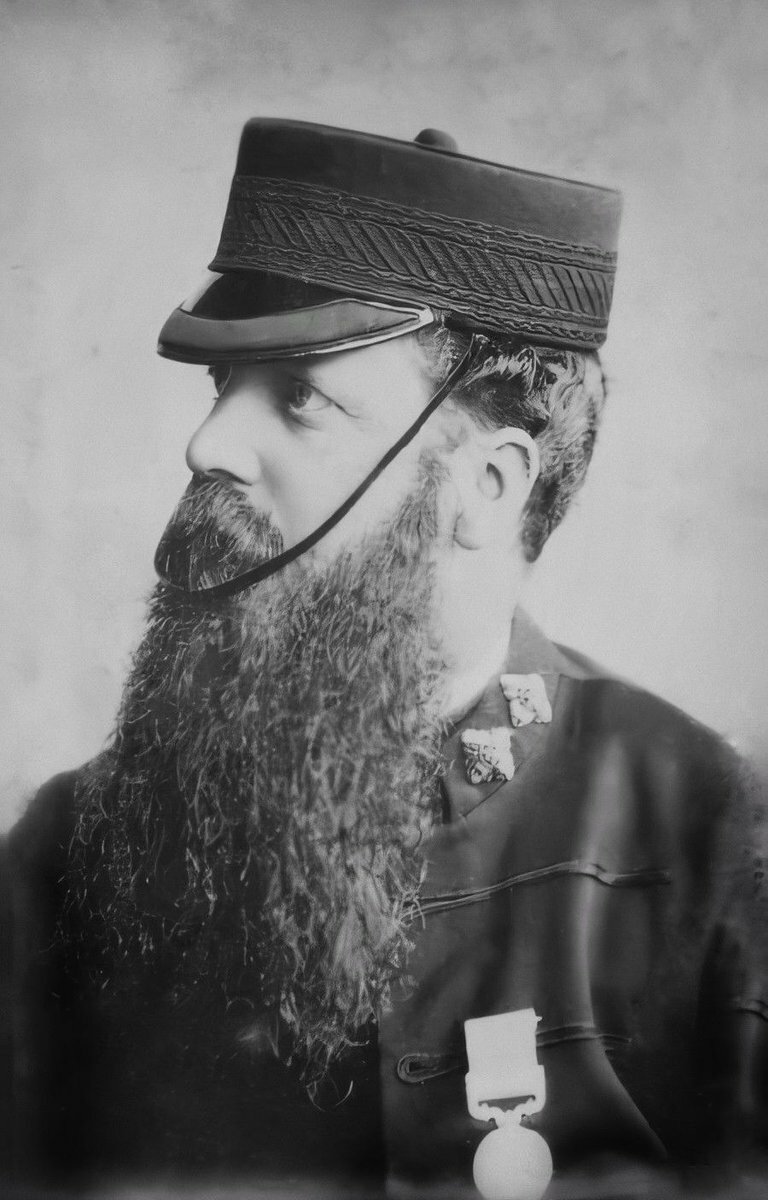
As the preparations were being made for the staff of the Mission Station at Rorke's Drift, Smith found himself appointed as the Chaplain at that station, alongside comrades such as Surgeon-Major Reynolds, Lieutenants John Chard and Gonville Bromhead, who would themselves carve their names in history. Smith's striking physical appearance is noted both in print and in oils:
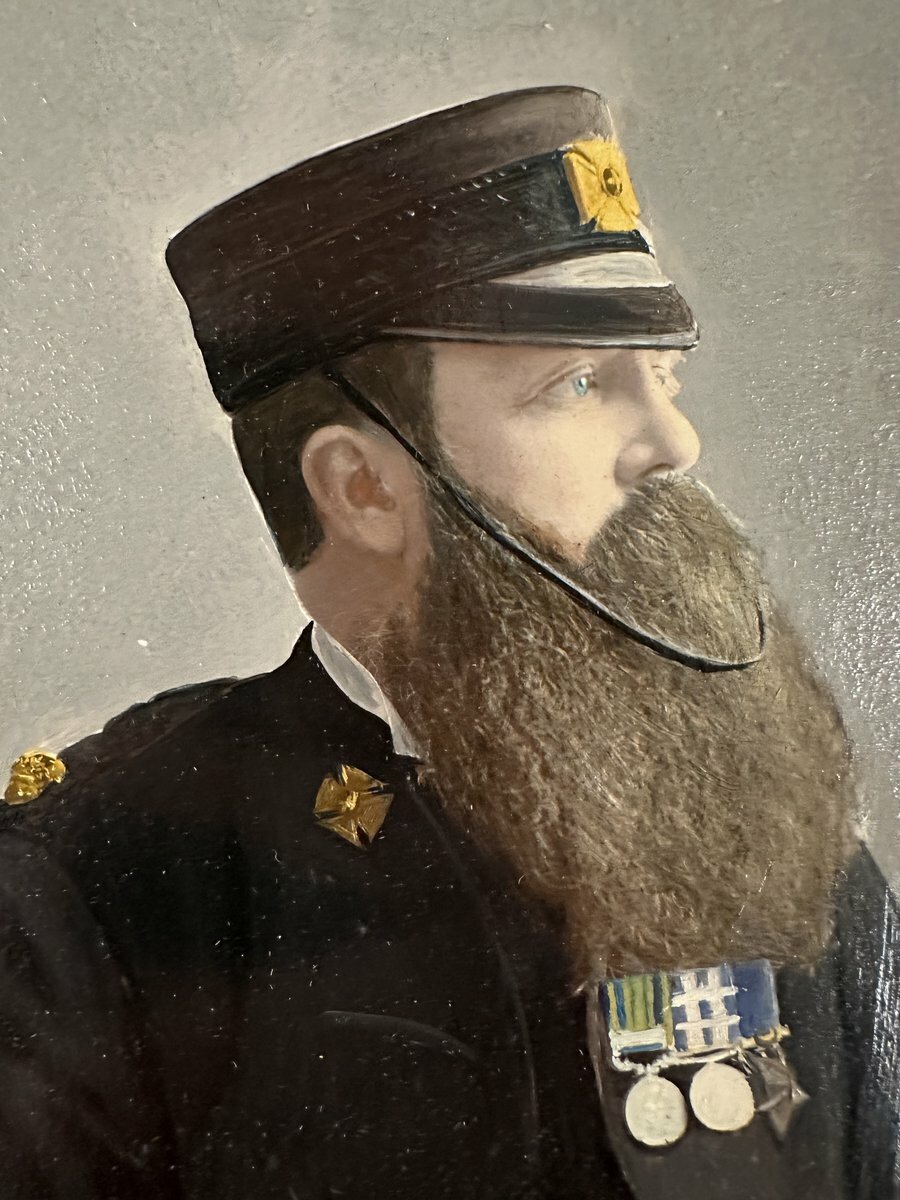
'A tall man with a great red beard, he had been appointed Chaplain to the Volunteers and was invariably clad in a tattered alpaca ecclesiastical frock, which had long since turned green with age.'
One can imagine that commanding figure about the place and as that fabled day of 22 January 1879 drew on, those at Rorke's Drift could hear the distant - and foreboding - rumble of artillery. Morris continues:
'Otto Witt was still at the mission station to keep an eye on his property, but he had moved from his house to a tent. Shortly after lunch he set out to scale the Oskarberg with Chaplain George Smith, Surgeon Reynolds and a soldier named Wall. The men hoped to discover the reason for the artillery fire they had heard from the distance, but although the back slopes of Isandhlwana were clearly visible, no movement could be seen. After a while a body of natives suddenly crossed the saddle and disappeared in the low ground on the near side. Smith had a telescope, and the men assumed they were a detachment of the NNC.
Some time later a few horsemen were observed riding toward the post along the Natal bank. Thinking they might be in search of medical assistance, Reynolds descended to find the post alerted by the arrival of first Gardner's note and then Vane and Adendorff. He was shocked to see Vane on Shepard's horse, but there was no time to question him as the arrangements for his patients demanded his immediate attention.
Smith, Witt and Wall remained on the Oskarberg, with a clear view across five or six miles of the Natal bank of the Buffalo, down to a sharp bend which hid Fugitive's Drift. Suddenly they saw the Undi corps, still on the Zulu side near the distant bend.
There were two headringed regiments: the uThulwana, 45 years old and 1,500 strong, and the uDloko, 41 years old and 2,000 strong. A few companies of the uThulwana were missing; they had reached the ravine on the Nqutu plateau well in advance of the rest of the regiment, and they had charged with the umCijo while Mavumengwana and Tshingwayo held back the rest of the Undi corps. The bachelor inDluyengwe, 33 years old and numbering over 1,000, had all crossed the river to the Natal shore by now and had reassembled. A few of them had been killed by the fugitives during their flight, and more had fallen to the fire of the Edendale contingent or had drowned in Fugitive's Drift, but their ranks were largely intact. They had been led during the fight by Usibebu, the commander of the uDloko, but Usibebu had been wounded and had turned back, passing the command of his regi- ment to another inDuna. The inDluyengwe moved off upstream, firing into the crevices of the rocky outcroppings to flush out Natal Kaffirs who had escaped earlier, and pausing to set fire to the small kraals and occasional European homesteads that they passed. When they drew abreast of the Undi corps at the bend they paused to rest on a small knoll, while Dabulamanzi, who had brought the uThulwana and the uDloko to the water's edge several miles upstream from Fugitive's Drift, crossed to join them. The current at the bend was swift and treacherous, and the warriors linked arms and edged into the stream until they formed a human chain to the Natal shore. The rest of the warriors crossed in their shelter, and the reunited impi paused on the knoll and took snuff. Then the warriors rose, formed ranks and began to move aimlessly toward the Oskarberg. A party of scouts detached itself and raced ahead, moving toward the western flank of the mountain, and then the three regiments, over 4,000 warriors strong, broke into a flat run to round the flank, led by Dabulamanzi and a corpulent inDuna mounted on white horses. Smith snapped shut his telescope and with Witt and Wall fled down the slope to cry the warning. Harry Lugg later remembered his shout: "Here they come, black as Hell and thick as grass!"
The barricades were going up and Witt, already upset by the ruination of his house and garden, became frantic at the sight of the destruction of his furniture. He asked for an explanation in his broken English, and as he grasped the magnitude of the disaster across the river, he suddenly turned white. His wife and three infant children had left several days earlier in a wagon with a single native retainer to make their way to friends in Durban, and they were now, he knew, at the Umsinga Mission Station. In his excited imagination, nothing stood between them and a bloodthirsty Zulu impi but the Buffalo River and a few miles of open country. Abandoning the last claim to his homestead on the spot, he turned and fled up the track to Helpmakaar to find his family.
Chaplain Smith considered going with him but then discovered that his Natal Kaffir groom had already made off on his horse. He decided to stay to assist the defenders...
It was four-thirty in the afternoon, barely an hour since Vane and Adendorff had ridden up to the drift. The back wall was complete, but a long stretch of the front wall, at the western end in front of the hospital, was only one layer of biscuit boxes high, and two towering piles of mealie bags were still heaped in front of the storehouse. Dalton had set several men to unscrewing ammunition boxes as soon as the first warning arrived, and a dozen of the fifty boxes in the storehouse were open. The men grabbed their rifles and stuffed extra cartridges into their expense pouches. Chard and Bromhead posted the men around the perimeter, mixing the casuals and the ambulatory patients in with "B" Company. Those of Stephenson's Natal Kaffirs who carried rifles manned the walls, and the rest of the company, clutching their assegais, huddled in the cattle kraal. Bromhead ordered the men to fix their bayonets, and then sent Frederick Hitch, a twenty-three-year-old private from Gloucestershire, scrambling up to the ridge pole of the hospital for a clear view of the western flank of the Oskarberg.
Then, with the Zulus still out of sight, the mounted natives who had been posted at the drift and on the flanks of the mountain streamed past the camp, and without a glance at the mission station they fled headlong up the road to Helpmakaar. Lieutenant Vause followed in their wake, reining in long enough to yell that his men would not obey orders before he too disappeared up the road. It was hard to blame the horsemen. They had just witnessed the destruction of a force five times as large as the one at the mission station, and the sight of an advancing impi of 4,000 Zulus was too much for them. Durnford's mounted natives had performed creditably at Isandhlwana - much better than anyone had expected - but they had seen enough fighting for one day.
While Chard was still digesting the implications of this desertion, a second defection occurred. There were still no Zulus visible, but a spatter of shots was heard up the road as the fleeing horsemen crossed the front of the oncoming impi. As Chard himself dryly put it, "About the same time Captain Stephenson's detachment of the Natal Native Contingent left us, as did that officer himself." The Natal Kaffirs simply vaulted over the barricades, fled over the road and across the fields beyond, and melted into the distant landscape. No one had anticipated much support from this source, but tempers along the barricade boiled over at the sight of the fleeing European N.C.O.'s. An angry voice shouted, "Come back here!" and an instant later a shot rang out and one of Stephenson's sergeants, a foreigner, dropped with a bullet in his back.
Chard had no time to cope with the incident. In an instant, his situation had deteriorated appallingly. He had counted on 350 men to line the walls when he laid out the perimeter, and now, with the Zulus on top of him, there were only 140 men left in the post. Over thirty of them were incapacitated, and only the 81 men of "B" Company formed a cohesive, dependable unit. There were not nearly enough men left to man the original perimeter, which stretched for almost 300 yards, and there was no time to effect a change. The hospital would have to be abandoned, and it would have to be evacuated, somehow, under fire. Pulling a few men out of the line, he hastily set them to work running a new line of biscuit boxes and mealie bags straight out from the western front corner of the storehouse to the front wall along the ledge, bisecting the post. With the solid stone structure at his back, the western kraal wall on his right, the new wall on his left and the wall on the ledge in front, he would have a last redoubt which he might be able to hold with whatever men could reach the new enclosure.
The battle raged as scores of Zulu threw themselves on that gallant band who stood firm, with Smith being something of a rallying point for them, constantly showing himself to the fire and never displaying an ounce of fear. Morris again:
'The defenders, fully exposed, were pinched against the front wings and the inset veranda, firing and thrusting and swinging clubbed rifles at a bristling hedge of assegais. The men filled the narrow strip, leaving no room for lateral movement, and it was impossible to reinforce them during the rushes and difficult to pass fresh ammunition to the hard-pressed men at the far end. Old King Cole fell dead, with a bullet through his head that smashed the bridge of the nose of the man beside him. There was never a letup, and the men were nearing the end of their strength.
More and more Zulus had clambered up to the Oskarberg terraces and their fire grew galling. It had already wounded Scammell and killed Byrne; now Privates Scanlon, Fagan and Chick fell and Corporal William Allan was wounded in the arm. A hammered slug from a muzzle-loader smashed into Hitch's shoulder, inflicting a fearful gash and shattering the shoulder blade to splinters. Hitch fell back and rolled to the center of the yard. When he caught his breath, he crawled over to the wall of the hospital and sat up to rest beside Corporal Allan under the small window that formed the only opening from the interior of the building on that side.
The men along the back wall ignored the struggle behind them and devoted their attention to keeping down the barrage from the terraces. During the initial rush Private Dunbar of "B" Company, firing over one of the wagons built into the wall, had dropped the corpulent inDuna on the white horse, and with eight careful successive shots he killed eight more Zulus. Such expert marksmanship kept the Zulus in the ditch and behind the cooking shanty away from the wall, but it could not cut the increasing fire from the slopes, and an hour and a half after the fight started it became obvious to Chard that he could not hold the front wall much longer. Only a few Zulus had moved past the blank rear of the storehouse to attack the cattle kraal, and a handful of men were holding the eastern end of the post, firing over the kraal walls and from a barricaded door on the far side of the storehouse and a hayloft opening directly above it.
Chaplain Smith had slung a large haversack filled with loose cartridges about his neck. He circled the perimeter incessantly, filling outthrust hands and expense pouches and replenishing his supply from time to time from the open boxes in front of the storehouse. He exhorted the men with wild Biblical phrases, sternly reproving every blasphemy and obscenity his ear caught; defenders of the barricades that day recalled him shouting out: "Don't swear, men, don't swear - but shoot them, boys, shoot them!" The din was deafening, and few voices could be distinguished over the continual crash of the rifles and the clanging of assegai blades on barrels and bayonets. The incessant shouts of "uSuthu!" throbbed from thousands of Zulu throats, now gathered in a unified chant, now rising to a shrieking crescendo during the rushes.
The men crowded against the front of the hospital could hold out no longer, and shortly after six o'clock Chard pulled them back into the yard, bridging the short gap between the front wall and the near front corner of the building with a few boxes and bags. There were no loopholes in the front of the building, and thus no firing to take the Zulus in the flank as they swarmed up on the terrace to attack the new dog-leg barricade. The move shortened the length of the front wall that had to be defended, and it released almost a score of men to add to the reduced perimeter, but it abandoned the front of the building, and with it the two empty front rooms. The main door and the front window had been barricaded, but they were not defended, and when the Zulus broke in, they would have access to the interior door to the two rear rooms which sheltered Hook, nine patients and the wounded Zulu. Hook, alone on his feet, was already defending two loopholes and the door to the back, and he would then have two doors to defend.
The fire from the new dog-leg wall kept the front of the building clear for a while, but it could not reach the back of the inset veranda or the empty, open storage space in the near front corner, and several score of warriors sheltering there now began to attack the front of the building. The men along the front barricade were also beginning to waver. The unending torrent of Zulus was fast eroding their strength, and the fire from the Oskarberg terraces was still striking home behind them. Chard would soon have to abandon the yard completely, to pull his entire force back into the enclosure in front of the storehouse.'
The night continued on apace, with the perimeter being defended slowly being eroded away by the weight of the enemy and the fires which engulfed Rorke's Drift. It was a truly desperate moment:
'Chard and his men now occupied the last bastion. There could be no further retreat, and if the final walls were breached, there would be no survivors. It was long past ten o'clock and the fight had been raging without pause and with ever-increasing ferocity for more than six hours, but the determined assailants were still coming on as hard as they had at the outset. The ruined interior of the hospital still blazed fitfully, sending up showers of fat red sparks and faintly illuminating the screaming warriors who still pressed forward with unflagging courage.
The defenders were exhausted and their throats were parched; their heads ached and their ears rang with the din and the ceaseless explosions. They remembered curious sounds: the rustling thump of bullets striking the mealie bags and the splintery clangor as they tore into the tinned contents of the boxes. Chaplain Smith was still making his rounds, piling handfuls of cartridges beside the men at the embrasures and shouting his hoarse, homely encouragements. Most of the men had fired several hundred rounds through their scorching barrels, and the fouled pieces kicked brutally, lacerating trigger fingers and pounding shoulders and biceps until they were swollen and raw. Here and there an overheated barrel glowed dully in the dark, cooking off rounds before the men could raise their guns to fire. The breeches jammed unless they were unloaded at once; the heat softened the thin rolled brass, which stuck to the chamber while the extractor tore the iron head off the case, and men dug at the open breeches with their knives to pick out the empties. Despite the protective wooden forestocks, the barrels blistered palms and burned finger tips, and the men wrapped rags around their left hands or sucked at their fingers and tried to fire with one hand, resting the guns on the mealie bags…
The men had lost all count of the furious charges and all sense of time. They existed in a slow eternity of noise and smoke and flashes, of straining black faces that rose out of the darkness, danced briefly in the light of the muzzle blasts, and then sank out of their sight. It was long after midnight before the rushes began to subside, long after two o'clock in the morning before the last of them was over. The Zulus had settled down behind every shelter, behind the outbuildings and the bushes, in the ditches and bushes, behind the abandoned barricades and behind piles of their own dead, and hundreds of them maintained a desultory fire against the enclosure as the night wore on. Scores of flung assegais flashed over the walls, scraping across the rocky ground or clattering against the walls of the storehouse. There was no rest for the defenders, except for the occasional man who had dropped across his gun in a stupor.
By four o'clock in the morning the last flicker of light from the hospital was gone, and the Zulu fire finally died with it. Darkness and a strange, uneasy silence settled over the post. Heads ached and bodies were stiff, and the faint whispering noises of the night were drowned In ringing ears, but for the moment there was an end to the fighting.’
When dawn came, the scene was one of utter chaos but a victory against all odds had been secured. Smith had played a key role and for his reward it is reported he was offered either the Victoria Cross - as went down to a number of those who played a similar part in the Defence - or a permanent commission. Given the immediate requirement to provide for his future employment, Smith took the latter. He would have been the 12th Victoria Cross for Rorke's Drift.
On 4 February, he presided over the burial of Lieutenants Melvill & Coghill and began the service for the Prince Imperial, before a catholic minister arrived on the scene. He saw further action at the Battle of Ulundi and was awarded one of 14 Medals issued to Chaplains, nine of these with the clasp '1879'.
He also penned an important first hand account of the action, published without attribution 'By an Eyewitness' by the Natal Mercury soon after. Helpfully, his original copy is signed 'G.S.' on the cover, giving confirmation of its actual author. This accompanies the Lot.
Further actions - final furlong
Serving at Aldershot from 1880-81 and Cork from 1881-82, he latterly saw further action in Egypt & Sudan, being present at the Battles of El-Teb & Ginnis (Medal & three clasps, bronze Star). Smith was made Chaplain to the Forces First Class (equivalent to a Colonel) on 10 February 1900 whilst stationed at Caterham Barracks. He returned to Africa and was stationed at Harrismith, Orange River Colony by 1903 and retired in 1906. Living at Preston, he found a great joy in travelling in the final years of his life. Smith even made the journey to Australia & New Zealand in the Spring of 1913. He visited Sydney and went to admire the painting which hangs there. The Director recalled:
'The Rev. George Smith, who is prominent in the painting, visited Sydney in 1912 or 13 and called on me when I was Director of the Art Gallery. He had not seen the completed picture, though he posed for the artist in London. He came specially to Sydney on his way to New Zealand, to see it. A tall man with a long grey beard entered my room and told me that his name was Mr. Smith and stated the object of his visit.
On inspecting the picture he was visibly upset upon seeing his late comrades, many of whom had since died of their wounds, and stood for some time before the painting in silence with bowed head and appeared very much affected. It was some time before he spoke, and then he said it was all too real and brought to him the tragic experience.'
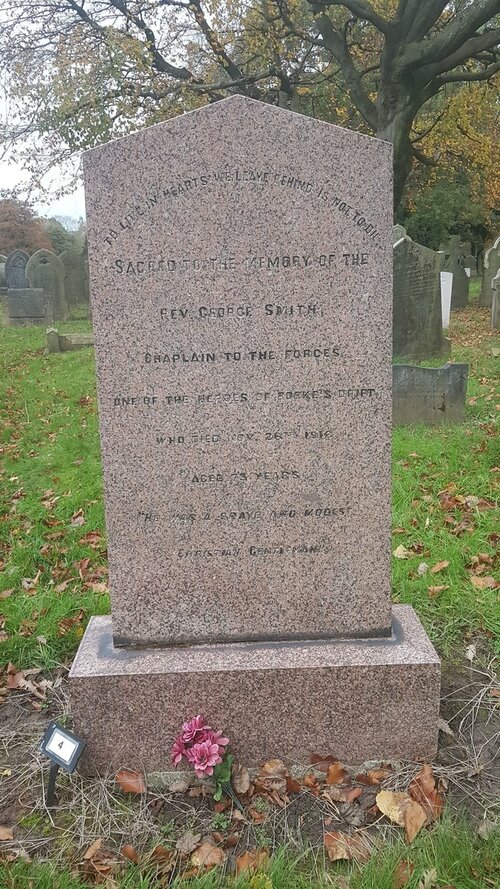
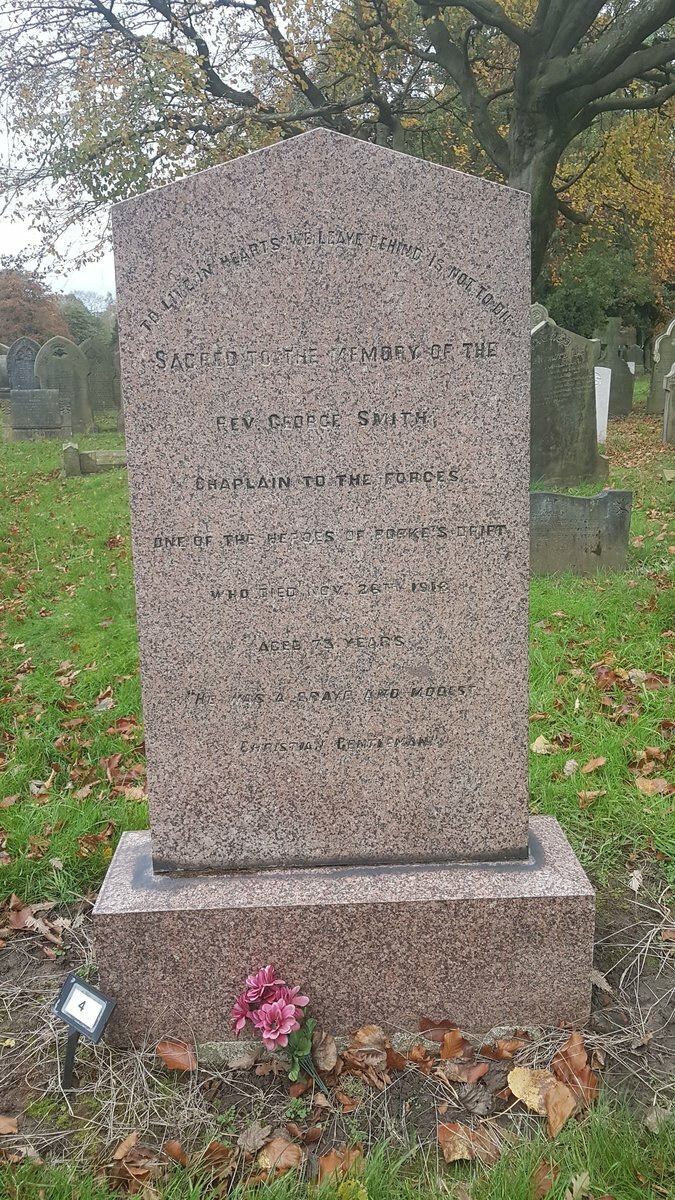
The fact of his visit made the newspapers in both places and was widely reported. Smith died on 26 November 1918 and is buried in the Church of England plot in New Hall Lane Cemetery, Preston, Lancashire.
Sold together with the following original archive:
i)
An oil painting of the recipient wearing his Medals, glazed and framed, overall 160mm x 195mm.
ii)
His own copy of Defence of Rorke's Drift, January 22 1879, by An Eye-Witness.
iii)
His epaulette, cloth and bullion, together with a collar badge, cloth and bullion.
iv)
A selection of period newspaper cuttings.
Reference sources:
The Washing of the Spears, Donald R. Morris, 1965.
Invasion of Zululand, 1879: Anglo-Zulu War experiences of Arthur Harness; John Jervis, 4th Viscount St. Vincent; and Sir Henry Buller, Brenthurst Press, 1979.
Rorke's Drift, Michael Glover, 1997.
The South African Campaign of 1879, J. P. Mackinnon & S. H. Shadbolt, 1973.
Subject to 5% tax on Hammer Price in addition to 20% VAT on Buyer’s Premium.
Sold for
£65,000
Starting price
£38000

Watch, listen and bid as if you were in the room. Now available for auctions worldwide.
Click here to bid live
An exclusive and confidential service for the discerning collector or vendor.
View the Gallery
Download every Spink catalogue on your iPad, iPod or iPhone using free Spink app.
Download From iTunes© 2026 Spink & Son. All rights reserved.