
Auction: 26001 - Orders, Decorations and Medals
Lot: 134
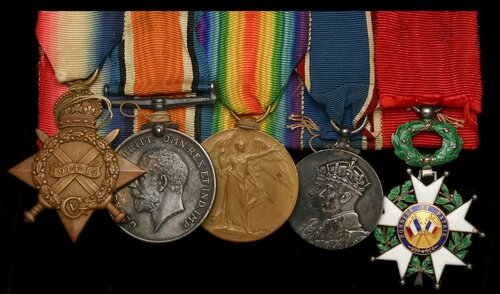
Five: Captain C. C. Craig, Royal Irish Rifles, who was wounded in action during the Battle of the Somme and was taken a Prisoner of War, also a Member of Parliament in Ireland from 1903-24
1914-15 Star (Capt. C. C. Craig. R. Ir: Rif:); British War and Victory Medals (Capt. C. C. Craig.); Coronation 1937; France, Legion of Honour, Knight's breast Badge, silver-gilt, silver and enamel, court mounted as worn, the last two loose, tiny enamel damage to the last, otherwise good very fine (5)
French Legion of Honour London Gazette 14 July 1917.
Charles Curtis Craig was born at Sydenham, County Down, Ireland on 18 February 1869. He was the son of James Craig and Eleanor Gilmour Browne, his father was a self-made millionaire as a result of whiskey distillery (Dunville's). Craig was educated at Clifton College, Bristol, and Craig’s parents wished him to become a clergyman, while Craig wanted to join the Royal Navy. He eventually became a member of the Royal Yacht Squadron at Cowes and sailed his own yacht under the flag of the Royal Ulster Yacht Club. Craig compromised by qualifying as a solicitor in 1891, but after his father’s death in 1900 he lived off income from his inheritance and retired from practice in 1902 to concentrate on politics. Craig helped reorganise the Unionist Party in the East Down constituency after the loss of the party’s seat to the tenant-farmer political insurgency led by T. W. Russell in the February 1902 by-election, briefly serving as constituency treasurer. On 6 February 1903 Craig was elected Member of Parliament for South Antrim, defeating the Russellite S. R. Keightley. This reflected the predominantly urban nature of the constituency; although Craig supported the principle of the Irish Land Act, 1903, he was one of the more pro-landlord unionist MPs. He saw tenant agitation as undermining the principle of contract and the rights of property and wished to limit the politically unavoidable precedent set by Irish land legislation. From 1903 until the 1906 general election Craig was the youngest Ulster Unionist MP.
At the 1906 general election Craig was unopposed in South Antrim, while his brother James unseated the Russellite MP for East Down. In a ceremony repeated after the January 1910 general election, the brothers shook hands on the Union Bridge over the River Lagan, which linked their constituencies, and were presented with white gloves. Despite his seniority in age and parliamentary experience, Craig was overshadowed politically by James.
Craig was returned unopposed at the December 1910 general election and made characteristically forceful contributions to parliamentary debates on the subsequent home rule bill. In March 1913 he called on unionists to arm: ‘Ten thousand pounds spent on rifles would be a thousand times stronger than the same amount spent on meetings, speeches and pamphlets’. Craig was prominent in organising the Ulster Volunteer Force (UVF) and became colonel of an Antrim battalion.
On the outbreak of the Great War Craig placed an order for 10,000 military uniforms without authorisation (the UUC agreed to reimburse him). He joined the Ulster Division on its formation, although he was over military age; he became a captain in the 11th (South Antrim) Battalion, Royal Irish Rifles, on 14 September 1914. After training, Craig entered the war in France on 5 October 1915. On 1 July 1916 he participated in the Ulster Division attack on the opening day of the battle of the Somme, reaching the Schwaben redoubt (fourth German defence line). Craig was then struck in the right leg by shrapnel and left in a shell hole. The Germans transported Craig on a wheelbarrow as he was too heavy for a stretcher.
On 9 July Craig was interviewed in hospital at Gütersloh in Westphalia by German intelligence, which mistook him for a nationalist MP ‘dedicated to war … in the separatist cause. He seemed to be something of a fanatic … He did not believe in the possibility of a compromise between catholic Ireland and the protestant minority in the province of Ulster’. Craig’s subsequent experiences of three internment camps were unpleasant; he later expressed regret that the Allies had not taken reprisals against German prisoners of war to secure better conditions for their own men.
In June 1918 Craig was transferred to an internment camp at Scheveningen in the Netherlands and repatriated to England on 3 October 1918; he reappeared in the House of Commons on 29 October to deliver an impassioned speech accusing the War Office of neglecting prisoners of war and equating them with deserters, criminals and shirkers.
At the 1918 general election Craig defeated a Sinn Féin candidate, Kevin O’Shiel and when parliament met became secretary to the Ulster Unionist parliamentary party. The following April he was appointed Deputy Lieutenant for Co. Down. When Edward Carson stood down as Unionist leader on 4 February 1921 and was succeeded by James Craig, who left Westminster to head the Northern Ireland government, Charles Craig became leader of Ulster Unionist Westminster MPs. He always maintained that all Ireland could have been ‘saved’ for the union without Liberal appeasement of Irish nationalism, but accepted partition as a fait accompli; the major preoccupation of his later parliamentary career was opposition to the boundary commission. He applied for his medals in May 1920 and they were sent to him at 29 Brompton Square, London SW3. After abolition of the South Antrim Westminster seat in 1922, Craig ran unopposed with Hugh O’Neill in the two-seat Co. Antrim constituency at the 1922 and 1923 general elections. (In 1924 they secured the largest majority of the election, 58,250 votes over a Sinn Féin candidate.) Craig refused office in the 1922–3 government formed by Andrew Bonar Law, to remain free to represent Northern Ireland’s interests. On 5 December 1922 he became a member of the Irish privy council just before it lapsed, and on 27 September 1923 joined the privy council of Northern Ireland. On the formation of Stanley Baldwin’s first government in May 1923 Craig became parliamentary secretary to the minister of pensions and resigned as leader of the Ulster Unionist MPs; he held this position until the formation of a Labour government in February 1924. In January 1926 Craig became a director of the World Auxiliary Insurance Corporation and was elected chairman in May 1928, succeeding his deceased brother-in-law John Wimble. He announced that he would not contest the 1929 general election in December 1928, saying he found it hard to adjust to the changed position of Ulster MPs at Westminster. Thereafter he was an occasional visitor to Northern Ireland; though retaining lifelong honorific positions in the Grand Orange Lodge of Ireland, he never attended its meetings. Craig died at Malmesbury District Hospital, Wiltshire on 28 January 1960.
Subject to 20% VAT on Buyer’s Premium. For more information please view Terms and Conditions for Buyers.
Sold for
£2,600
Starting price
£320
Watch, listen and bid as if you were in the room. Now available for auctions worldwide.
Click here to bid live
An exclusive and confidential service for the discerning collector or vendor.
View the Gallery
Download every Spink catalogue on your iPad, iPod or iPhone using free Spink app.
Download From iTunes© 2026 Spink & Son. All rights reserved.