
Auction: 26001 - Orders, Decorations and Medals
Lot: 117
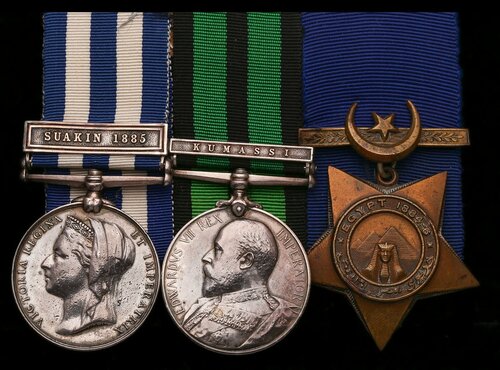
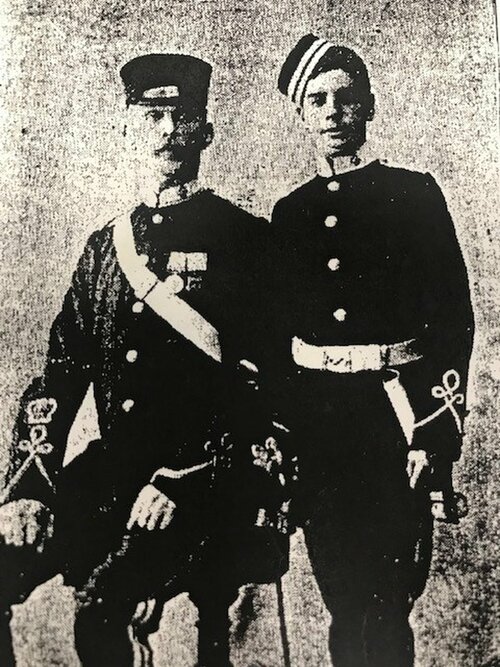
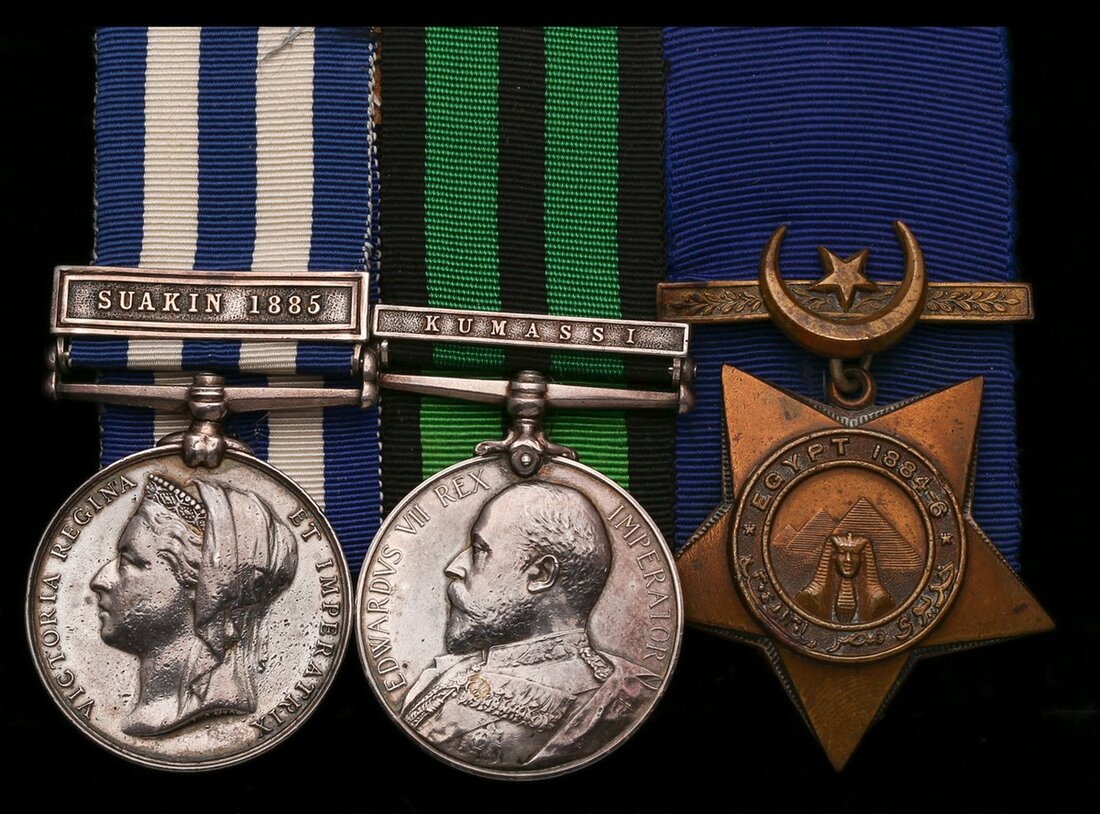
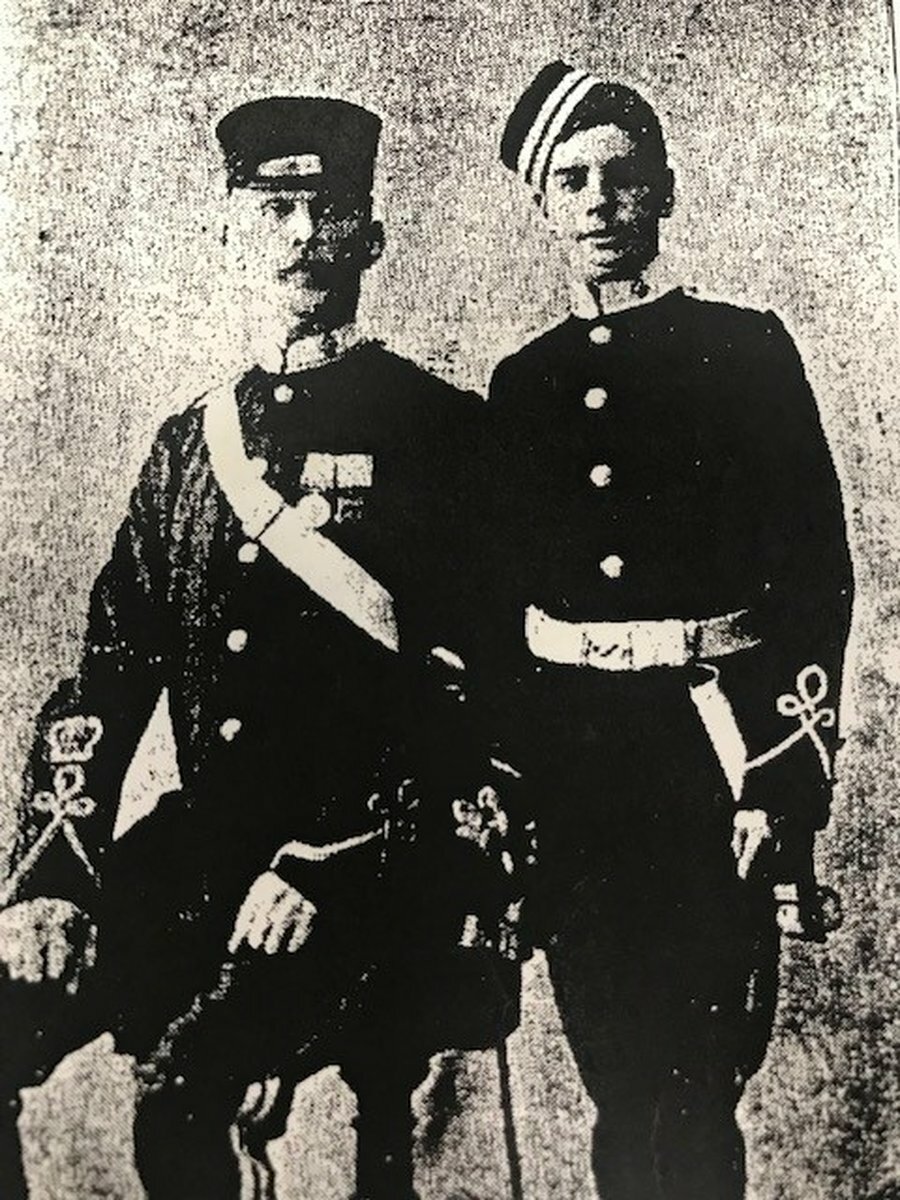
Three: Staff-Sergeant Major P. Shanley, Army Service Corps, late King's Own Scottish Borderers, who was wounded at the Battle of Abassa on 30 September 1900, regarded as a '...a fine old veteran of the Army Service Corps who had come out at the end of his service to see a fight and was very pleased that he had shot a man who was taking aim at him'
Egypt 1882-89, undated reverse, 1 clasp, Suakin 1885 (3074, 2nd CL: S.Sgt P. Shanley. 3rd Co. C & T.C.); Ashanti 1900, silver issue, 1 clasp, Kumassi (S.Serjt:-Maj: P. Shanley. A.S.C.); Khedive's Star, dated 1884-6, court mounted for display pitting from Star, otherwise very fine (3)
Arthur Patrick Shanley was born at Clongesh, Longford, Ireland on 23 June 1849. He attested for the King's Own Scottish Borderers on 23 April 1868 and was promoted to Corporal on 10 June 1870. Shanley reverted to Private on 1 May 1872 and transferred to the Army Service Corps on 30 June 1872. Promoted to 2nd Corporal on 15 January 1873, Corporal on 30 October 1873 and Sergeant on 7 February 1877. He was re-engaged at the Curragh to complete 21 years service on 2 September 1878 and promoted to Colour-Sergeant on 14 November 1878. Shanley however was reduced to the rank of Sergeant on 26 December 1880 as a result of being drunk on duty. He served in the Egypt & Sudan campaign from 17 February-8 June 1885 and retired on a Warrant Officer's pension on 17 November 1891.
However, he served with the Ashanti Field Force as a Special Service N.C.O. along with three other members of the Army Service Corps and was slightly wounded on 30 September 1900. He appears in the book From Kabul to Kumassi by General Sir James Willcocks the Commander in the Ashanti campaign and Shanley was known as 'A fine old veteran of the Army Service Corps who had come out at the end of his service to see a fight and was very pleased that he had shot a man who was taking aim at him'.
The 30 September 1900 was the last day on which (in the light of events as we now know them) the Ashantis should ever be able to say they fought the white man in any numbers. The fighting line consisted of 600 men, while 600 men were told off to guard the long string of carriers. At 9 a.m. the advanced scouts were fired on from the front, and left flank, and almost before any deployment could take place the enemy, who occupied a low crescent-shaped ridge poured in a heavy fire, freely using our own .303 carbines of which they had a great number, captured near Kumassi.
As soon as sufficient troops were deployed a general advance of three companies took place with two in support and Sikhs in reserve, one company of the West African Regiment on our right under Captain St. Hill, with Lieutenant Aspinall, doing particularly good work and driving the enemy back on the village of Obassa. Major Montanaro, who commanded the advanced guard, ordered the cease fire and charge but the Achuma tribesmen were dogged, and refused to do more than retire a few yards, where they had a second position and re-opened a fusilade all along their line, although exposed to the close fire of a Maxim excellently worked, which was doing much execution.
A second charge forced them back on the flanks, but their centre would not give way, and so, after five minutes of rapid firing, I ordered up the company of Sikhs, under Captain Godfrey, Indian Staff Corps. The Ashanti does not like the combined sound of bugles and drums sounding the charge, but the brave fellows faced it this day right well, and as the Sikhs, with their warlike Khalsa cry, dashed into them, led by Captain Godfrey, they stood their ground and fired killing some and wounding several including the brave Major Mellis, severely, and killed a fine soldier who had earned the Order of Merit (the Indian V.C.) on the frontiers of the Punjab.
With the Sikhs went all the rest of the fighting line, a company of more from each of the corps composing the Field Force - fitting end to all their labours. The Ashantis had made their last fight in the campaign, they had been heavily beaten, and they now ran as they had never done before. Their flight was a panic, they left guns, ammunition and many barrles of powder on the field; no attempt was made to remove their belongings nor even their dead - 62 bodies lay in our direct front as we moved on, and I afterwards found we had killed 150, including six chiefs, and the wounded must have numbered many more. Our casualties were Major Meliss, Indian Staff Corps, and Lieutenant Luard, Norfolk Regiment, severely wounded, and Major Willans, Army Service Corps; Captain Charrier, Munster Fusiliers; Captain Pamplin Green, 3rd Essex Regiment, and Sergeant-major Shanley, Army Service Corps, slightly wounded; three men killed and 28 wounded.
Upon retirement, Shanley became a grocer and lived at Croydon, Surrey. He died on 22 June 1914 and considered himself as the the first Pioneer Sergeant of the British Army. The latter part of military service saw him with No. 2 (Depot) Company and his final wish was that a gun carriage the Company should convey his remains to his final resting place. With six bearers, his final wish was duly granted.
Subject to 20% VAT on Buyer’s Premium. For more information please view Terms and Conditions for Buyers.
Sold for
£1,700
Starting price
£1200
Watch, listen and bid as if you were in the room. Now available for auctions worldwide.
Click here to bid live
An exclusive and confidential service for the discerning collector or vendor.
View the Gallery
Download every Spink catalogue on your iPad, iPod or iPhone using free Spink app.
Download From iTunes© 2026 Spink & Son. All rights reserved.