
Auction: 26001 - Orders, Decorations and Medals
Lot: 102
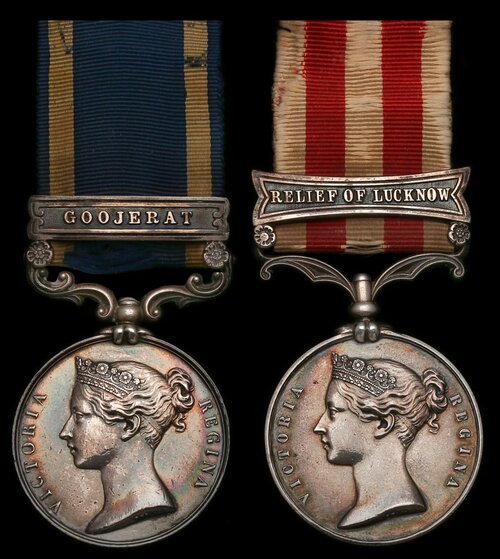
The campaign pair awarded to Lieutenant-General W. A. Crommelin, C.B., Royal Engineers, who was shot above the ankle during the attack on the Residency during the Indian Mutiny, and who later served as Chief Engineer at Oudh
Punjab 1848-49, 1 clasp, Goojerat (Lieut. W. A. Crommelin. Engineers.); Indian Mutiny 1857-58, 1 clasp, Relief of Lucknow (Major W. A. Crommelin, C.B. Chief Engr Oudh.), light contact marks, very fine (2)
[C.B.] London Gazette 27 July 1858.
William Arden Crommelin was born on 21 May 1823 and was the son of Charles B. Crommelin and was of French Flanders descent. He entered the East India Company Military Seminary at Addiscombe, Surrey in February 1840 and left on 10 December 1841 as First Engineer of his term with the rank of Second Lieutenant. He arrived in Calcutta in November 1843 and became Assistant Garrison Engineer at Fort William.
The Anglo-Sikh Wars
In 1844 he was transferred to Hazareebagh. After the Battle of Ferozeshah he was called upon to join the Army of the Sutlej and arrived just after Sobraon, and was sent to join the Engineers engaged at Kunderghat, in front of Ferozepore, in preparing to pass over the army; and then had to prepare two bridges of boats at Nagarghat, nine miles up, for the return of the troops. In March 1846, he became one of the two Executive Engineers of the new province of Jullunder, and commenced the provision for cover for troops at three cantonments, when he was called upon to proceed with the expedition to Kote Kangra. Crommelin went as Brigade-Major.
The difficulty was to get the 18-pounders up a distance of forty miles from the exit to the Beas into the plains up to Kangra. This was done in a week, but a very hard week's work.
The only practicable plan for such hurried work was to follow in the main the bed of the river which came down the Kangra, and the river was crossed probably fifty times. The Sikh Sirdars were at first inclined to resist, but when they saw a couple of large elephants slowly and majestically pulling an 18-pounder tandem fashion, with a third pushing behind, they were amazed, but said not a word.
When the last gun had reached the plateau, they returned to the fort, and an hour later the white flag was raised. Crommelin was now appointed Garrison Engineer at Lahore. In the following year the second Sikh War began with the troubles at Mooltan. Crommelin was diligent with the preparations, and made two boat bridges across the Sutlej and Ravee. He served throughout the campaign in Northern Punjab, and was present at the action of Ramnuggur on the Chenab, and afterwards with Sir. J. Thackwell in the flank movement by which the Chenab was crossed twenty miles above Ramnuggur, while the Chief remained there facing the enemy, and at the action of Sadoolapoore. He was present at Chilianwalah, and also at the crowning victory of Gujerat, on which occasion he served in immediate attendance on the Chief Engineer, Sir John Cheape.
After the battle he was sent in charge of a pontoon train to follow Sir Walter Gilbert in his pursuit of the defeated Sikhs, when he made a bridge over the Jhelum and one over the Indus. In fact, during this campaign he bridges all the great rivers of the Punjab. After the war he was Chief Engineer at Peshawur, but in 1850 went home on furlough, not returning until 1853, when he became Civil Engineer of the Peshawar district. While there he designed a great suspension bridge over the Indus; but it was never taken up in execution, being superseded for the time by the tunnel project.
Indian Mutiny
In 1854 Crommelin was attached as Assistant to Colonel Napier (afterwards Lord Napier of Magdala), then Chief Engineer of the Punjab. He was promoted to Captain on 15 April 1856 and was transferred to the Public Works Office in Calcutta as a Deputy Consulting Engineer, and held that post when the Mutiny broke out. Crommelin was ordered to join Havelock, and arrived at Cawnpore on 25 July 1857. When Havelock, after his first advance, decided on returning to Cawnpore with his sick to get reinforcements, Crommelin strengthened the position at Mangalwara, six miles from the river, so that Havelock might remain there until the bridge was ready. On 12 August 1857 the Battle of Bussarat Gunge was fought, and at its close Crommelin returned to the river to make final arrangements; on the 13 everything was ready, and in less than a day the passage was successfully accomplished.
On the 15 August followed the fight at Bithoor. Havelock remained at Cawnpore until 15 September, when Outram arrived. During the previous month Crommelin had made frequent reconnaissances and had completed arrangements for crossing the river again. The force now marched on Lucknow, and on the 25 September they marched into that place. In the final rush up to the Residency, where our troops suffered so severely, Crommelin was struck by a bullet just above the right ankle, a second nearly cut his scabbard in two, and a third mortally wounded his horse. When he was obliged to give up active work, both Outram and Napier insisted that he was to retain the Chief Engineership of their force. His wound gave him a great deal of trouble, and after five weeks' incessant work hospital gangrene set in so rapidly, that at one time he feared he must lose his leg. The mining operations which formed such a remarkable part of the defence had been initiated by Captain Fulton in the earlier part of the siege, and were developed in an extraordinary manner under Crommelin's command, so as to cover the greatly extended position occupied after the first relief.
After the effectual relief of Lucknow by Sir Colin Campbell and the arrival of the force at Cawnpore, when he had regained his health to a certain extent, he offered his services for active duty in the field, but Sir Colin thought his lameness incapacitated him for further active duty at that time. Strange to say, Havelock in his Despatches omitted to mention the work, or the name of the Engineer Officer who had rendered him such eminent and essential services. But the gallant Outram did not fail to notice the omission, and on 25 September 1858, wrote to Crommelin that he had written officially to Army Headquarters on the subject. Outram remarked: 'These operations were certainly most remarkable efforts of engineering skill, accomplished under great personal exposure and exertion on the part of the Engineer and his corps.' Lord Canning thus wrote to the Court of Directors:
'Your Honourable Court will observe that while the first passage of general Havelock's force in July last occupied nearly a week, the same force, owing to the admirable arrangements made by Captain Commelin, crossed in about five hours.
The bridge by which the third passage was effected in September was carried across the Ganges when within three feet of its highest level. Considering the means and force by which it was completed, and that in face of an enemy in full possession of the opposite bank, it was one of the most remarkable operations of the kind that military history can show.
'Yet amid all the comments that have been made in England on that remarkable campaign, and the praise that has been bestowed upon the leaders, the fact that the expedition involved three passages of the Ganges in full flood, or nearly so, would seem altogether to have escaped notice.'
During the second period of the defence of Lucknow, viz. from September 25 to December 18, the Engineers were reinforced by the officers who had accompanied Outram and Havelock. These were Captain Crommelin, who, on arrival within the Residency, assumed the functions of Chief Engineer, previously held by Lieutenant Anderson, Lieutenants Hutchinson, Russell, and Limond. Captain Commelin had been wounded on the day of entry, and while incapacitated for duty, Colonel R. Napier, Bengal Engineers, who was Military Secretary to Outram, undertook the duties of Chief Engineer in his place. Captain Oakes, Lieutenants Chalmers and Hall, acted as Assistant Engineers. The defence during the second period continued to be principally confined to mining and countermining operations. General Outram writes thus on the subject in his Despatch dated 25 November 1858:-
'I am aware of no parallel to our System of mines in modern war. Twenty-one shafts, aggregating 200 feet in depth, and 3291 feet of gallery have been executed. The enemy advanced twenty mines against the palaces and outposts; of these they exploded three, which cost us loss of life, and two which did no injury; seven have been blown in, and out of seven others the enemy have been driven, and their galleries taken possession of by our miners, results of which the Engineer Department may well be proud.'
Captain Crommelin, in his report dated 12 November, gives the following account of his proceedings:-
'We found soil to be generally light and sandy; still the greater portion of the galleries were run without casing.... I may here mention as an extraordinary fact, that two galleries were run respectively to lengths of 298 and 192 feet, without the aid of air tubes. In the latter the lights burnt well; but in the former the men were obliged to work in the dark, and were somewhat (though not greatly) affected by the foulness of the air... The utility of the galleries has proved most marked...On eight different occasions the enemy were heard mining towards our position. We waited patiently until their mines broke into our gallery. We then fired on them through the opening, wounding several, and in every instance we captured their galleries and tools, and then destroyed the former without using any powder. On the two other occasions, when the enemy were heard approaching, we commenced running out short branches through our own galleries, in order to lodge a charge for blowing in those of the enemy. Their miners, in both enclosures, abandoned their galleries. Our success so alarmed the enemy that they have latterly been afraid to approach near our position, and have twice exploded charges at ridiculously long distances from the works that they intended to destroy; indeed, nearer to their own buildings than to ours. I may add that since we commenced our listening galleries the enemy have failed to do us any injury with their mines, and our exposed front has remained perfectly secure.'
In 1858 Crommelin was appointed Chief Engineer of Oude, when he had to provide barrack accommodation at six cantonments. He held the post of Chief Engineer of Oude until 1864, when he was specially selected to supervise and superintend a general scheme for the provision of barracks, under the title of Inspector General of Military Works. On the retirement of General Dickens in 1877, he became Secretary to the Government of India in the Public Works Department. In 1878 he had a very severe illness and in January 1879 his resignation was accepted in a gratifying letter which gracefully acknowledged his valuable services; first, as a Military Engineer in the Punjab, and in the Mutiny of 1857; and secondly, as Chief Engineer in Oude, and afterwards as Inspector-General of Military Works, and as Secretary to Government. Crommelin was awarded a pension for his distinguished services in 1875. On his return to England he lived in Putney, South West London and died on 30 October 1887.
Subject to 20% VAT on Buyer’s Premium. For more information please view Terms and Conditions for Buyers.
Sold for
£1,700
Starting price
£550

Watch, listen and bid as if you were in the room. Now available for auctions worldwide.
Click here to bid live
An exclusive and confidential service for the discerning collector or vendor.
View the Gallery
Download every Spink catalogue on your iPad, iPod or iPhone using free Spink app.
Download From iTunes© 2026 Spink & Son. All rights reserved.