
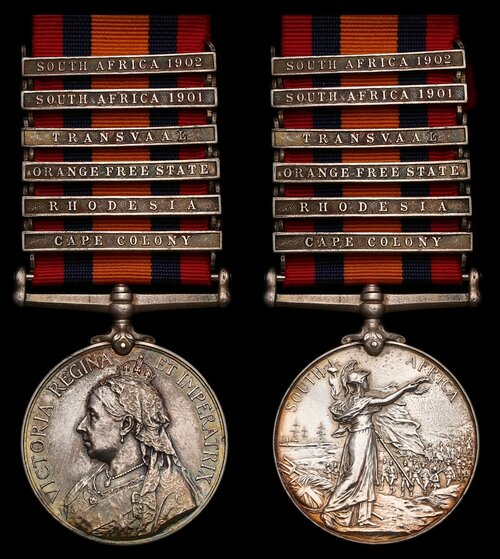
Auction: 26001 - Orders, Decorations and Medals
Lot: 83
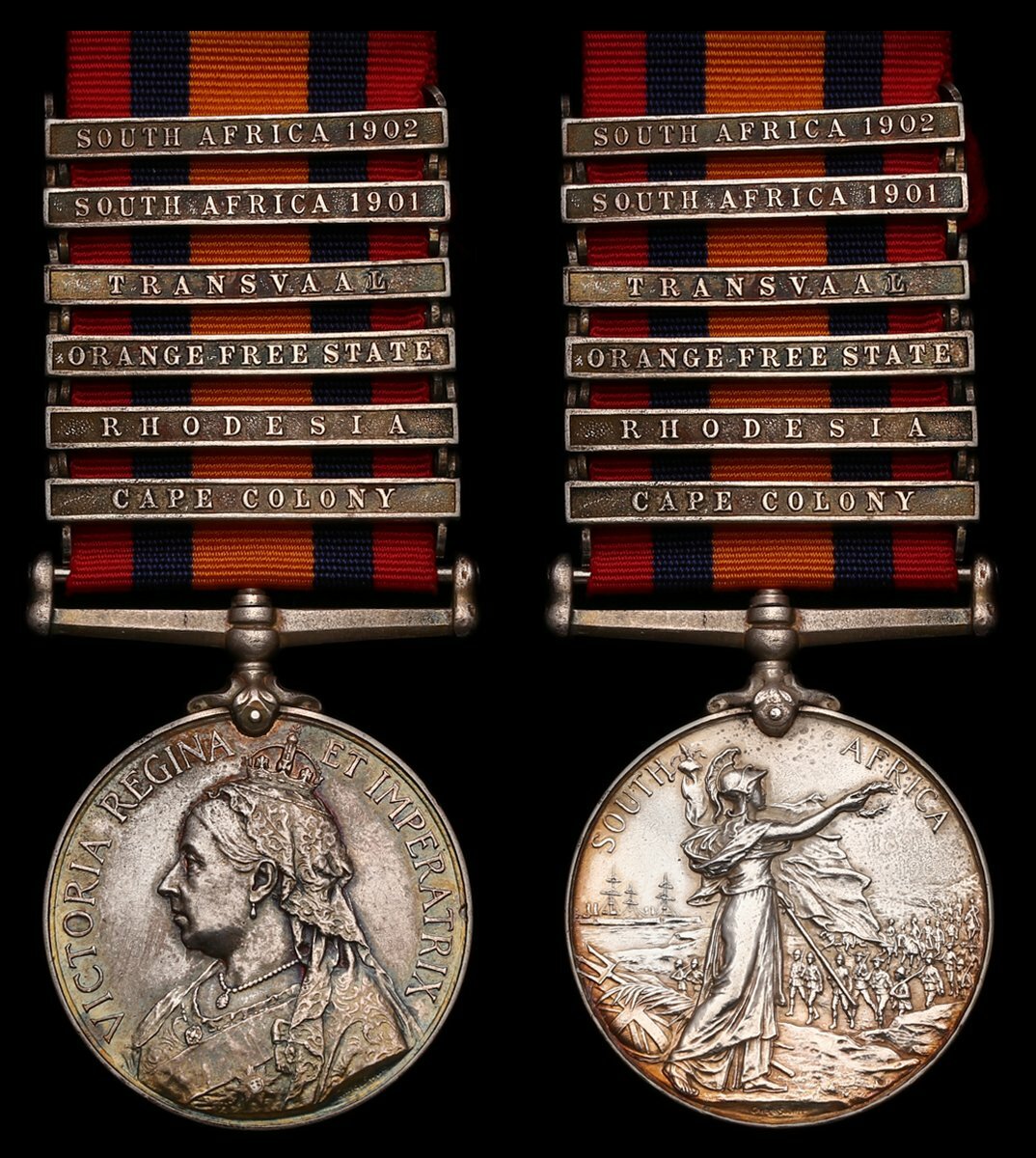
(x) Queen's South Africa 1899-1902, 6 clasps, Cape Colony, Rhodesia, Orange Free State, Transvaal, South Africa 1901, South Africa 1902 (542. Tpr. A. A. Doudney. C.B.C.), impressed in larger size capitals as officially done, clasps not attached to medal but found as a block of four and a top block of two, with a New South Wales Cyclists Touring Union badge and a Northern Suburbs B.C. badge, very fine throughout (3)
Albert Arthur Doudney, Lieut, Cape Colony Defence Force, late 542 Trooper NSW CBC, was born in St Leonards, Sydney, New South Wales in 1875, the son of Augustus Montague Doudney and Matilda Skerrett. He was an enthusiastic cyclist hailing from Hunters Hill in Sydney, and he participated in cycling racing during the 1890s. With the onset of the Second Boer War, which generated considerable excitement across the Colony. Doudney enlisted in the early 1900s. Trooper Albert Doudney departed from Sydney on 28 February 1900 with the NSW Citizens Bushmen's Contingent, aboard the transports Atlantian and Maplemore, as part of A Squadron, and arrived in Cape Town on 2 April. The ships then continued to Biera, where they disembarked on 12 April and made their way to Bulawayo, Rhodesia (now known as Zimbabwe).
The regiment's staff, along with A Squadron, served under the command of General Plumer and engaged in the relief of Mafeking in May. Remaining under Plumer's command, they later participated in General Baden-Powell's column during the relief of Rustenburg in July. At a certain point, Trooper Doudney was seconded to the Rhodesian Field Force, where he served with the Imperial Staff as a Bicycle Despatch Rider. His primary responsibility was to transport messages and orders between units, especially when other communication methods were unavailable or deemed unreliable, in addition to contributing to reconnaissance, scouting, and patrolling.
In a newspaper, The Cumberland Argus and Fruit Growers Advocate dated Wednesday 26 September 1900, page 2, The War in South Africa - A Bicycle Despatch Rider's Experiences is a letter written by Trooper Doudney about his adventures. This states:
'Trooper A. A. Doudney, of the Rhodesian Field Force (a cousin of Trooper Guy Dondney, of the N.S.W. Lancers), in a letter to his brother, dated "Mafeking, August 13th." gives the following interesting particulars of a bicycle despatch rider's experiences:
We started from Mafeking with ten guns, including pom-poms, sur force being made up of Imperial Bushmen, etc. Nothing occurred until we got the other side of Zeerust to a place called Wonderfontein.' From there I was sent back with despatches to Lord Edward Cecil at Zeerust and stayed the night in Zeerust. Next morning, Lord Cecil gave me orders to ride like the devil back to the column, as the Boers were shelling the Australian Bushmen at Elands River. When I got up, I gave my despatchers to Lord Errol and Sir Fred Carrington, and orders were given for the troops to move on at once. We rode half the night and then encamped. The next morning, I was sent ahead to find out where the enemy's snipers were camped, so I rode on ahead and captured a Kaffer, from whom I gained the required information. Soon after this some of the scouts on the right of me came up. I was sitting down eating some sardines with one of them when ping came a bullet from the Boers. Our men coming up behind, bearing the bullets pass them and seeing us on the top of the bill, opened fire on us. We didn't take any notice at first, till one bullet went between the two of us, and then we thought it was time to get. The next moment a volley of bullets whistled all around us. An officer came up, and stopped our men from firing on us, which saved our bacon. When the general and his staff came up, I went forward again with him, and presently the Boers big guns opened fire on us, and nothing could be beard but the shriek of the shells over our beads, and the bursting of the pom-poms around us. Three pom-pom shells burst right in the midst of us, and only for me falling flat on my face, I would not be writing this letter now. Presently, the order was given to retreat, as the Boers position and artillery were too strong. We retreated for ten miles, but the Boers followed us along the hills sniping away all the time, luckily, however, doing no damage, except to knock a spoke out of the wheel of my bicycle, as it was a conspicuous object, being red. We went about another ten miles, and there we camped. When we got into camp, I received orders to ride around to a Boer mill in the mountains. I only found Mrs Boer at home, and after I carried out my instructions, she gave me some supper, and I rode back to camp. But there is no rest for the wicked! And I bad to ride back to the scene of our battle, right through the enemies' pickets. I got back again all right. The guards must have been sleeping or drunk, I don't know which. When I got back to camp, I had to start again towards Zeerust, so it wasn't till 4 o'clock the next morning that I finally got to bed, dead tired. The next morning the column got on the move at about 9 o'clock, and the Boers opened on us from the hills after we had gone about half-a-mile. Colonel Gray sent back from the front for a cyclist to ride between the guns and the scouts, the most dangerous position on the field. None of the other cyclists would go, and when I came up, I took the job on myself, as I was beginning to enjoy the ping of the bullets. When I got up to the firing line I had to stand up with my machine and await orders, while the other soldiers laid down behind rocks. The bullets were now humming like hail stones, but by this time I didn't take the slightest notice of them, except sometimes stooping to look for one when it fell close in the road of my feet. Our pom-poms gradually drove the Boers out of the hills, and we went the rest of the way into Zeerust unmolested. The next morning, we left Zeerust at 9 o'clock, and shortly afterwards 1 overtook, and captured, two Boer cyclist despatch riders, and under the orders of Lord Errol, took them forward with me. They wanted to stop and see some of their friends, and say goodbye, and I wasn't bard hearted enough to refuse them, and consequently I had a good dinner in the Boer houses. The next night we arrived at Ottshoop, and I stopped that night in a Boer bouse, sleeping with my two prisoners in a room to myself, and after warning them not to give me a crack on the head in the dark, I fell sound asleep till daylight the next day. I put them on a traction engine and came safely into Mafeking nothing the worse for my first battles. The next two days we spent fighting were the most exciting ever I spent in my life, and I hope we will have tons more of it yet. It is just as well that I left A squadron of the Bushmen's, as they were all captured.'
On 25 June 1901 Trooper Doudney returned home to New South Wales by the steamer Morayshire. In The Daily Telegraph dated Friday 5 July 1901 page 8 he was welcomed home by the North Sydney Cyclist Club, this article states:
Mr. A. A. Doudney, who had just returned from the war was welcomed home by the North Sydney Club at a dinner on Sunday last. Mr. Doudney, who was attached to the Rhodesian Field Force as a cyclist despatch rider, covered close on ten thousand miles in the performance of his duties, and met with many adventures. Doudney must have returned to South Africa at some point towards the end of 1901, where he was appointed as a lance sergeant and subsequently commissioned as a lieutenant in the Cape Colonial Defence Forces, specifically Burge's Squadron, also referred to as L Squadron. This unit operated in conjunction with the British Army. The squadron was integrated into the 2nd Division, a British military formation during the conflict. The Cape Colony Defence Force was a local defence unit formed from the residents of the Cape Colony, making his involvement in it quite unusual.
Upon his return to Sydney for the second time, he received a fine of 5 shillings for clinging to a tramcar while it was in motion, a behaviour that was quite popular among cyclists at the North Sydney Police Court in February 1902. Additionally, he was required to pay costs amounting to 5 shillings and 6 dimes. In March 1901, he was awarded the Queen's South Africa Medal, and the roll indicates that eight members of the NSW Citizens Bushmen's Contingent, including Doudney, were not listed for clasps. In August 1904, these clasps were sent to Sydney, and he was presented with the clasp for Cape Colony, Orange Free State, Transvaal, and Rhodesia. Although these clasps are correctly linked, they are not attached to his medal. On 4 July 1907, he received the South Africa 1901 and South Africa 1902 clasps. The South Africa 1902 clasp, verified on the roll, was awarded for his service with the Cape Colony Defence Force. This clasp was not given to members of the NSW Citizens Bushmen's Contingent. Both clasps are properly connected but remain unattached to his other clasps.
After his second return home from the war, he eventually moved to Western Australia, where he became a boundary rider in the vicinity of Burracoppin, a town situated along the Great Eastern Highway, cast of Merredin in the wheatbelt region of Western Australia. It would be reasonable to think that, as a boundary rider, he would be someone on a horse monitoring the outer boundaries of the property. However, as notified in The Sydney Morning Herald on Saturday 21 March 1908, page 14, Doudney inspected the fences by riding his cycle:
'A wonderful example of the durability of the modern bicycle tyre comes from Western Australia. In the course of his duties as inspector of rabbit proof fences, Mr Doudney had to cover every 10 days about 240 miles on his wheel. The roads were exceptionally bad, being for the most part sandy and stubbly. Notwithstanding these draw backs, Mr Doudney in the past 19 months is said to have ridden his machine, fitted with one pair of Persan tyres, the wonderful distance of 12,960 miles.'
Following this, he pursued a degree in dentistry and qualified in June 1911, while residing in Sydney, New South Wales. In 1914, he wed Edith Torrens at the Presbyterian Church located in Mullumbimby, a town within the Byron Shire in the Northern Rivers area of New South Wales.
He established his practice in Port Macquarie, and in October 1924, he faced a lawsuit in the Banco Jury Court brought by Zilpha Hannah Ryman, who sought £2000 in damages. She alleged that she visited the defendant's clinic for tooth extractions, but the procedure was executed so poorly that fragments of the teeth were swallowed, resulting in a severe and extended illness. Following this, she consulted a doctor in Sydney, who recommended her admission to North Shore Hospital, where she gave birth to a baby that unfortunately did not survive for long. It was also revealed that the plaintiff was afflicted with neuralgia and chronic bronchitis. After considering additional evidence, the court ultimately awarded the plaintiff £250 in damages.
In 1933, they relocated to Nimbin, New South Wales, where he operated a dental practice on Main Street. By 1943, they resided on Finch Street in Bingara, a small town situated along the Gwydir River in New South Wales, where he continued his dental practice. By the early 1950s, they had moved to 26 Broonarra Street, The Entrance, New South Wales, and records indicate they were still there in 1963. He died on 24 January 1965 and was cremated at the Northern Suburbs Memorial Gardens and Crematorium, with his ashes interred at East Terrace 3 Wall 19.
Subject to 5% tax on Hammer Price in addition to 20% VAT on Buyer’s Premium.
Sold for
£460
Starting price
£240
Watch, listen and bid as if you were in the room. Now available for auctions worldwide.
Click here to bid live
An exclusive and confidential service for the discerning collector or vendor.
View the Gallery
Download every Spink catalogue on your iPad, iPod or iPhone using free Spink app.
Download From iTunes© 2026 Spink & Son. All rights reserved.