
Auction: 26001 - Orders, Decorations and Medals
Lot: 51
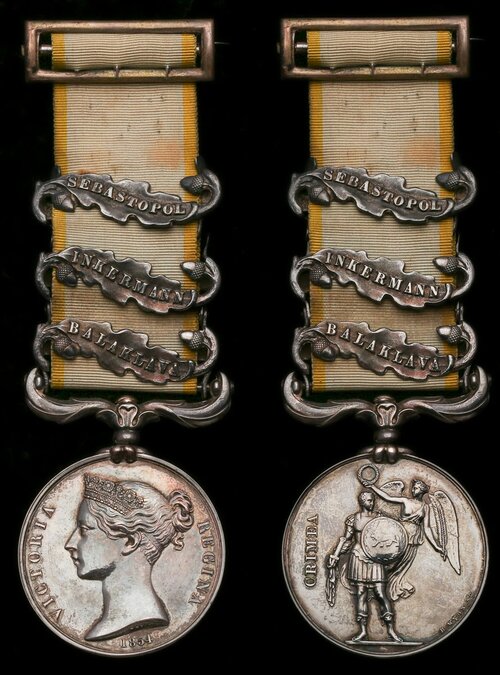
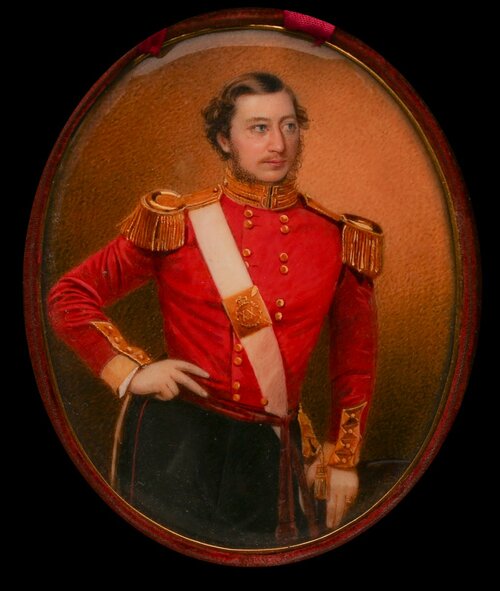
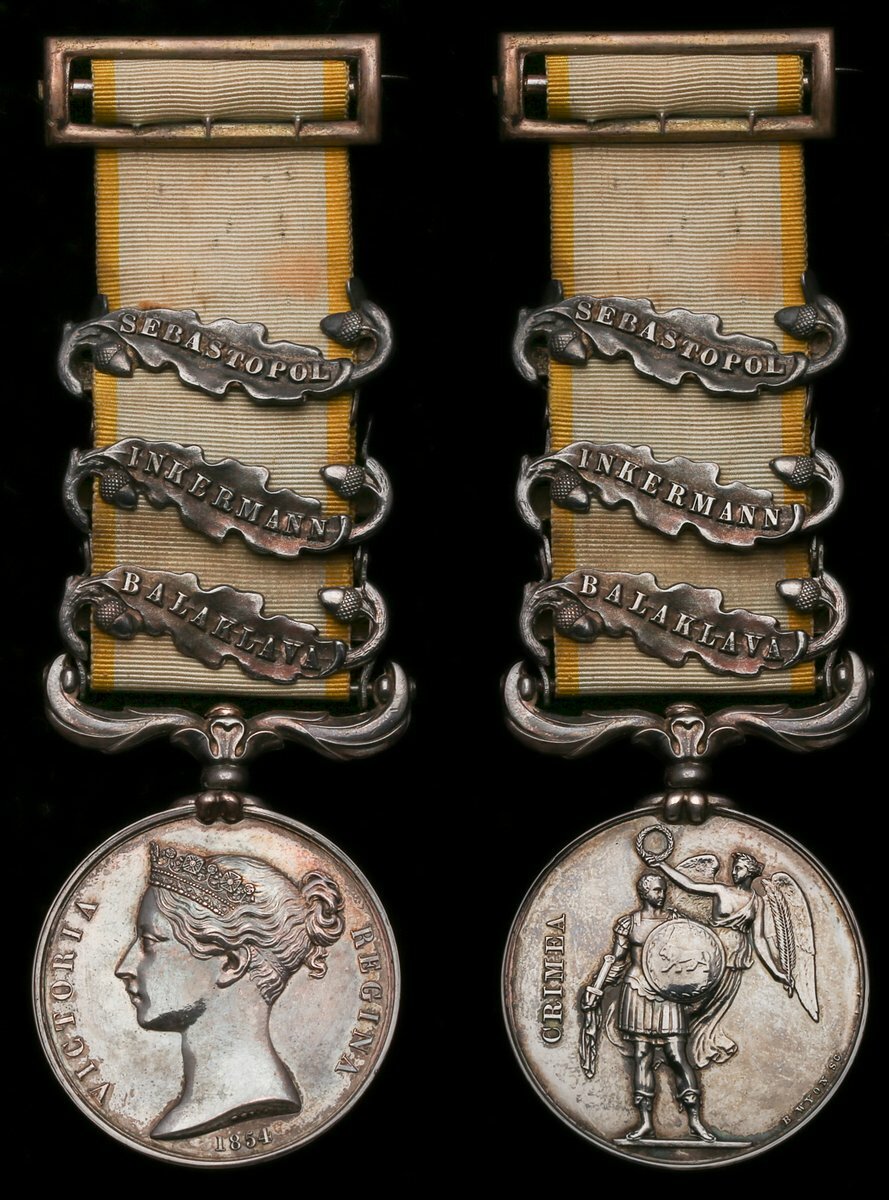
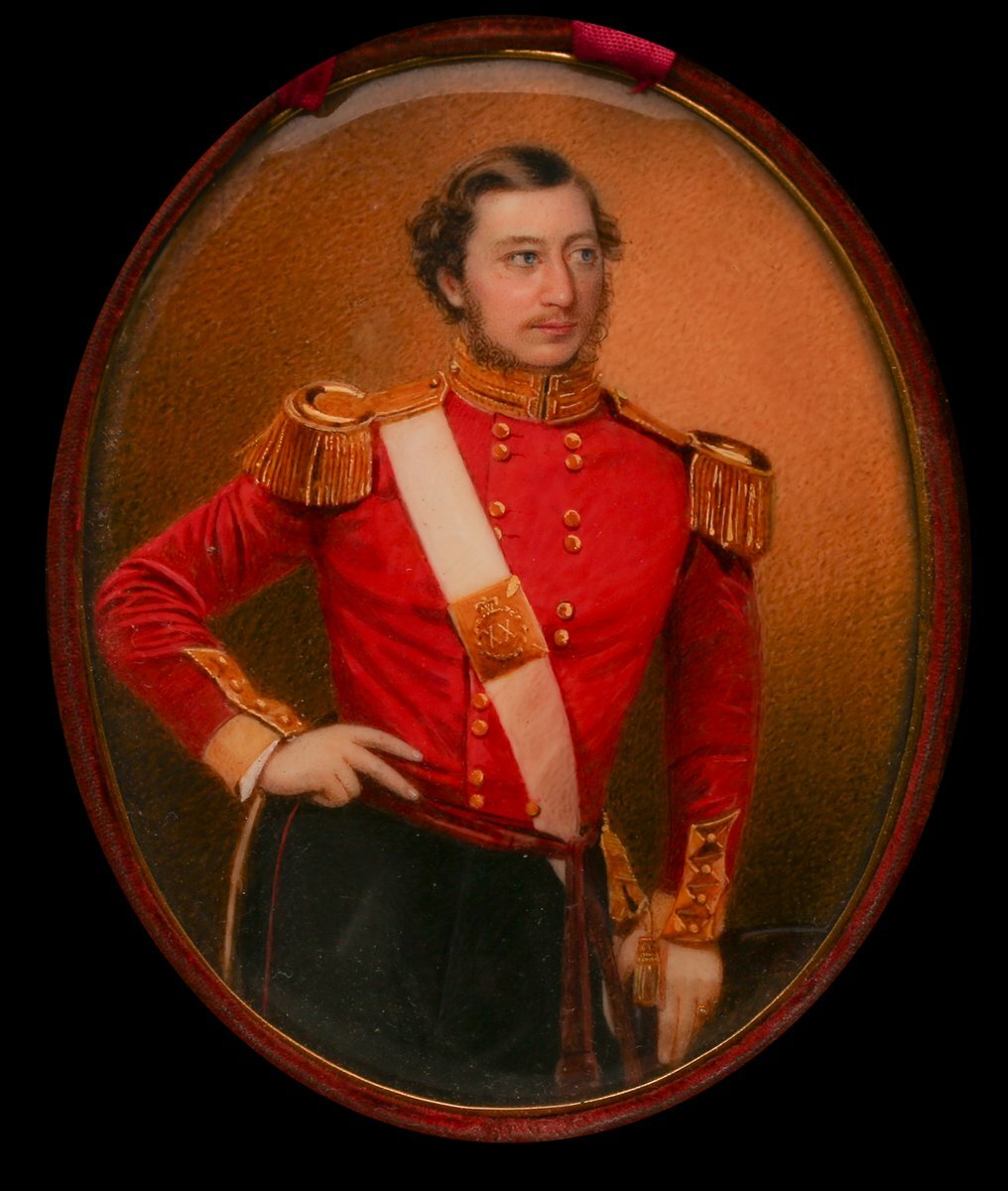
The outstanding Crimea Medal awarded to Lieutenant W. H. Dowling, 20th (East Devonshire) Regiment of Foot, killed in action in the famous Sandbag Battery during the Battle of Inkermann, the only officer casualty of the unit for the entirety of the Crimean War
Crimea 1854-56, 3 clasps, Balaklava, Inkermann, Sebastopol (Lieut. W. H. Dowling, 20th Foot), officially engraved by Hunt & Roskell, the last clasp loose on ribbon as issued, together with a fine portrait miniature of the recipient in uniform of the 20th Foot, believed to be painted by Sarah Carpenter, contained in an oval glazed frame, the reverse containing locks of his hair attractively set with his initials 'W.H.D.', last initial detached, the medal and portrait contained in a contemporary fitted case for display, and sold with an original newspaper cutting, the medal dark toned, extremely fine
William Henry Dowling was born in 1824, the third son of Captain Joseph Dowling, Barrack Master at St James's Barracks, London, who had fought at the battle of Waterloo and who had seen much service in the Peninsula, including the sanguinary battle of Albuhera. He joined his regiment in the Crimea on 22 September 1854, a couple of days after the battle of the Alma, in which the 20th had been in attendance, guarding the left flank of the attacking allied army but had not been brought into action.
The History of the XX Regiment notes that when the Battle of Inkermann began Dowling and another Lieutenant- Vaughan- were leading the detachments of the Regiment and engaged in different parts of the field to their main body. It states that as his men had been in the trenches all day they had been in camp when the action started, however at once many of them volunteered for duty, marching with Colonel Horn's wing to the front. However as the history states they were soon separated from Horn and 'worked their way up to the Sandbag Battery, there joining their own wing, which had entered the battle under Colonel Crofton'.
The unit arrived, filling the line next to the Coldstream Guard where they immediately found themselves under heavy attack. Dowling, finding the senior officers wounded called upon Colonel Cunynghame for orders, the old Colonel forming them up properly and sending them back onto the attack where they joined General Cathcart. This unit found themselves under attack by the Iakoutsk Regiment and soon surrounded by superior numbers.
The History of the XX Regiment takes up the story:
Still, if Russian narrators speak truly, there were some, at least, of our soldiery who cut their way out through the column. The Russians, indeed, seemed to have thought that the main body of their assailants succeed in cutting through. "At this moment," says General de Todleben, "confusion began in the ranks" (Cathcart's ranks), "but being quickly rallied, these rave troops made a supreme effort, and throwing themselves a way through the midst of our soldiers."
The gallant Dowling was shot through the head, as he led his small band of heroes to the charge. It is very gratifying to be able to confirm General De Todleben's statement, that some of the XX did cut their way through the Russian column.'
The following information was taken from the accompanying cutting, the origins of which are unknown:
'We deeply regret to observe in the list of killed at the battle of Inkermann, the name of Lieutenant W. Dowling of the 20th Regiment. This young officer will be remembered as having been resident here during last winter and summer, when he won the esteem of all who had the pleasure of his acquaintance by his kind and gentlemanly manner. Lieutenant Dowling left only in the month of May last to join his regiment, then about to embark for the East. In a letter written to his brother two days before he was killed, he said, 'If I survive, I will write to you directly after the action; but if not, know, my dearest brother, that I fell as I should, at the head of my company.' By the following extract from the letter of a fellow officer, dated Nov. 6, to Mr. Dowling's brother it will be seen that the gallant Lieutenant met his death where he most desired - 'You will see by the papers the day was a most fearful one. Your poor brother was killed while most gallantly leading and cheering on his company in a desperate charge. He was buried today within a few yards of Generals Cathcart and Goldie. His loss is most bitterly felt by every one in his regiment. It must be some satisfaction to you, though a sad one, to know how nobly he died. Poor William! he can have suffered little, for it was found that he had been shot through the head, and his death must have been almost instantaneous.'
Lieutenant Dowling is buried in the Cathcart Hill Cemetery, in the Crimea, where his grave is marked with a stone cross, bearing the inscription:
'sacred to the memory of
w. h. dowling esq.
lieut. xx regt.
who was killed at inkermann
5th november 1854'
Dowling was the only officer of the 20th (East Devonshire) Regiment killed at Inkermann and, indeed, throughout the whole war, although a good many were wounded. The Battalion's losses at Inkerman specifically amounted to 9 officers and 162 other ranks; sold together with copied research.
Subject to 20% VAT on Buyer’s Premium. For more information please view Terms and Conditions for Buyers.
Sold for
£2,200
Starting price
£1600
Watch, listen and bid as if you were in the room. Now available for auctions worldwide.
Click here to bid live
An exclusive and confidential service for the discerning collector or vendor.
View the Gallery
Download every Spink catalogue on your iPad, iPod or iPhone using free Spink app.
Download From iTunes© 2026 Spink & Son. All rights reserved.