
Auction: 26001 - Orders, Decorations and Medals
Lot: 45
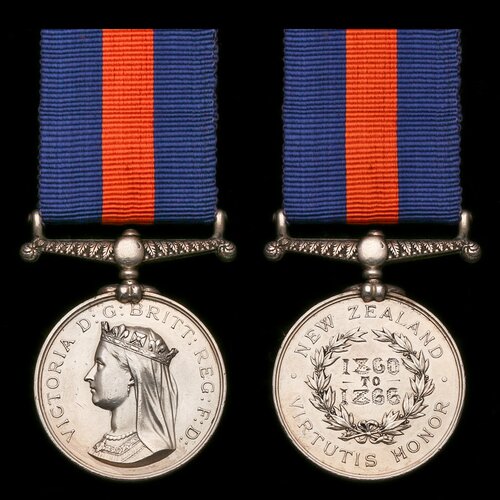
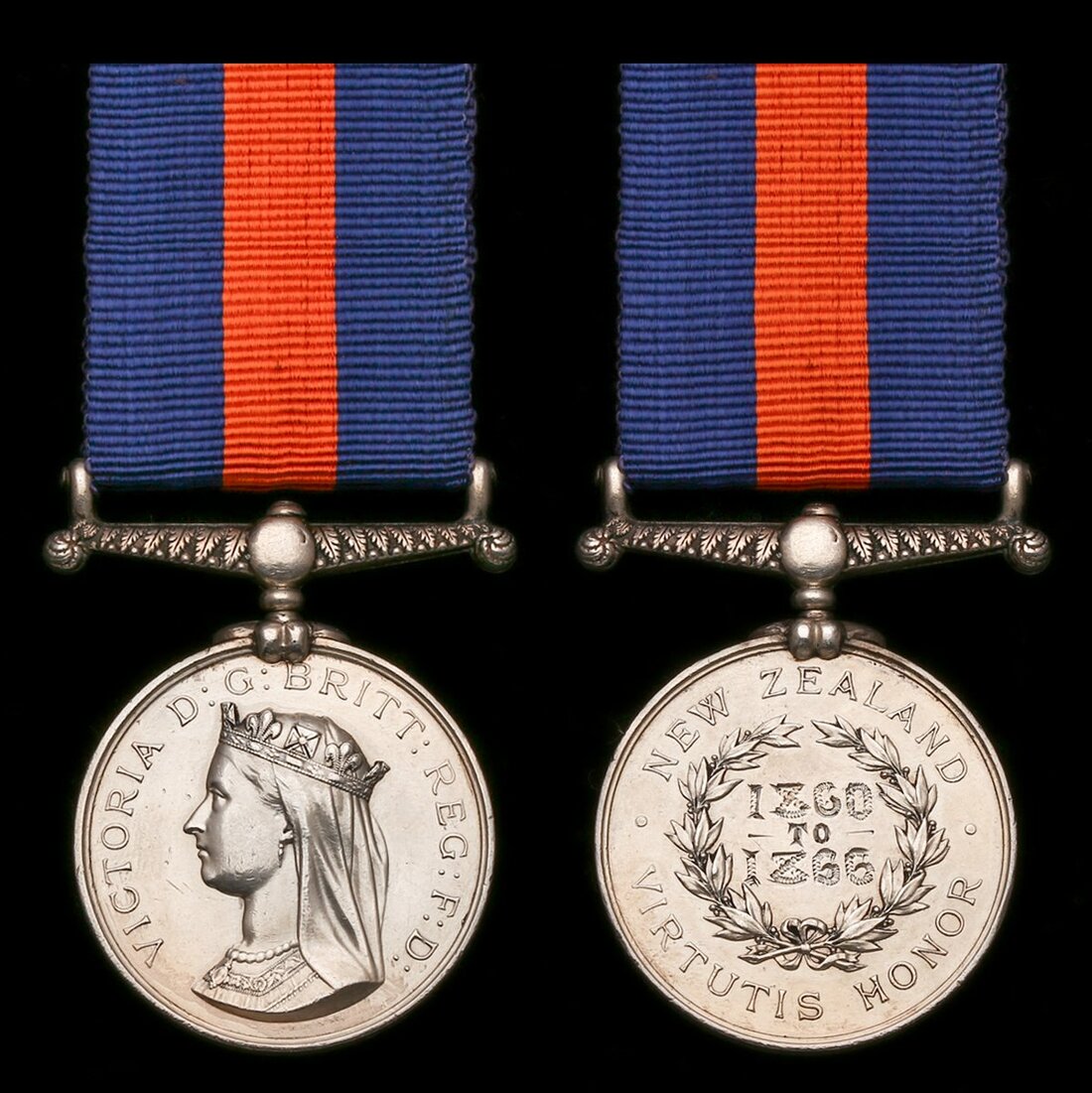
The New Zealand Medal awarded to Colonel J. Lawrence, 14th Regiment of Foot (West Yorkshire Regiment (Prince of Wales's Own)
New Zealand 1845-66, reverse undated and privately engraved '1860 to 1866' (Lieut. John Lawrence, 2nd Bn. 14th Foot), very fine
John Lawrence would have been embarked on 8 September 1860, when Headquarters and five companies of the 2nd Battalion, including Lawrence, proceeded by rail from Curragh to Cork and embarked aboard the Robert Lowe for New Zealand, arriving at Auckland on 29 November 1860. Over five hundred strong, their arrival was recorded in the Southern Cross newspaper the following day. The journey was a very pleasant and very speedy one, indeed in his 1924 book White Wings, author Sir Henry Brett wrote:
'She sailed from Cork on September 7 (sic) in charge of Captain Congalton, and crossed the equator after 21 days at sea. The meridian of the Cape was passed on November 2, and the vessel arrived after a voyage devoid of incident. She thus made her passage out in 82 days, 15 of which the ship was under steam. This was four days better than the previously unequalled record of the Spray of the Ocean, established the previous year, when she arrived in Auckland after a dashing passage of 86 days from Deal.'
On 4 January 1861, Major W. Douglas, in command of two companies of the 2nd Battalion consisting of seven officers, and 200 men, proceeded to Taranaki. It was here that the armed conflict over land ownership and sovereignty between the Maori and New Zealand Government was most pronounced, and it was here that the first shots had been fired almost a year earlier on 17 March 1860, when the Maori stockade fort was attacked by men of the 65th Foot and a number of seamen from H.M.S. Niger.
On 14 January, Major-General Thomas Pratt's force marched from Waitara towards Huirangi. They came under heavy fire from the Maoris who had manned their rifle pits and trenches between Kairau and Huirangi. For the 14th Regiment, it was the first of six significant engagements, including two attacks on the Redoubts at Huirangi, an engagement at Brooklands on 3 March, and two further engagements at Pratt's Long Sap at Te Arei.
A ceasefire was agreed on 19 March 1861, but not before the British had suffered approximately 50 killed and 130 wounded, together with further militia casualties. In December 1861, the 14th Foot moved to Pokeno where they began to construct a military road to Drury.
In late April 1863, the conflict was reignited, fuelled by lingering Maori resentment over land sales at Waitara, Government delays, a large scale land confiscation policy, and the rise of the Hauhau movement - which was strongly opposed to the alienation of Maori land and eager to strengthen Maori identity. On 17 July 1863, Lieutenant-Colonel C. W. Austin, in Command of the Koheroe Camp, attacked the Maori forces which were building in numbers and firing upon incoming reinforcements of the 12th and 70th Regiments; the 14th suffered three killed and eight wounded, whilst the Commanding Officer himself was wounded leading from the front.
At the Battle of Rangiriri, Austin's luck ran out when he died as a result of a gunshot to the thigh. The ball lodged and he soon died from blood loss. Five further men of the 14th were killed, the majority caught within a 'wonderful specimen' of earthwork engineering. With the Maori raising of a white flag, the men surveyed the narrow ditch killing zone through which only one man could advance at a time:
'Our best and bravest officers rushed at it; it was only to meet certain destruction. Capt. Mayne, Capt. Mercer, Lieut. Downes, Lieut. Alexander, Col. Austin, all tried it in vain.'
On 23 May 1864, the 14th marched to Otahuhu and then made their way to Napier. On 22 November the regiment moved from Napier to Auckland aboard H.M.S. Falcon, where they rejoined No. 7 Company under Brevet-Major Strange. For the 14th there would be further conflict at Waikoko, but eventually, on 15 October 1866, the men were pulled out and No's 3, 4 and 7 Companies embarked on the Siam for Hobart Town, Australia.
Lawrence latterly served as Colonel of the 1st Volunteer Battalion, Loyal North Lancashire Regiment and retired in late 1905.
Subject to 20% VAT on Buyer’s Premium. For more information please view Terms and Conditions for Buyers.
Sold for
£1,800
Starting price
£320
Sale 26001 Notices
"Further biographical information has since been located. Colonel Lawrence was born on 5 June 1837, latterly served with the Londonderry Artillery Militia and died in 1909. He was present in the field in the province of Taranaki 4 January-31 March 1861 and in the action at Koheroa on 17 July 1863 (WO76/313 refers)."

Watch, listen and bid as if you were in the room. Now available for auctions worldwide.
Click here to bid live
An exclusive and confidential service for the discerning collector or vendor.
View the Gallery
Download every Spink catalogue on your iPad, iPod or iPhone using free Spink app.
Download From iTunes© 2026 Spink & Son. All rights reserved.