
Auction: 26001 - Orders, Decorations and Medals
Lot: 10
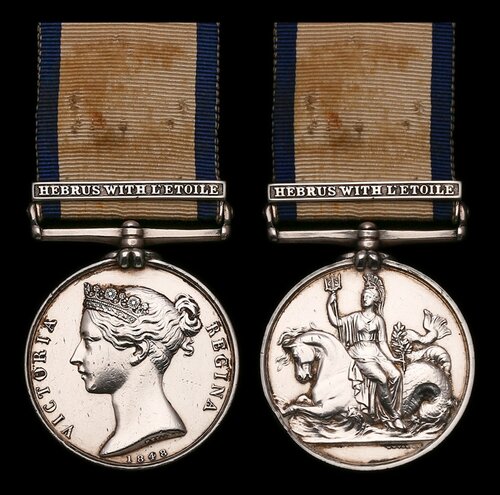
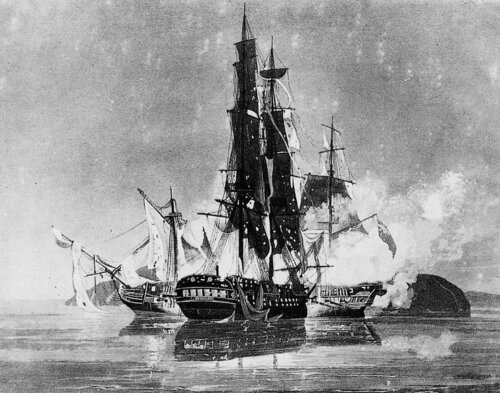
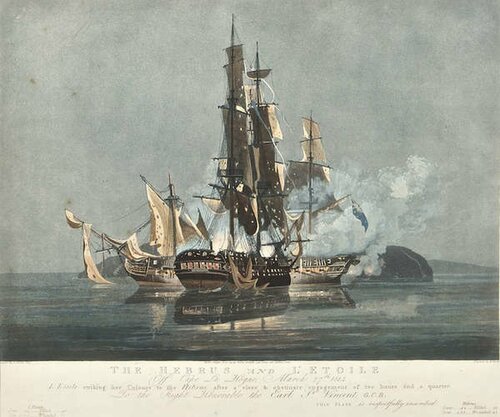
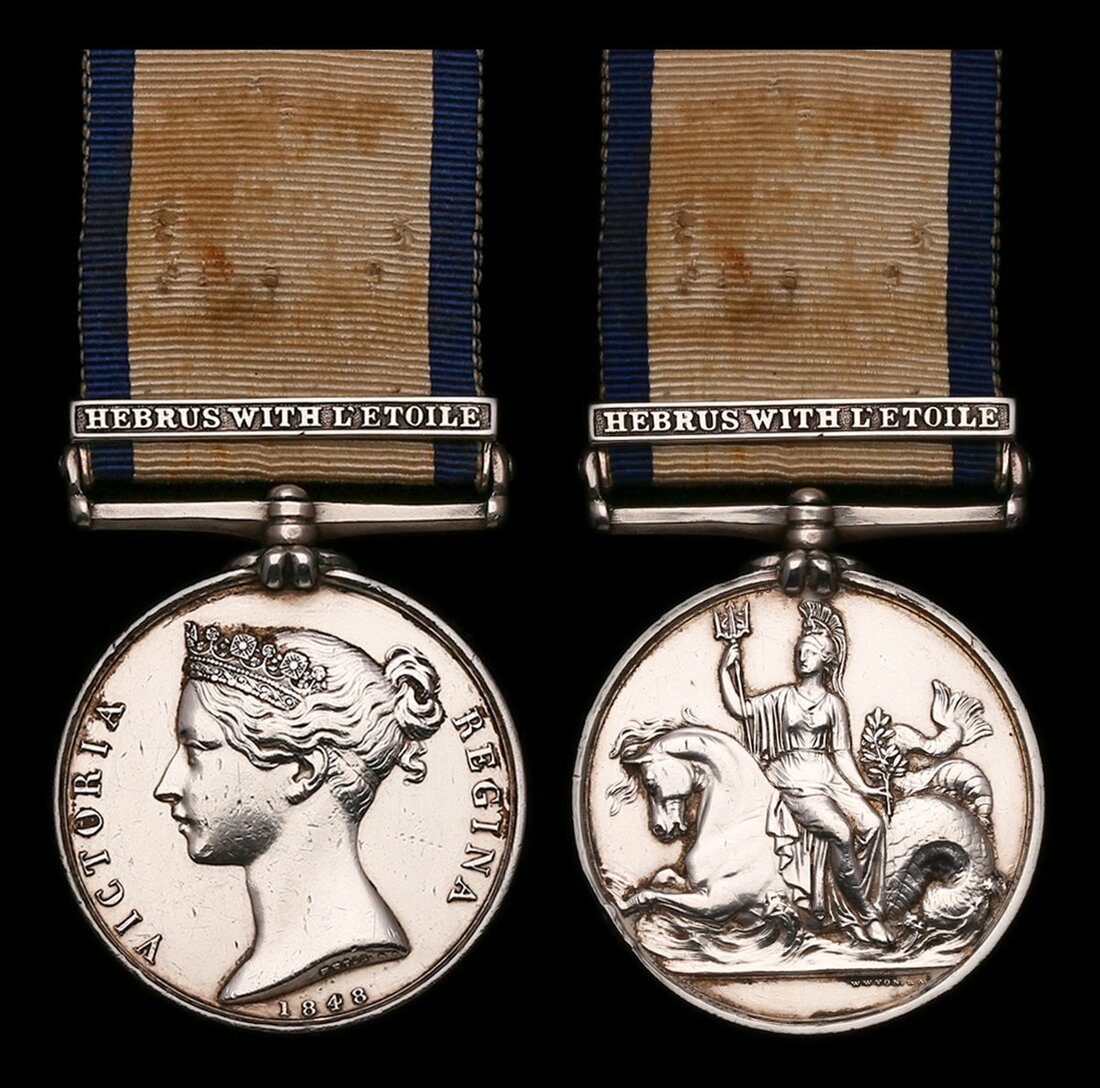
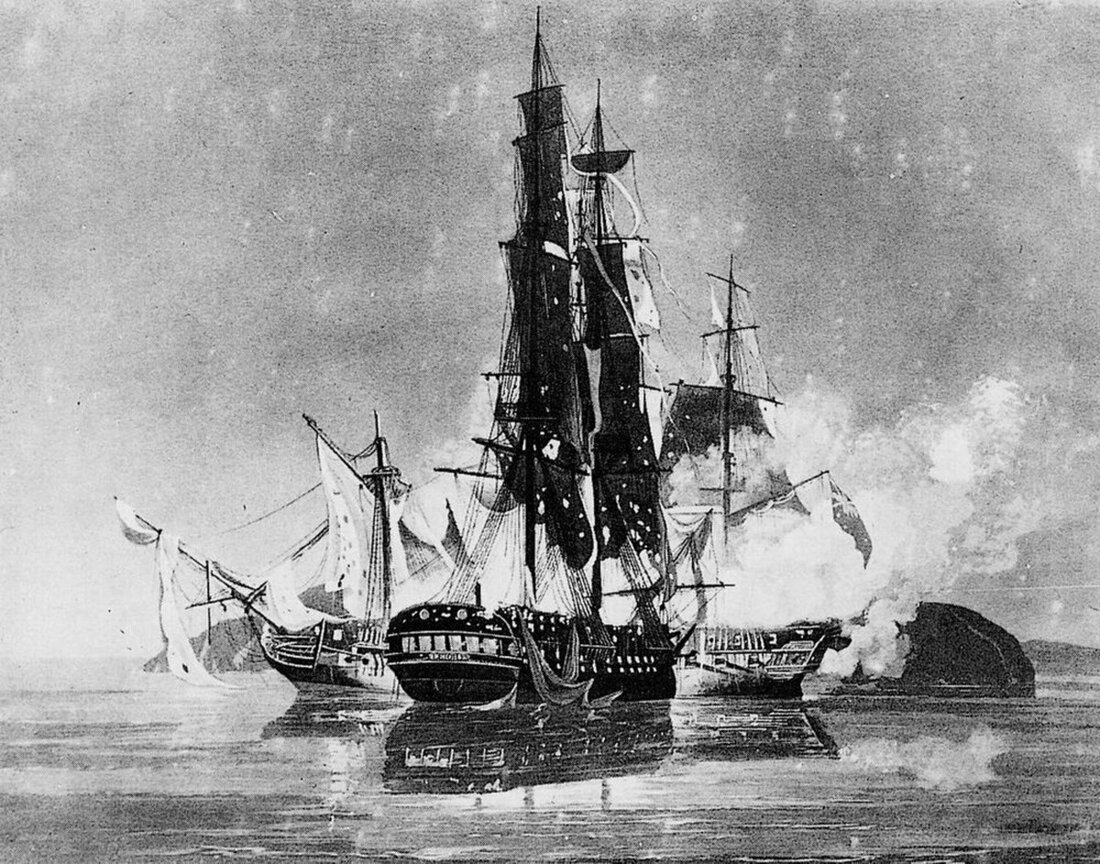
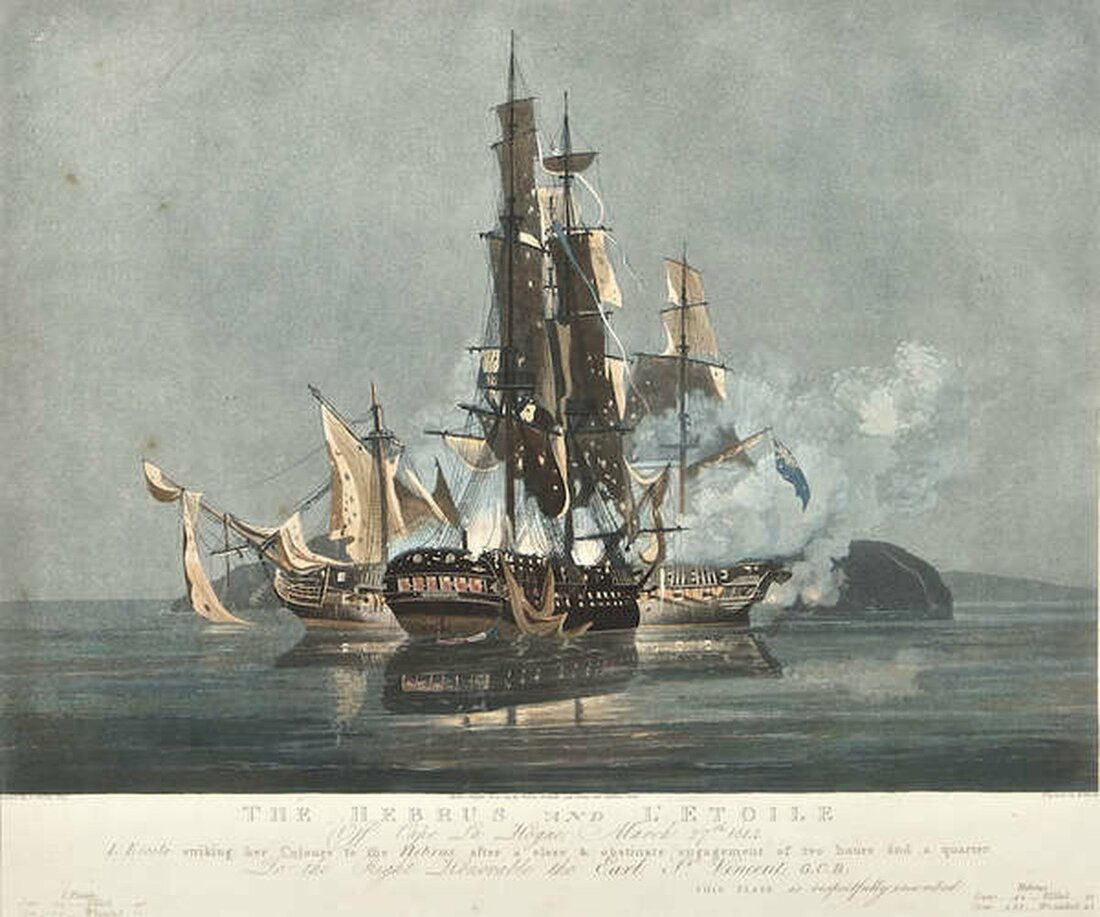
The Naval General Service Medal awarded to Paymaster J. Maddocks, Royal Navy, who was 'mentioned' for his gallant command of the Small Arms men on the Quarter-Deck of Hebrus at the capture of the French frigate L’Etoile in March 1814, an epic Gold Medal action
Probably also sharing in the expedition up the Patuxent River in August 1814, which resulted in the destruction of the Chesapeake Bay Flotilla, he was also present in the Revolutionnaire when she shared in the cutting-out of Greek pirate vessels in 1821; Maddocks even dared to nominate himself for a newly-instituted 'reward for valour' in 1856 for his previous gallant acts upon the creation of the Victoria Cross - he was duly notified that would not be possible due to V.C. not being '...granted for services before the present War'
Naval General Service 1793-1840, 1 clasp, Hebrus With L´Etoile (J. Maddocks. Purser.), edge bruise, very fine
Provenance:
Glendining's, November 1907, when the result of this Medal named 'Maddocks' was reported in The Times, selling for £9-13-0.
Spink, April 2009.
40 clasps were issued for this single-ship Gold Medal action, to Hebrus at the capture of the French frigate Etoile on 27 March 1814.
It is understood another Medal to this man, apparently named 'Maddock' and with the box of issue resides in a private collection.
John Maddocks/Maddock appears on the lists of the Clerks at Portsmouth Dockyard in the period until May 1806, when he joined the Saracen. Transferred to the Medusa the following year, he served aboard the Hebrus from 1813-15. He was the Purser when, on 27 March 1814, Captain Edmund Palmer in Hebrus brought the French frigate L’Etoile to action near Cape La Hogue, after a chase of 120 miles. The engagement lasted over two hours, when L’Etoile, her mizzen mast shot away and her hull much shattered under four feet of water, struck her colours. Of her crew of 320, 40 were killed and over 70 wounded, many of whom later died. The Hebrus lost her fore topmast and fore yard, and all her masts were shot through, but her killed and wounded were altogether less than 40. The action was fought within range of a shore battery, which, on the surrender of L’Etoile opened a heavy fire on her conqueror. Captain Palmer brought his prize into Plymouth Sound on 29 March, and declined the honour of a knighthood which was offered to him as a reward for his services. He did, however, receive the Small Naval Gold Medal for the action. Hebrus was subsequently transferred to serve in North America, where she participated in the expedition up the Patuxent River in August 1814, which resulted in the destruction of the Chesapeake Bay Flotilla, presumably with Maddocks still present.
A letter from Palmer to Sir Michael Seymour, Bt., he further brings praise for the exact actions shown by Maddocks on that famous day:
'Sir,– When the Hannibal and H.M. ship under my command separated on the morning of the 26th, in chase of the two French frigates we had fallen in with” (off the Isle de Bas), “we continued in pursuit of the one you were pleased to detach us after, the whole day, with all our canvas spread. About midnight she reached the Race of Alderney, and the wind scanting, we began to gain upon her fast; by the time she had run the length of Point Jobourg, leading into the bay of la Hague, she was obliged to attempt rounding it almost within the wash of the breakers; and here, after an anxious chase of 15 hours, and running him upwards of 120 miles, we were fortunate enough, between one and two A.M., to bring the enemy to battle; we crossed his stern, our jib-boom passing over his taffrail, and shot in between him and the shore, in eight fathoms water; and it falling nearly calm about this time, the ships continued nearly in the same spot until the conclusion of the action. At its commencement we suffered severely in our rigging; the enemy firing high, he shot away our fore-topmast and fore-yard, crippled our main-mast and bowsprit, and cutaway almost every shroud, stay, and brace we had. Our fire from the first, and throughout, was directed at our opponent’s hull; and the ships being as close together as they could be without touching, he suffered most severely, every shot which struck passing through him. About four o’clock his mizzen-mast fell by the board, and his fire ceased; when, after an obstinate contest of two hours and a quarter, he hailed us, to say that he had struck his colours. The moment we could get possession, it became necessary to put the heads of both ships off shore, as well from the apprehension oi grounding, as to get them clear from a battery which had been firing at both of us during the whole action, those on shore not being able from the darkness to distinguish one from the other; fortunately the tide set us round the point, and we anchored soon afterwards in Vauville bay, in order to secure our masts as well as we were able.
The prize proves to be l’Etoile French frigate, mounting 44 guns (28 eighteen-pounders on the main-deck, and the remainder carronades), with a complement of 320 men; she was commanded by Mons. Henri Pierre Philibert, Capitaine de frigate, who was returning, together with la Sultane the other frigate, from a four months’ cruise to the westward.
L’Etoile is a very fine ship, quite new, and sails well; she had 40 killed and upwards of 70 wounded; her remaining masts are shot through, and her hull is extremely shattered; she had four feet water in her hold at the time she surrendered. We are also a good deal cut up, several of our guns dismounted, and I have to regret the loss of some brave men, 13 killed, and 25 wounded, some of them, I fear, dangerously. Amongst the former was a most promising young gentleman, Mr. P. A. Crawley, who fell early in the action.
I cannot. Sir, sufficiently express to you how much I have to admire in the conduct of every one whom I had the pleasure to command upon this occasion. I beg most earnestly to recommend Mr. Robert Milborne Jackson, the senior Lieutenant; as also to give my best testimony to the exertions of the junior Lieutenants (Messrs. George Addis and Horatio Bennet Cock), together with Lieutenants Griffiths and M‘Laughlin, of the marines. To Mr. M‘Gowan, the Master, I am much indebted, for the skill and care with which he conducted the steerage of the ship, during a period of much difficulty and peril.
Mr. Maddocks, the Purser, very handsomely volunteered his attendance on deck, where he rendered good service.
I cannot close this letter without observing, that I derived the greatest assistance from the professional ability of Captain William Sargent, R.N., who was serving on board with me as volunteer; and I notice with great pleasure the care and attention of Mr. Boyter, Surgeon, not only towards our own men, but to those of the enemy also, I have the honor to be. [SIGNED]'
The article In Port After Action also gives further excellent details. Having originally stated Maddocks as amongst those killed in action, a note states:
'Note.—As my gallant friend, John Maddocks, the Purser, not only disdained to go below, but actually commanded the Small-Arm men on the Quarter-Deck, it would be unfair not to state in this place that his noble conduct elicited the warmest praise of our Captain and officers; as did also that of my two messmates, Ben. Andrews (who commanded the guns on the forecastle at a period of the greatest danger), and young Michael Turner, who, just about my own age, was quartered at the after carronades.
At the close of the article " In Port after Action," which appeared in our Magazine for last month, by an accidental error of the press Mr. John Maddocks (formerly Purser of the Hebrus) is classed with those who have "gone to that bourne from whence no traveller returns ;" but we are happy to state that this officer is still in the land of the living.'
Serving in the Revolutionnaire from 1818-21, it is assumed he shared in her part in the actions which led to the independence of Greece from the Ottoman Empire. In May 1821, the barge and pinnace of her led a cutting-out of pirate ships at Patras, with Maddocks perhaps again in the action. He was Secretary to Rear-Admiral Ross by 1837, Maddocks still remained on the Navy List by 1867. In that period he had also made an application for a newly-instituted reward of valour, putting his name forward for the Victoria Cross. He was thus informed that the V.C. '...cannot be granted for services before the present [Crimean?] War.'
Subject to 20% VAT on Buyer’s Premium. For more information please view Terms and Conditions for Buyers.
Sold for
£4,600
Starting price
£4500

Watch, listen and bid as if you were in the room. Now available for auctions worldwide.
Click here to bid live
An exclusive and confidential service for the discerning collector or vendor.
View the Gallery
Download every Spink catalogue on your iPad, iPod or iPhone using free Spink app.
Download From iTunes© 2026 Spink & Son. All rights reserved.