
Auction: 23113 - Orders, Decorations and Medals - e-Auction
Lot: 321
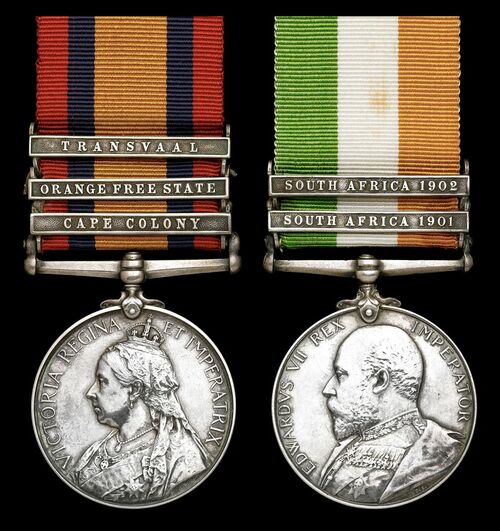
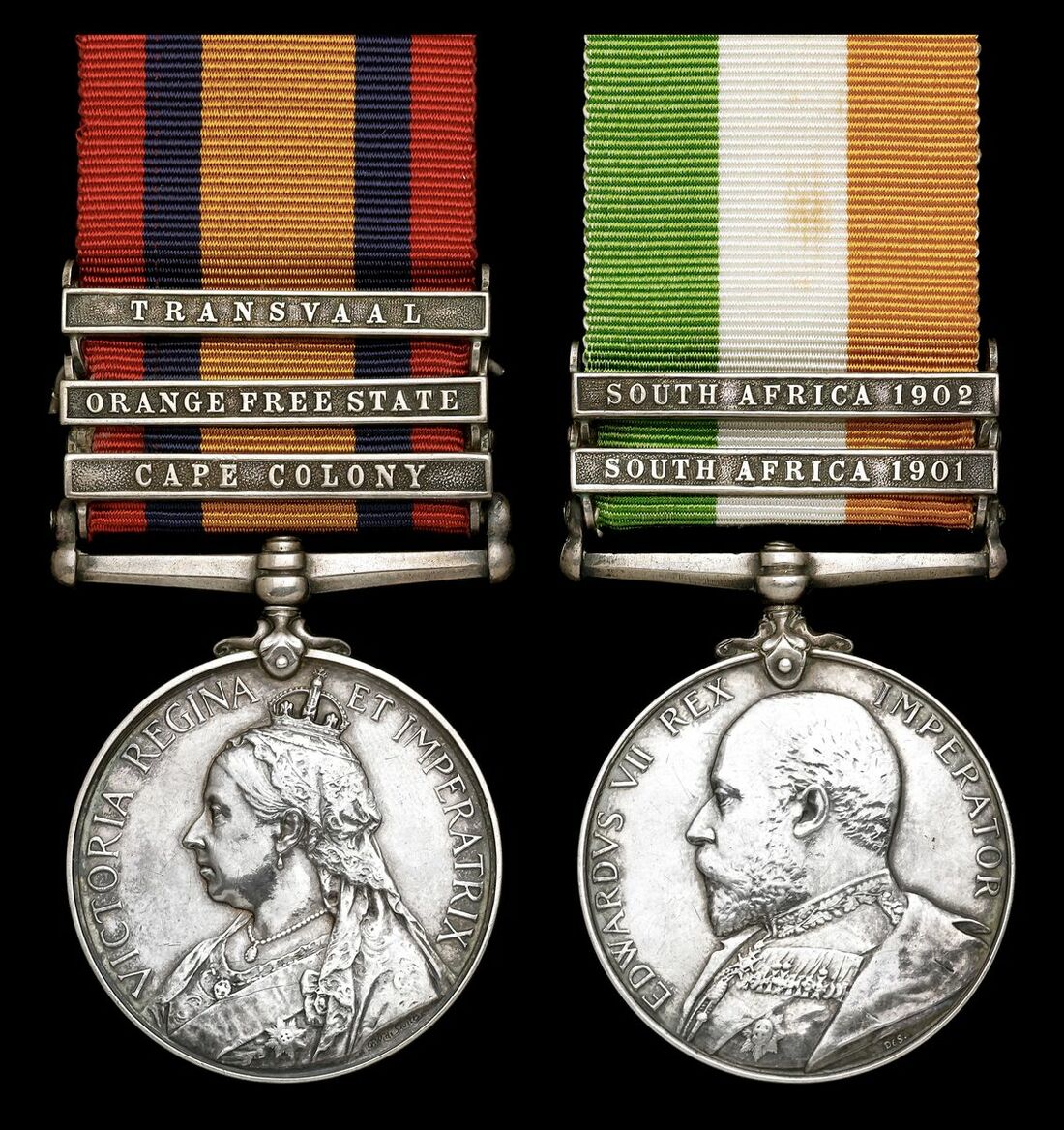
A 'Battle of Biddulphsberg' pair awarded to Private J. Lowther, Scots Guards, who was seriously wounded during the action on 29 May 1900
Queen's South Africa 1899-1902, 3 clasps, Cape Colony, Orange Free State, Transvaal (8379. Pte. J. Lowther. Scots. Gds.), the final clasp mounted unofficially by a pin; King's South Africa 1901-1902, 2 clasps, South Africa 1901, South Africa 1902 (8379 Pte. J. Lowther. Scots Guards.), good very fine (2)
21 men of the Scots Guards wounded at Biddulphsberg.
Jeremiah Lowther was born at Tadcaster, Yorkshire on 9 April 1871, the son of John and Hannah Lowther. Working as a Labourer prior to enlisting at Bradford on 17 September 1889 with the Scots Guards, his attestation papers note previous service with the 2nd West Yorkshire Artillery Volunteers. He was to be at home until 16 September 1896 when he joined the Army Reserve.
That was not to be the end of Lowther's military career however, and he re-joined the colours on 13 November 1899. Entering the war in South Africa on 3 January 1900 with the 2nd Battalion Scots Guards, this unit joined the 8th Division under General Rundle and soon found themselves in the vicinity of the Senekal and the Biddulphsberg Kopje.
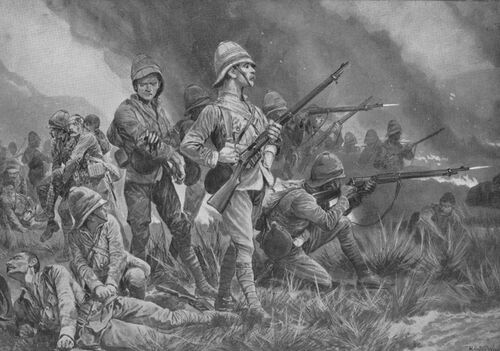
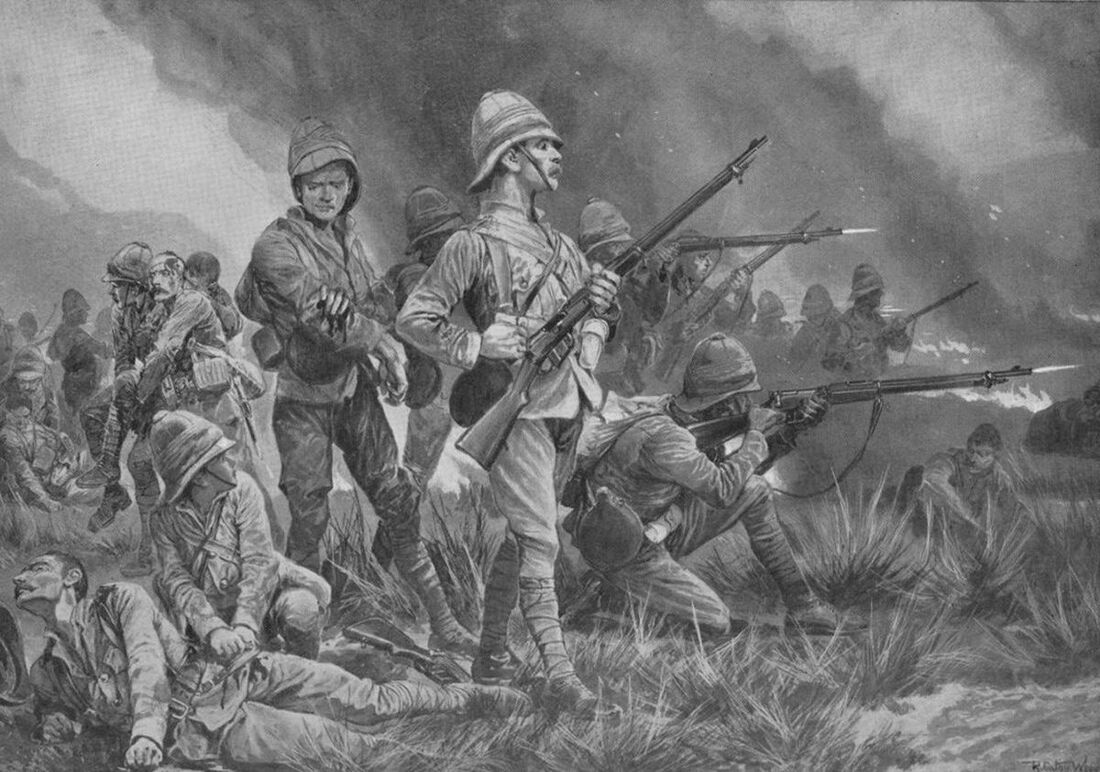
Here they clashed with a Boer Commando under General De Villiers; a sharp skirmish on 25 May 1900 saw a number of British casualties and General Rundle responded by advancing on the Boer positions at Biddulphsberg, where a major action developed with the Grenadier Guards taking the brunt of the enemy fire. During the attack the dried grass was set alight and a number of British casualties were horrifically burned to death. An eyewitness account in The Weekly Mail, 30 June 1900, describes the scene stating:
'The scene on the battlefield at this moment was one of the most awful description. The battle had now fully developed. From the front, where the Grenadiers had disappeared in the smoke, the crackle of rifles was deafening, and the bullets, fired too high by the Boers, fizzed—the word best describes the sound—past us incessantly. Ten guns on our side and two on the Boers' added their roar, the bursting of shells and the demoniac scream of shrapnel made up a perfect pandemonium of sound. Over all, and dominating all, was the dreadful popping crackle of the flames from the burning grass, while the smoke hid everything. Biddulph's Berg, the Boer guns, our own guns, the Grenadiers, and the Scots Guards, who had moved up in support of them, had all vanished. One saw nothing but vast rolling billows of thick blue-white smoke, rearing themselves far over the tops of the hills. Out of this great pall that hung over the battlefield came the dreadful din, and from under its edge crept stricken and bleeding figures, groping along in the semi-darkness, or staggering feebly, supported between blackened and dishevelled comrades, towards the busy doctors at the rear. It was bewildering, it was terrifying, it was horrifying.'
Lowther is listed as severely wounded during the battle, making him one of 21 for his Battalion. He was doubtless lucky that the Grenadiers rather, than the Scot's were the focus of Boer fire; he was further lucky that the bushfire raging on the hill did not claim him like so many others. Despite his wound listed as severe, he was able to recover and keep serving without being invalided. Lowther left South Africa on 4 August 1902, arriving in Britain at the end of the month and was discharged soon afterwards.
Despite his injuries he lived a long life - being listed as a Railway Goods Checker on both 1911 and 1939 censuses. Lowther died on 23 January 1951 at Lower Agbrigg, Yorkshire West Riding.
Subject to 20% VAT on Buyer’s Premium. For more information please view Terms and Conditions for Buyers.
Sold for
£350
Starting price
£110
Watch, listen and bid as if you were in the room. Now available for auctions worldwide.
Click here to bid live
An exclusive and confidential service for the discerning collector or vendor.
View the Gallery
Download every Spink catalogue on your iPad, iPod or iPhone using free Spink app.
Download From iTunes© 2026 Spink & Son. All rights reserved.