
Auction: SW1012 - Bonds & Shares Certificates of the World
Lot: 121
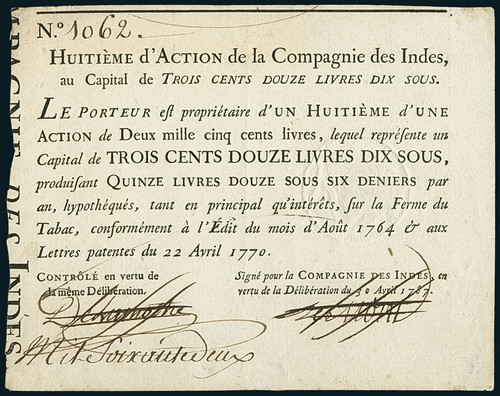
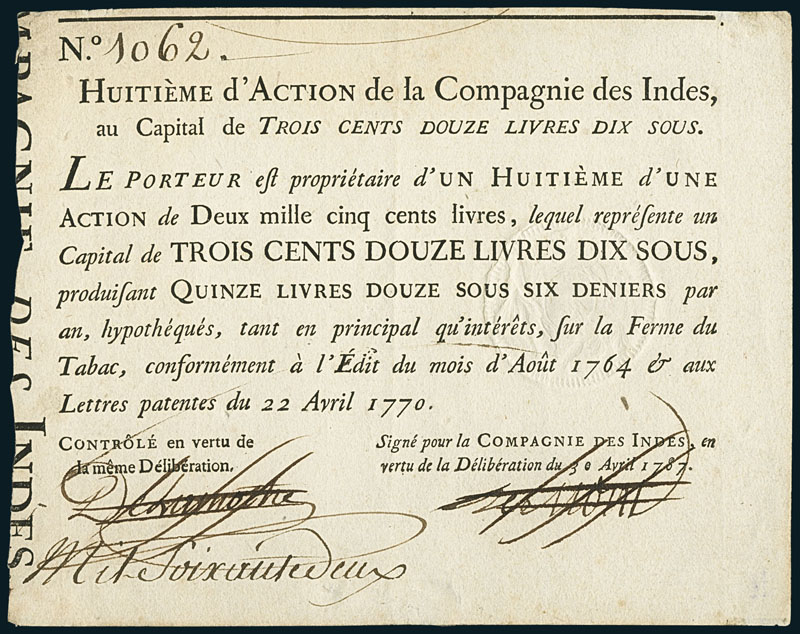
Compagnie des Indes. 1/8 Share of the capital 312 Livres 10 Sous, 30 Avril 1787. Nr. 1062. One invisible tear below. Probably one of the most important companies in financial history: The first French East India Company or Compagnie française pour le commerce des Indes orientales was a commercial enterprise, founded in 1664 to compete with the British and Dutch East India companies in the East Indies. Planned by Jean-Baptiste Colbert, it was chartered by King Louis XIV for trading in the Eastern Hemisphere. It resulted from the fusion of three earlier companies, the 1660 Compagnie de Chine, the Compagnie d'Orient and Compagnie de Madagascar. The Compagnie des Indes Orientales was granted a 50-year monopoly on French trade in the Indian and Pacific Oceans, a region stretching from the Cape of Good Hope to the Straits of Magellan. The French monarch also granted the Company a concession in perpetuity for the island of Madagascar, as well as any other territories it could conquer. The Company failed to found a successful colony on Madagascar, but was able to establish ports on the nearby islands of Bourbon and Île-de-France (today's Réunion and Mauritius). By 1719, it had established itself in India. John Law & the Mississippi-Bubble: The Compagnie was in the centre of the famous Mississippi-Bubble when, in 1719, John Law of Lauriston merged the Compagnie des Indes Orientales and the Compagnie du Mississippi and other French trading companies into Compagnie (Perpetuelle) des Indes with a monopoly of commerce on all seas. This sparked off one of the earliest and most famous economic bubbles in human history. The French government allowed John Law to issue 50'000 new shares at 500 Livres with just 75 Livres down and the rest due in nineteen additional monthly payments of 25 Livres each. The share price skyrocketed from 1'000 to 15'000 Livres per share. It was the time that the word millionaire was created. When the bubble burst at the end of 1720, France found itself in a deep financial and economic crisis. Law had fled for Venice. The Compagnie des Indes, however, resumed its operating independence in 1723. With the decline of the Indian Mughal Empire, the French decided to intervene in Indian political affairs to protect their own interests, notably by forging alliances with local rulers in south India. From 1741, the French, under Joseph François Dupleix, pursued an aggressive policy against both the Indians and the British until they were ultimately defeated by Robert Clive. Several Indian trading ports, including Pondichéry and Chandernagore, remained under French control until 1954. The Companie des Indes dissolved in 1769, about 20 years before the French Revolution. King Louis XVI issued a 1769 edict that required the company to transfer all its properties, assets and rights (which were valued at 30 million Livres) to the state. The King agreed to pay all of the Company’s debts and obligations, though holders of Company stock and notes received only an estimated 15 percent of the face value of their investments by the end of corporate liquidation in 1790. The company was re-established in 1785. It was given monopoly on all trade with countries beyond the Cape of Good Hope for a period of seven years. This new agreement did, however, fail to anticipate the French Revolution. Five years later, on 3 April 1790, the monopoly was abolished by an act of the new French Assembly, which enthusiastically declared that the lucrative Far Eastern trade would henceforth be "thrown open to all Frenchmen". The Compagnie des Indes fell into decline and was finally liquidated in 1794. Liquidation scandal: As the company was heading toward its end, it became embroiled once more and this time in its most infamous scandal. On 24 August 1793, the revolutionary Committee of Public Safety had banned all joint-stock companies. It specifically seized the assets and papers of the Compagnie des Indes. While its liquidation proceedings were being set up, directors of the company bribed various senior state officials to allow the company to carry out its own liquidation, rather than be supervised by the revolutionary government. When this became known the following year, the resulting scandal brought down many key figures in the French Revolution, such as Georges Danton and many other members of the Montagne (a political group during the French Revolution that, together with the Jacobins, unleashed the Reign of Terror in 1794). (Sources: Wikipedia & Federal Reserve Bank of New York). This certificate represents a one-eighth of a share of 2’500 Livres. The dividends are secured by the customs income of the tobacco-monopoly. This certificate is one of the few existing shares of this famous company. This is the only one-eighth share certificate we know of. It is in a remarkably good condition. Shares of the Compagnie des Indes are of highest rarity in Scripophily. VF.
Sold for
SFr16,000

Watch, listen and bid as if you were in the room. Now available for auctions worldwide.
Click here to bid live
An exclusive and confidential service for the discerning collector or vendor.
View the Gallery
Download every Spink catalogue on your iPad, iPod or iPhone using free Spink app.
Download From iTunes© 2026 Spink & Son. All rights reserved.