
Auction: 7022 - Orders, Decorations, Medals & Militaria
Lot: 92
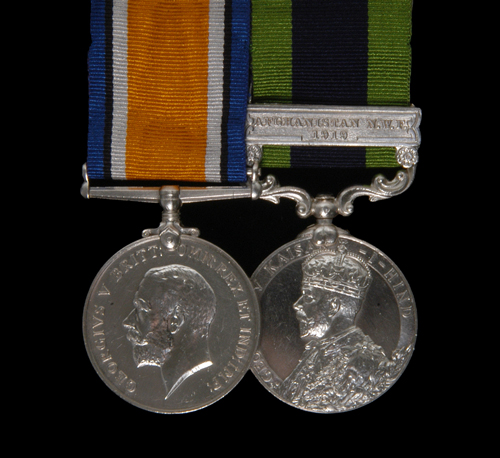
An Unusual India General Service Pair to Lieutenant E.J.A. Bryant, 40th Pathans, Who Led the Action at Chabb, Where, Had It Been a Regular Military Operation, He Would Undoubtedly Have Been Decorated For His Gallant Bravery British War Medal (2. Lieut. E.J.A. Bryant.); India General Service 1908-35, G.V.R., 1st ´Kaisar-i-Hind´ type, Calcutta Mint issue, one clasp, Afghanistan N.W.F. 1919 (Lieut. E.J.A. Bryant. 40 Pathans.), extremely fine (2) Estimate £ 220-250 Lieutenant Eric John Aldous Bryant, born July 1899; Commissioned Second Lieutenant, 3rd Battalion, The Welch Regiment, 24.4.1918; transferred 40th Pathans, Indian Army, 17.10.1918; Promoted Lieutenant, 24.4.1919. The Action at Chabb ´In April 1919 the 40th Pathans were involved in the arrest of a few outlaws, which involved a certain amount of fighting in which the Regiment was ultimately involved. The arrest of a gang, which had been terrorising the Attock district for nearly two years, had been the object of the Police. The gang was formed in June 1917, when three Saiyids of the Saiyid village of Jabbi Shah Dilawar, in the jurisdiction of Tammam Police Station, absconded after murdering the two sons of their inveterate enemy, the illaqadar, also a Saiyid. They then made their way across the Indus to Independent Territory, with one servant, under the leadership of one Lal Shah, an ex-police constable and a burly ruffian of the most blood-thirsty type, whose violence eventually drove two of his companions to leave him. Altogether they were responsible for five murders, five looted villages, and three abductions of women. Their refuge in Independent Territory secured for them an immunity which reacted in a most undesirable way on the rest of the Attock District. Eventually they were traced to the banks of the Sohan River in the Rawal Pindi district. The Police had already arrived, and it was at this point that the 40th Pathans were called upon. The Battalion was entrained with great secrecy at night for Chabb on the Campbellpur-Mianwali line, accompanied by Mr. Montague Butler, Deputy Commissioner of Campbellpur. But on arrival there, as it was found that touch with the outlaws had been lost, the Battalion, less one company under Major Hill which remained in Chabb and the surrounding villages, withdrew to Campbellpur, after, however, having scoured the District in widely extended order on more than one occasion. Major Hill had orders to continue the search, and after some days a patrol under Lieutenant Bryant went out to investigate some tracks which had been reported by a villager. The tracks led to a cliff some 70 feet high abutting on the bank of the Sohan River near Jabbi. Thirty feet up the cliff the entrance to a cave was discernible. Lieutenant Bryant, having procured some ladders, proceeded to investigate, but as he reached the top fire was opened from the cave, one bullet penetrating his cheek. Bryant sent back to Hill, who, calling in his men from the surrounding villages, brought up the remainder of the Company. But before the latter´s arrival a naik of the 40th, a police constable, and a villager had been seriously wounded. That night too, an additional force with Lewis guns had been summoned from Campbellpur, and reached Chabb on 5th April. On that day it was obvious that the outlaws were cornered. They had chosen their position with considerable skill for a role of passive defence. The cliff was of friable sandstone, and it overhung so as to enable the garrison of the cave to draw water from the river which ran about two feet deep just under the cliff. No one could get at the cave either from above or below without coming under the outlaws´ fire. The only defect was that egress was nearly impossible, once the cave had been located as their stronghold. Their only hope was rain in the hills or a dust storm, either of which happenings might have made an escape by night worth trying. The weather, as a matter of fact, was sultry and suggested rain, so much so that atmospheric conditions on the night of April 5th-6th made lamp signalling impossible. However, during the 5th and 6th efforts were made to reduce the outlaws by rifle and Lewis gun fire, but with no effect. The whole difficulty in reducing the enemy consisted in the fact that their refuge contained a right-angled turn which, of course, afforded them shelter from the Company´s fire. In response, therefore, to a wire to Peshawar, a gun and 150 lbs. of high explosives with a party of the 7th Sappers and Miners under Lieutenant Whitehead, M.C., R.E. arrived. The gun, however, was not sent. A parley then ensued with the outlaws, but came to nothing, the latter in the end saying that they would prefer to die, incidentally condemning the women they had with them to the same fate. There was, therefore, nothing for it but to attempt extreme measures, and the women would have to take their chance with the men. Lieutenant Whitehead thereupon decided to try to fix a charge of 8 lbs. of high explosives as near the mouth of the cave as he could get. He was let down the side of the cliff by a country rope and fired the charge as soon as it was possible, but with little effect. He was shot at by the outlaws during the process, but the covering fire from the opposite side of the river prevented them taking a proper aim. The whole countryside was out on points of vantage and the Sohan gorge rang with the unusual sounds of battle! It was about 6 p.m. that Lieutenant Whitehead again let down a second charge of 38 lbs. of high explosives. This did the trick, exploding exactly opposite the mouth of the cave and bringing away a large piece of the cliff, with the result that even the nerves of the leader, Lal Shah, could stand no more. After the dust and smoke had subsided, from which the rope, holding the explosive charge, was seen fantastically emerging, Lal Shah was observed hastily scrambling down a second rope thrown down to him from above, while the other two outlaws, Sher Shah and Aulia, were lying unconscious inside the cave. Their arms had meanwhile been thrown into the river below. The women were found unhurt except for sundry singeings and were restored to their parents. The two unconscious outlaws, having been revived, were taken into Jabbi with their leader Lal Shah, and were subsequently hanged. The names of Lieutenant Bryant, 40th Pathans, and Lieutenant Whitehead, M.C., Royal Engineers, were brought to the notice of the General Officer Commanding Northern Army, and there is little doubt that the conduct of both these Officers, had it taken place during the course of regular military operations, would have earned a further reward. The thanks of the Punjab Government were conveyed to all the troops concerned.´ (History of the 5th Batt. (Pathans), 14th Punjab Regt. [late 40th Pathans] refers).
Sold for
£320


Watch, listen and bid as if you were in the room. Now available for auctions worldwide.
Click here to bid live
An exclusive and confidential service for the discerning collector or vendor.
View the Gallery
Download every Spink catalogue on your iPad, iPod or iPhone using free Spink app.
Download From iTunes© 2026 Spink & Son. All rights reserved.