
Auction: 7022 - Orders, Decorations, Medals & Militaria
Lot: 1058
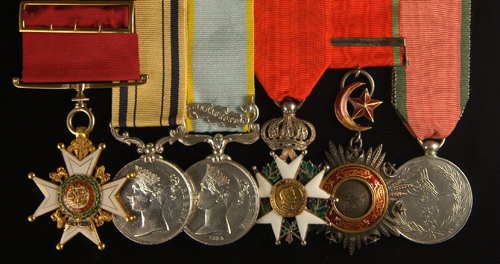
A Crimea C.B. Group of Six to Colonel H.C.C. Owen, Royal Engineers, Who Lost a Leg as a Result of a Wound Received in the Trenches in Front of the Redan, Sebastopol, 19.4.1855 a) The Most Honourable Order of the Bath, Military Division, Companion´s (C.B.) breast Badge, gold (indistinct Hallmarks for London) and enamel, 1st 1815 wide suspension type, with swivel ring, maker´s initials ´IN´ on suspension loop, with its integral gold riband buckle b) South Africa 1834-53 (2nd Capt. H.C.C. Owen, Rl. Engrs.), edge bruising c) Crimea 1854-56, one clasp, Sebastopol, unnamed as issued, foliate suspension ends smoothed, possibly to facilitate mounting d) France, Second Empire, Legion of Honour, Chevalier´s breast Badge, silver, gold centres, and enamel, enamel damage e) Turkey, Order of the Medjidieh, Fifth Class breast Badge, silver, gold, and enamel, with additional contemporary silver riband buckle f) Turkish Crimea, British Die, neatly plugged with ring and ball suspension, light contact marks overall, nearly very fine or better (6) Estimate £ 2,800-3,200 Colonel Henry Charles Cunliffe Owen, C.B., (1821-67), born Lausanne, Switzerland; educated privately and at the Royal Military Academy Woolwich; commissioned Second Lieutenant Royal Engineers, 1839; Lieutenant 1841; embarked for the Cape of Good Hope for service in the Kaffir War of 1846-47, where he supervised the construction of the boat bridge over the Fish River (thanked for his services in General Orders by Sir P. Maitland and Sir G. Pechels); Second Captain 1847; permitted by the Commander-in-Chief to accept an appointment under the Royal Commission for the Exhibition of 1851 as computer of space for the United Kingdom, and later as superintendent of the Foreign Departments, and finally, after the Exhibition was opened, as its General Superintendent; elected as an Associate Member of the Institution of Civil Engineers, 1852; with the outbreak of the Crimea War Owen joined the British forces before Sebastopol, where he was wounded by a musketball (19.4.1855 London Gazette 1.5.1855), when engaged in the trenches directing his men to turn some rifle-pits in front of the Redan, which had just been captured from the Russians; he lost his leg and was invalided home (C.B.; Mentioned in Lord Raglan´s Despatches; Legion of Honour; Medjidieh; given pension of £100 per annum); Brevet Major July 1855; appointed Assistant Inspector-General of Fortifications at the War Office, October 1855; served as Deputy Inspector-General of Fortifications under Sir John Fax Burgoyne, 1856-60; Commanding Royal Engineer of the Western District; advanced Brevet Colonel, 1862; died as a result of a chill contracted whilst working, buried in Plymouth Cemetery and a stained-glass window was erected to his memory in the Chancel of St. James´s Church, Plymouth.
Sold for
£4,200

Watch, listen and bid as if you were in the room. Now available for auctions worldwide.
Click here to bid live
An exclusive and confidential service for the discerning collector or vendor.
View the Gallery
Download every Spink catalogue on your iPad, iPod or iPhone using free Spink app.
Download From iTunes© 2026 Spink & Son. All rights reserved.