Auction: 26052 - Jewellery & Objets de Vertu
Lot: 76
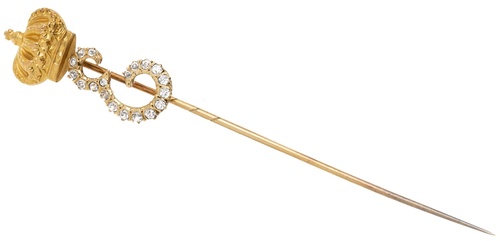
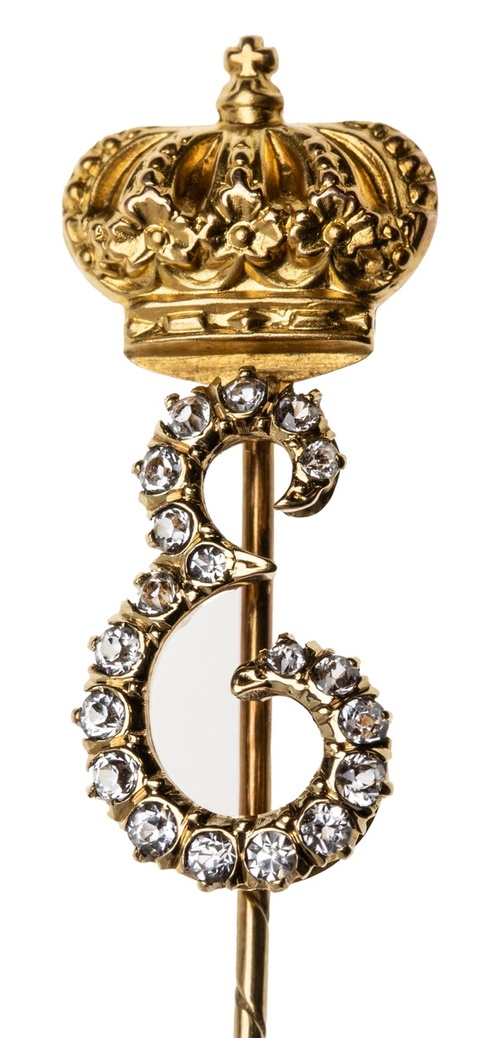
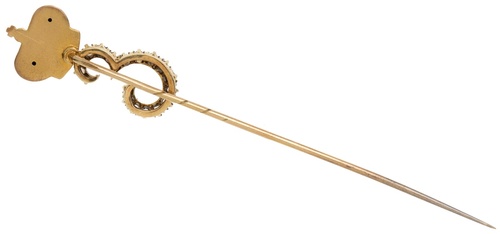
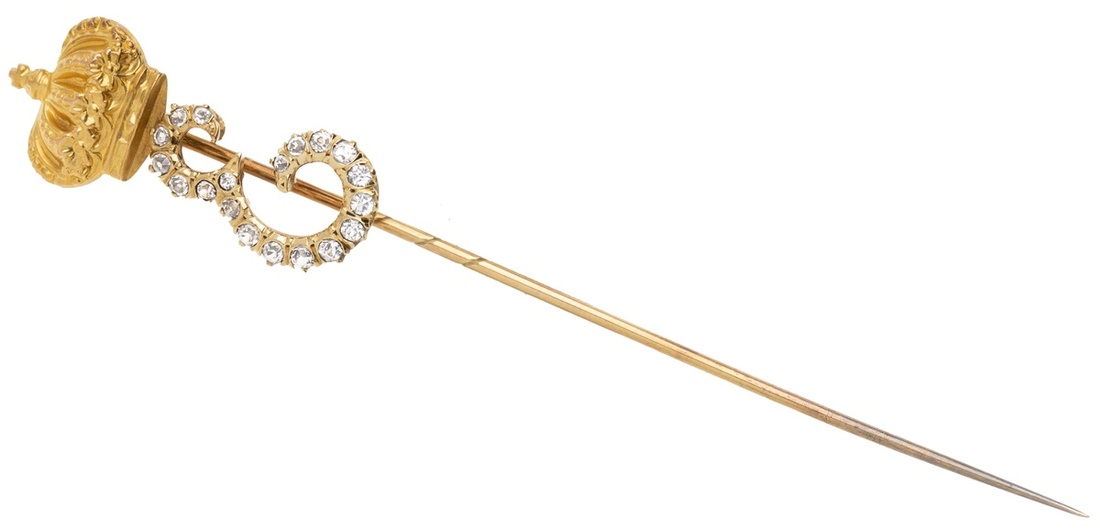
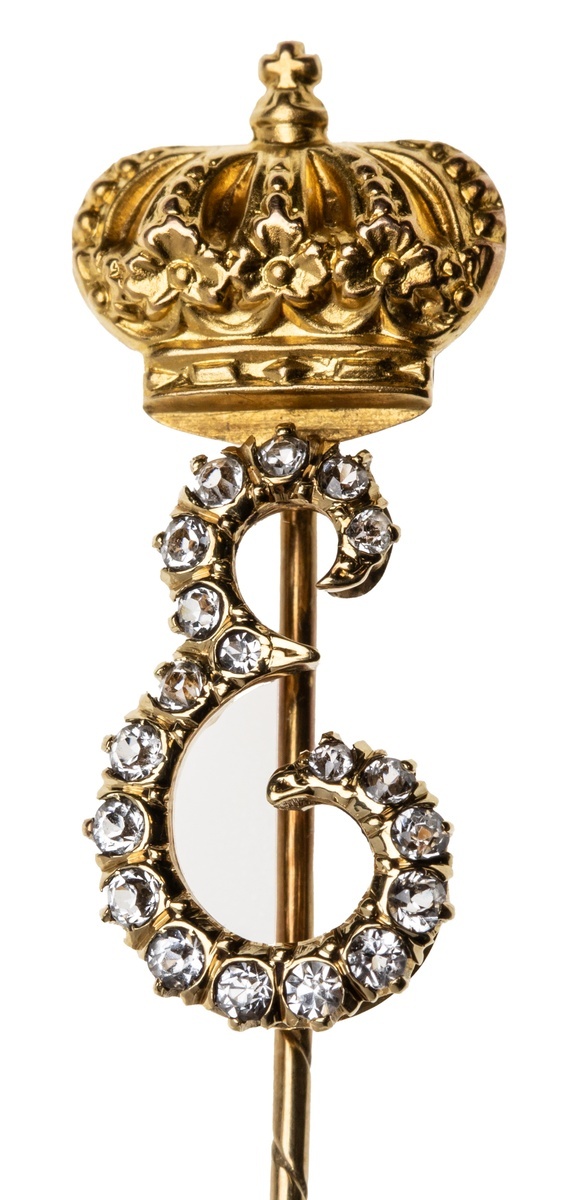
(x) AN EARLY 20TH CENTURY STICK PIN, WITH MONOGRAM OF QUEEN ELISABETH OF BELGIUM
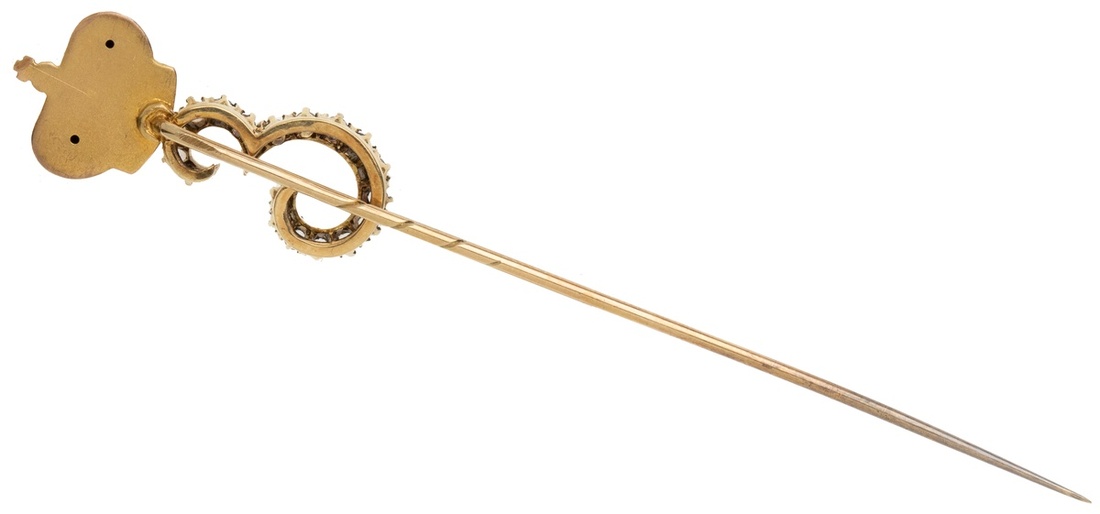
The head designed as the crowned monogram 'E' of Queen Elisabeth of Belgium (1876-1965), set with small old-cut diamonds.
Unmarked
Accompanied by a brown box with gilt Belgian crown, the cream silk and velvet interior inscribed 'E. et R. ALTENLOH. JOAILLIERS-ORFEVRES FOURNISSEURS DE L.L.M.M. LE ROI ET LA REINE 96. MONTAGNE DE LA COUR ET PLACE ROYALE BRUXELLES'.
Size/dimensions: 7.50cm long
Gross weight: 2.49g
All diamonds are present, secure and well matched. The gold is in excellent condition with slight patina to the end of the shaft, which is intact and straight. The pin is offered in excellent condition.
Elisabeth, born Duchess in Bavaria and a niece of Empress Elisabeth of Austria, married Albert I of the Belgians. During the First World War she remained close to the front and worked among the wounded, and she later founded the music competition that still bears her name.
Between the mid-nineteenth century and the First World War, the stick pin was an essential accessory for any well-dressed man, worn to secure and ornament the folds of a cravat or tie. It was also one of the most personal gifts a sovereign or royal household could bestow. Pins set with a crowned cypher or monogram were given as tokens of favour and remembrance to courtiers, officials, household staff, visiting dignitaries, and the guests and companions of royal shooting parties, regattas and state visits. Small enough to be given freely, yet unmistakably royal, they carried their recipient's connection to the court wherever they were worn.
Reading these jewels is part of their appeal. The initials are often intertwined or mirrored so that they read in either direction, sometimes with a regnal numeral, and the form of the crown above signals rank: imperial and royal crowns, the archducal crown of the Habsburgs, and the strawberry-leaved coronet of a duke. Many pins survive in the cases of the court jewellers who supplied them, and the cases in this section form a small directory of royal patronage, from Sy & Wagner, Court Goldsmiths in Berlin, and V. Mayer's Söhne, Imperial and Royal Court Jewellers in Vienna, to E. & R. Altenloh, purveyors to the King and Queen of the Belgians, and Benzie of Cowes, the yachtsmen's jeweller.
The families represented here, among them Hanover, Denmark, Belgium, Bavaria, Saxony, Prussia and Habsburg Austria, were closely bound together by marriage, and pins such as these passed freely between their courts. Within a few years, many of these monarchies had gone. The war that began with the assassination of Archduke Franz Ferdinand in 1914 ended in 1918 with the fall of the German, Austro-Hungarian and Russian empires, and the crowned cyphers on these small gold jewels belong to a world that vanished almost overnight.
Subject to 5% tax on Hammer Price in addition to 20% VAT on Buyer’s Premium.
Estimate
£500 to £700
Starting price
£400

Watch, listen and bid as if you were in the room. Now available for auctions worldwide.
Click here to bid live
An exclusive and confidential service for the discerning collector or vendor.
View the Gallery
Download every Spink catalogue on your iPad, iPod or iPhone using free Spink app.
Download From iTunes© 2026 Spink & Son. All rights reserved.