
Auction: 26052 - Jewellery & Objets de Vertu
Lot: 40
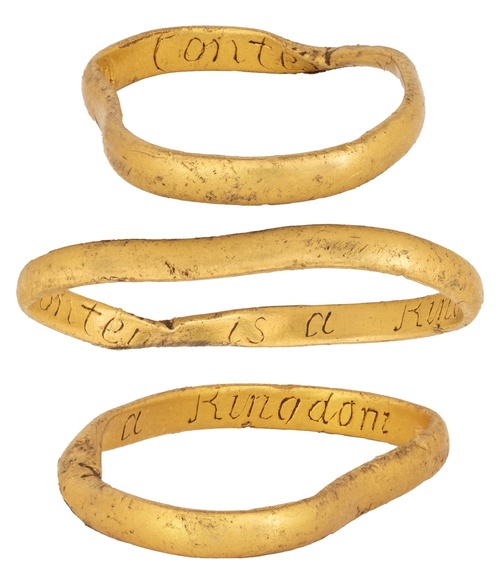
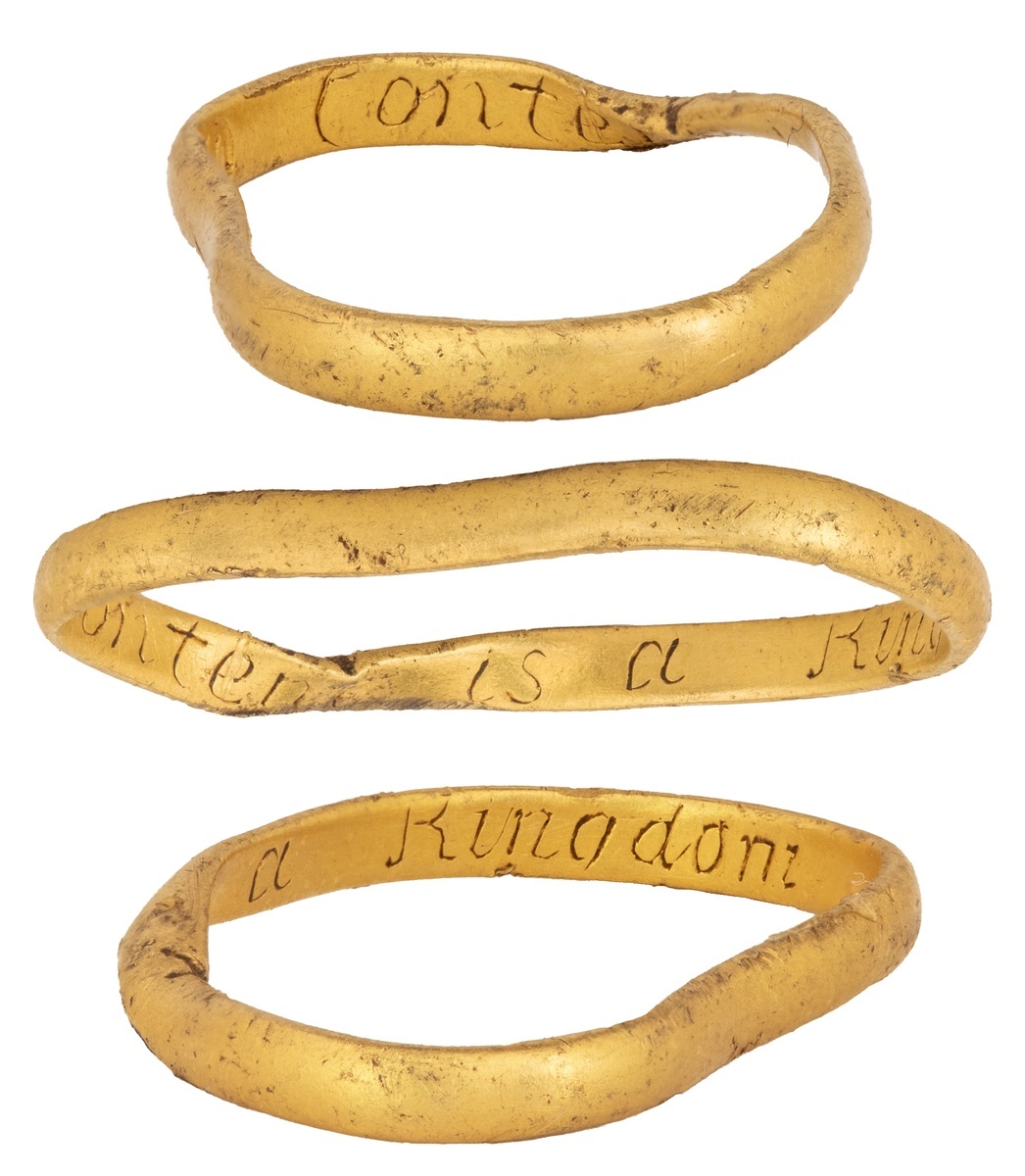
A POST-MEDIEVAL POSY RING - 'CONTENT IS A KINGDOM'
CIRCA 1613-1659
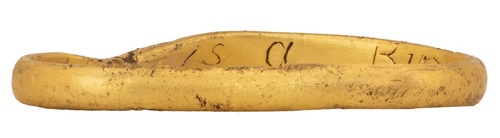
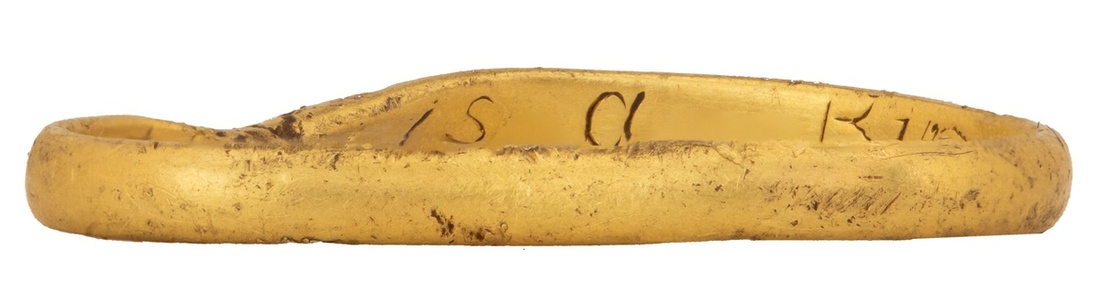
Plain band with italic script on the inside surface 'Content is a kingdom'.
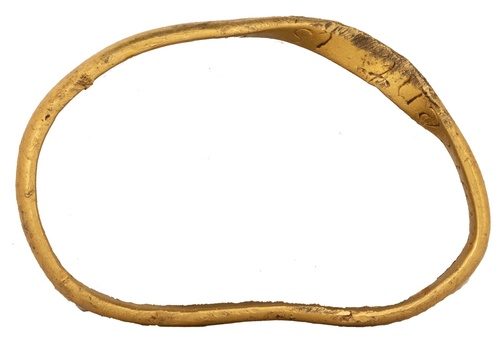
Maker's mark 'WL' in Roman capitals within a rectangular punch, struck before the word 'content' and inverted in relation to the inscription.
Analysed as 88.40% gold, 11.60% silver
Gross weight: 1.52g
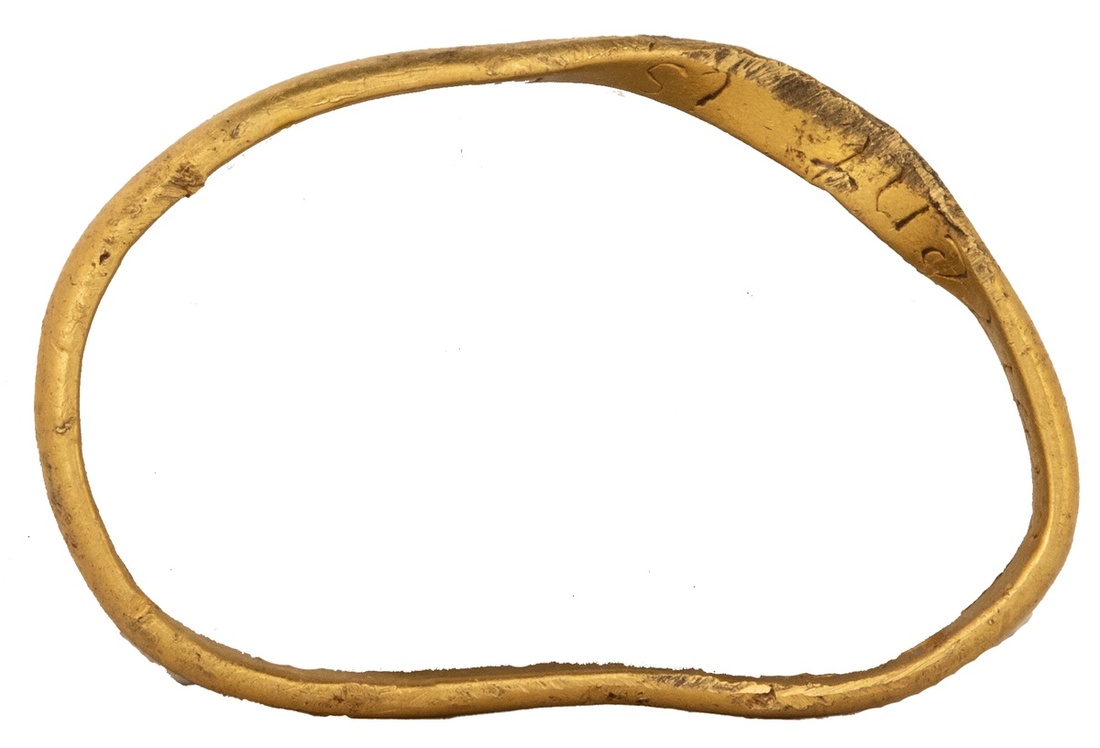
The band has been squashed and bent into an oval, but the evocative inscription remains legible and sharp. Some scuffs, possibly from farming machinery or the act of being recovered. Possibly be suitable for restoration and wear, and is offered here in fair condition.
Provenance
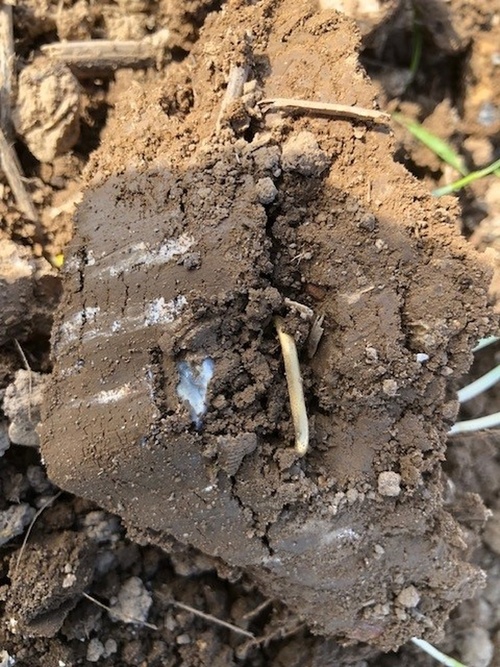
Found at Speen CP (West Berkshire) on 11 October 2023
~ Recorded with the British Museum (ref. PAS-BERK-78A25E; Treasure ref. 2023T1073) ~
“Content is a kingdom” expresses a commonplace of the seventeenth century: that contentment with one’s lot is worth more than a crown. The idea was voiced in St Paul’s letter “godliness with contentment is great gain” and in Sir Edward Dyer’s celebrated poem “My mind to me a kingdom is”, and the motto itself is recorded by Joan Evans in English Posies and Posy Rings (1931). Given at a betrothal or marriage, it carried a gentle promise: that the giver, having the beloved, wanted for nothing more.
An example of the same motto is preserved in the British Museum, bequeathed by Sir Augustus Wollaston Franks, whose collection of finger rings forms the core of the Museum’s holdings. That ring bears the mark “GC”, attributed to George Crompton, a London maker who became free of the Goldsmiths’ Company in 1632 and died in 1690. The present ring is struck with the mark “WL”, in Roman capitals within a rectangular punch, which is probably that of William Lyle I of Southampton, active from 1613 to 1659. The same words were therefore being set into rings by goldsmiths in both London and Southampton, a vivid illustration of how popular mottoes circulated among makers across the country.
The ring was found at Speen in West Berkshire, close to the site of the Second Battle of Newbury, fought on 27th October 1644, and in an area that has also produced other material from the Civil War. Its maker was active in the decades before the conflict, and while there is no way of knowing how it came to be lost, it is tempting to imagine it carried by one of those caught up in the fighting, a token of love or loyalty that never returned home.
Cf. British Museum AF.1220 (O. M. Dalton, Franks Bequest: Catalogue of the Finger Rings, London, 1912, no. 1139); J. Evans, English Posies and Posy Rings, London, 1931, p. 30.
Subject to 20% VAT on Buyer’s Premium. For more information please view Terms and Conditions for Buyers.
Estimate
£1,000 to £1,500
Starting price
£800


Watch, listen and bid as if you were in the room. Now available for auctions worldwide.
Click here to bid live
An exclusive and confidential service for the discerning collector or vendor.
View the Gallery
Download every Spink catalogue on your iPad, iPod or iPhone using free Spink app.
Download From iTunes© 2026 Spink & Son. All rights reserved.