Auction: 26052 - Jewellery & Objets de Vertu
Lot: 35
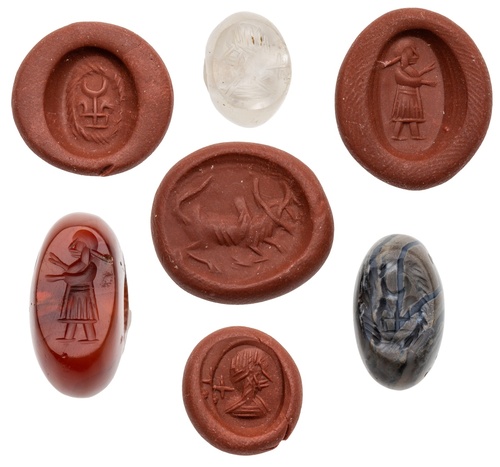
A GROUP OF FOUR SASANIAN QUARTZ UNDECORATED ELLIPSOID STAMP SEALS (4)
CIRCA 300-500 AD
Each of ellipsoid form with a large central suspension hole and plain exterior, in rock crystal, carnelian and agate, the flat faces engraved in intaglio: a standing man with a pigtail; a seated bull; a device of a crescent above an inverted letter pi and a short horizontal bar, within a border of leaves; and a male portrait in 'scratch' style with a four-pointed star to the left.
Accompanied by moulds.
Cf. Catalogue of the Western Asiatic Seals in the British Museum, Stamp Seals (1969), BD 6-7; EO 1-3; NG 2; AG 1-2.
Size/dimensions: faces 1.20cm to 2.10cm x 1.08cm to 1.79cm; 1.50cm to 2.60cm overall
Gross weight: 28.44g (total)
The seals are offered in good to excellent condition. The carnelian seal reatins a smooth high with sharp engraving lines which the banded agate and rock crustal examples display slightly more abrasion and surface pitting. All are structually sound and free of major fractures.
Provenance
From the contents of a private residence, Kent
The Sasanian dynasty ruled Iran and much of the Near East from AD 224, when Ardashir I overthrew the last Parthian king, until the Arab conquests of the mid-seventh century. Seals were used at every level of Sasanian society: to authenticate documents, close containers and secure goods, and to mark the identity and rank of their owners. Thousands of clay sealings recovered from administrative sites show how widely they were used, and many seals were also worn as personal ornaments and valued as amulets.
Most Sasanian seals were cut in hardstones such as carnelian, chalcedony, agate, jasper and rock crystal, and took two principal forms: the ellipsoid, pierced through its length and engraved on a flat oval face, and the dome, with a smaller flat base.
The subjects form a rich repertoire. Animals dominate: the humped zebu bull, the lion, the boar, which was associated with Verethragna, the god of victory, the ibex, gazelle, horse and birds. Some scenes, such as a lion springing upon a bull, continue imagery known in Iran since the Achaemenid period. Alongside them appear portrait busts, mythological and religious figures such as Gay?mard, the first man of Zoroastrian tradition, and abstract devices that served as personal emblems. Many seals carry short inscriptions in Middle Persian (Pahlavi) script, naming the owner or expressing a pious wish.
Subject to 20% VAT on Buyer’s Premium. For more information please view Terms and Conditions for Buyers.
Estimate
£300 to £400
Starting price
£5

Watch, listen and bid as if you were in the room. Now available for auctions worldwide.
Click here to bid live
An exclusive and confidential service for the discerning collector or vendor.
View the Gallery
Download every Spink catalogue on your iPad, iPod or iPhone using free Spink app.
Download From iTunes© 2026 Spink & Son. All rights reserved.