
Auction: 26050 - Jewellery & Objets de Vertu
Lot: 26
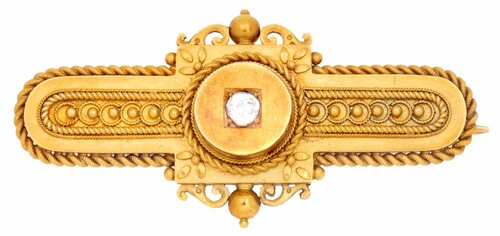
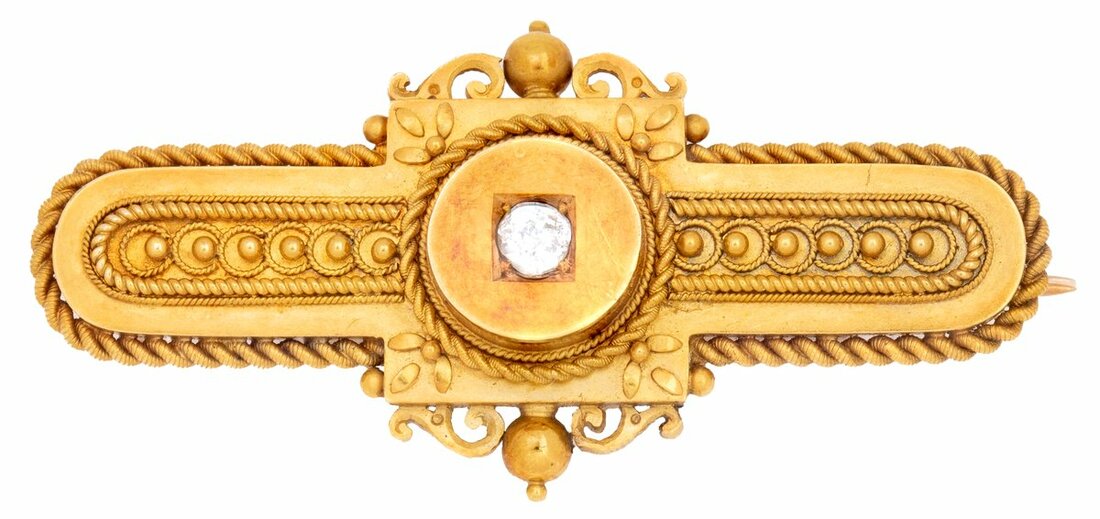
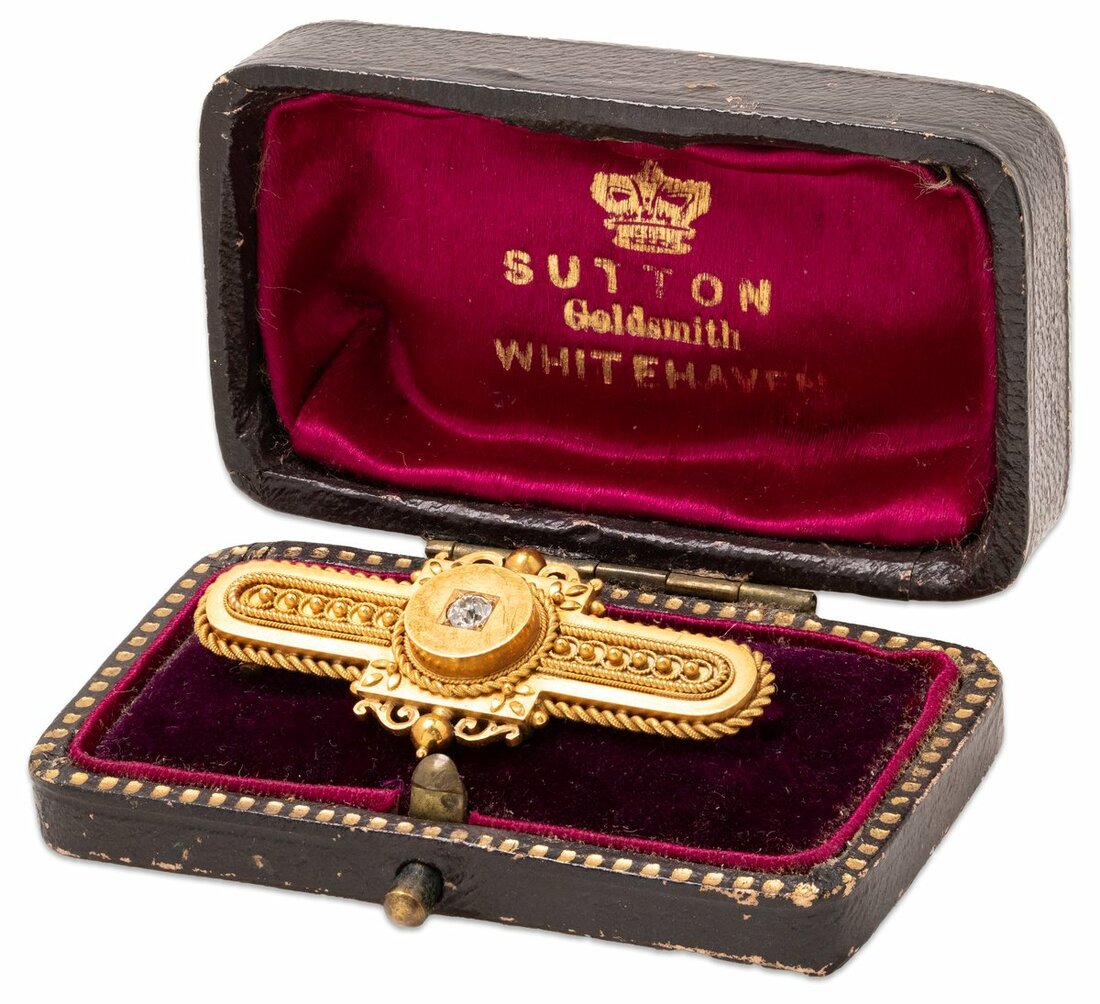
A VICTORIAN ARCHAEOLOGICAL REVIVAL DIAMOND BROOCH
CIRCA 1860-1880
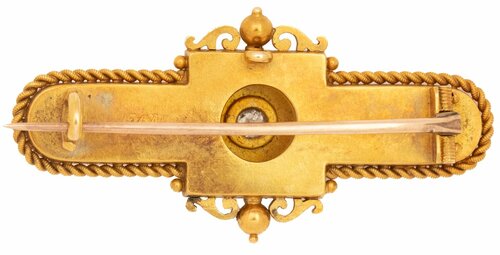
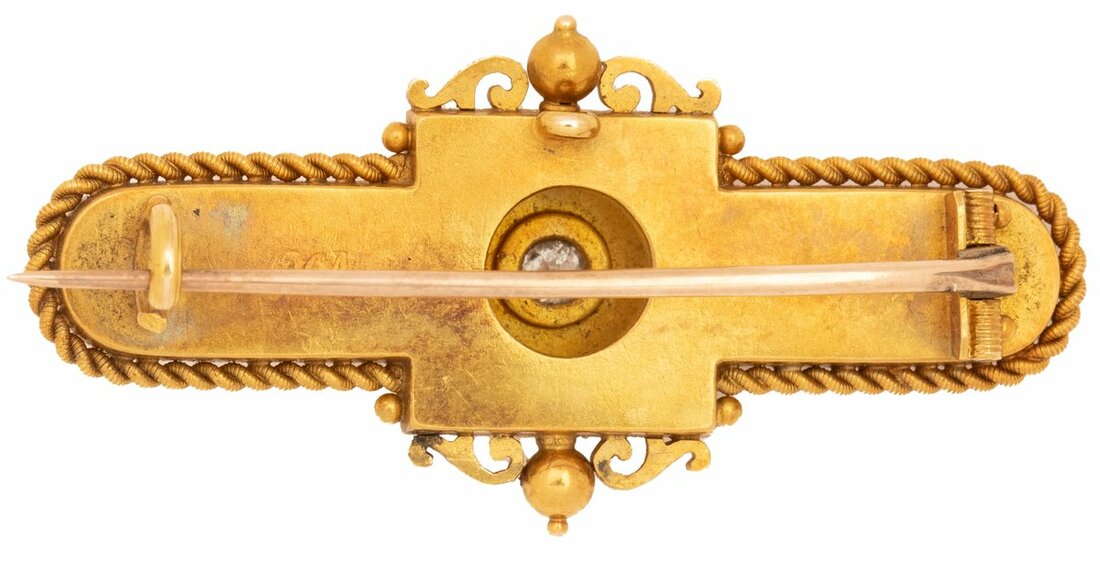
Featuring intricate granulation and cannetille wirework borders inspired by classical archaeological goldwork, centred with a single old mine-cut diamond, mounted in a bar brooch setting with c-clasp fastening.
Stamped 15CT
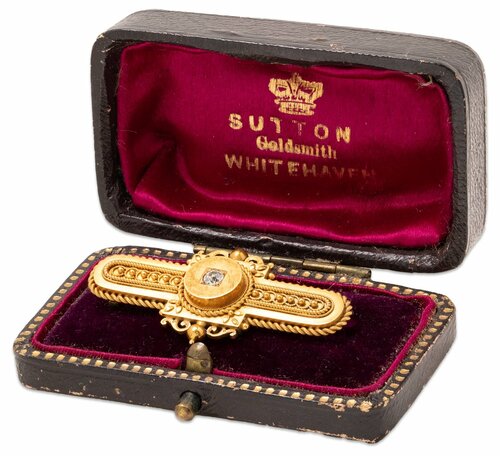
Accompanied by original velvet and silk lined fitted case stamped for Sutton Goldsmith, Whitehaven.
Size/dimensions: 4.50cm long
Gross weight: 6.01g
In very good condition. One old mine-cut diamond, approximately 0.12ct, bright and lively, with a small chip to the table facet and no fluorescence. The gold shows minimal wear. The clasp is functioning well.
The Etruscan Revival in Victorian Jewellery
The Etruscan Revival was one of the most influential and enduring stylistic movements in nineteenth-century jewellery design, emerging from a broader Victorian fascination with the ancient world. Its origins lie in a series of remarkable archaeological discoveries in central Italy during the late eighteenth and early nineteenth centuries, particularly the excavation of richly furnished Etruscan tombs at Cerveteri, Vulci, Chiusi, Orvieto, and Tarquinia. These finds revealed gold ornaments of extraordinary technical sophistication, characterised by intricate granulation, fine wirework, and highly refined surface decoration.
Interest in these discoveries intensified during the 1840s and 1850s, as advances in travel, scholarship, and museum collecting brought the art of antiquity to a wider European audience. The opening of major archaeological collections and the publication of illustrated antiquarian studies fuelled a growing appetite among collectors and jewellers for designs inspired by ancient sources. This enthusiasm was further encouraged by the rise of the “archaeological style,” in which Greek, Etruscan, and Egyptian motifs were freely interpreted and combined in contemporary jewellery.
The pioneering force behind the revival of authentic classical goldsmithing was the Roman workshop of Fortunato Pio Castellani (1794-1865), later continued by his sons Alessandro and Augusto. Unlike earlier revivalist jewellers, the Castellani family sought not merely to imitate ancient forms, but to rediscover and reconstruct historic techniques themselves. Their research into Etruscan granulation (minute gold spheres fused to a gold surface without visible solder) produced results of exceptional refinement and established a new benchmark for archaeological jewellery. Their creations, often inspired by artefacts from the Regolini-Galassi tomb and the Campana collection, became highly sought after by international collectors and visiting aristocracy.
Characteristic features of Etruscan Revival jewellery include the use of elaborate granulation, twisted wirework, cannetille ornament, applied rosettes, beaded borders, amphora and amphora-derived motifs, and stylised geometric patterns drawn from classical prototypes. High-carat gold was frequently employed to replicate the rich surface quality of ancient originals, while gemstones were typically used sparingly, serving as subtle accents rather than dominant features. The overall effect is one of sculptural richness, where texture, form, and craftsmanship take precedence over ostentation.
The influence of the movement extended beyond Rome to Paris, Naples, and London, where jewellers such as Jules Wiese, Eugène Fontenay, Carlo Giuliano, Robert Phillips, and John Brogden adapted archaeological motifs for an increasingly fashionable clientele. At its height in the 1860s, Etruscan Revival jewellery was widely admired by the European aristocracy and cultivated middle classes alike, and was frequently exhibited at major international exhibitions, including London in 1862.
Subject to 20% VAT on Buyer’s Premium. For more information please view Terms and Conditions for Buyers.
Sold for
£420
Starting price
£420

Watch, listen and bid as if you were in the room. Now available for auctions worldwide.
Click here to bid live
An exclusive and confidential service for the discerning collector or vendor.
View the Gallery
Download every Spink catalogue on your iPad, iPod or iPhone using free Spink app.
Download From iTunes© 2026 Spink & Son. All rights reserved.