
Auction: 26050 - Jewellery & Objets de Vertu
Lot: 20
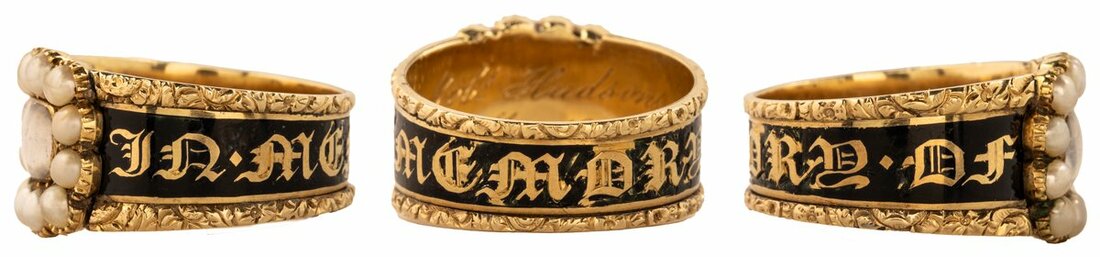
A GEORGIAN MOURNING RING TO CAPTAIN ROBERT HUDSON (D. 1816)
CIRCA 1817
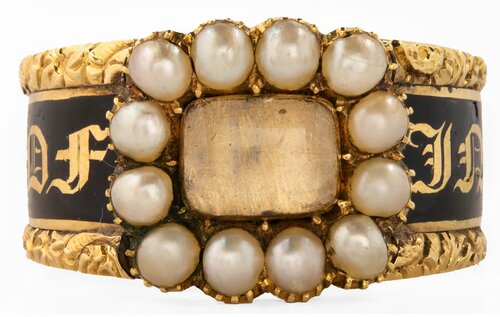
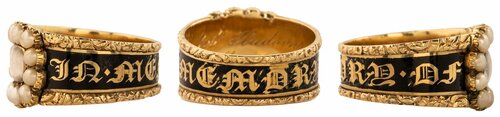
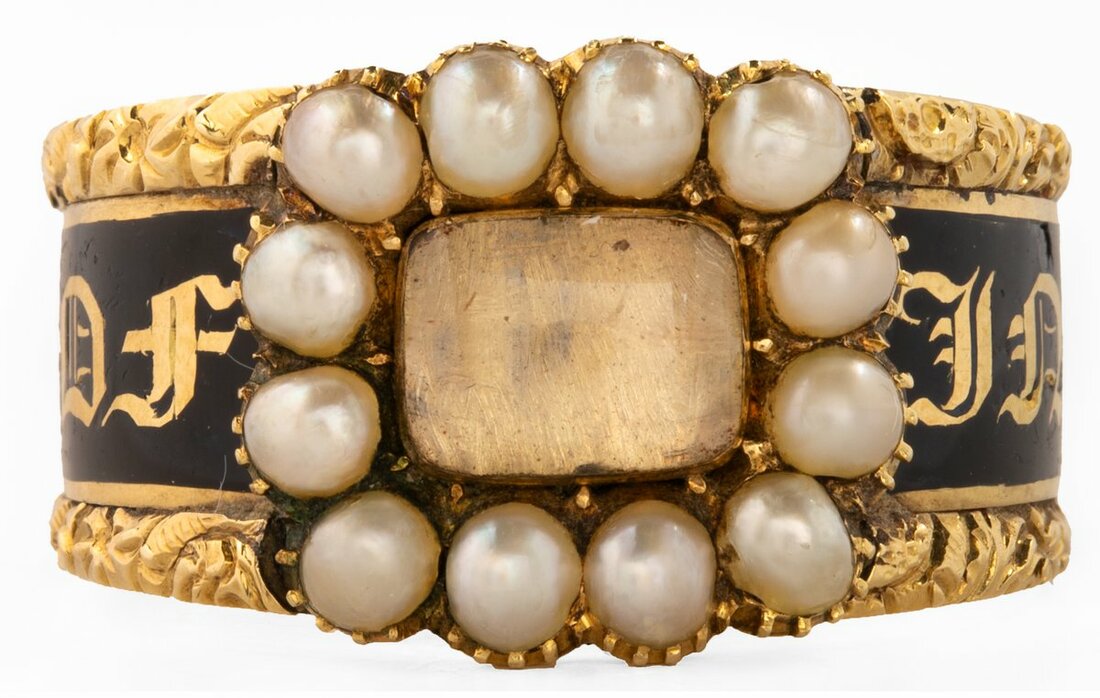
The band decorated with black enamel about the text ‘IN MEMORY OF’, centred by a glazed panel bordered by a halo of natural split seed pearls symbolising tears.
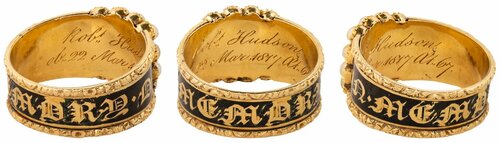
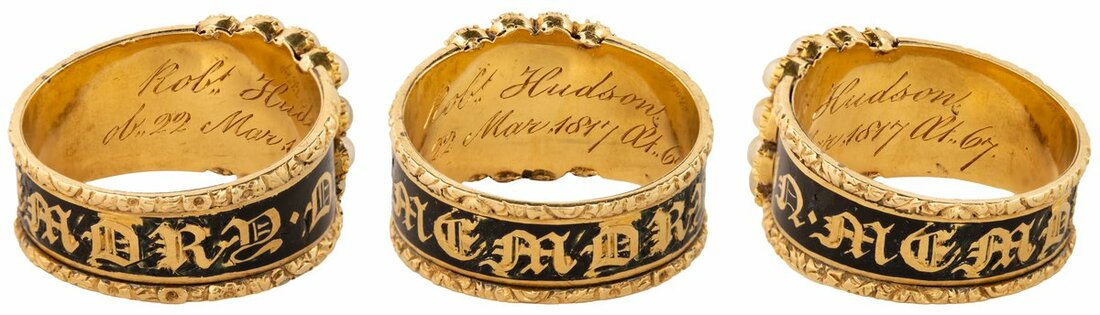
The interior is inscribed ‘Robt. Hudson | ob. 22 Mar 1817 aet. 67’.
Tests as 14ct gold.
Size/dimensions: ring size T 1/2 (US 9 3/4)
Gross weight: 6.55g
The pearls are all present and well matched. There is minor loss to the black enamel. The piece shows very light wear overall, particularly to the inscription. The hair or cloth formerly contained beneath the glazed panel is no longer present, and the item is offered in good condition.
Captain Robert Hudson (1750-1816)
Robert Hudson was a prominent East India Company commander whose career exemplifies the opportunities for wealth and social advancement created by Britain's maritime empire in the late eighteenth century.
Hudson entered the service of the East India Company in 1776 as a midshipman and subsequently completed eight voyages to the East. During a maritime career spanning more than two decades, he served aboard several of the Company's largest merchant vessels, including the Ponsborne, Vansittart, and Houghton. Rising steadily through the ranks, he assumed command of the Houghton in 1793 and completed two voyages as captain. His service placed him at the centre of the lucrative trade networks connecting Britain with India and China during a period of rapid imperial and commercial expansion.
A surviving portrait, now in the collection of the Royal Museums Greenwich, records Hudson at the height of his career. Depicted in the full uniform of the Company's marine service against a maritime backdrop, the portrait reflects both his professional achievements and the elevated social status enjoyed by successful East India captains. Such men occupied a distinctive position within British society, combining maritime expertise with commercial ambition and frequently returning from the East with substantial fortunes.
Following his retirement from active service in 1798, Hudson successfully transitioned from seafarer to merchant capitalist. Like many former Company captains, he invested heavily in shipping and commerce, becoming a director of the East India Company and entering into partnership with the influential Borradaile family of London shipowners. Through the firm of William and Richardson Borradaile of Fenchurch Street, Hudson acquired interests in several vessels engaged in the India and China trades, including the Inglis, a substantial East Indiaman launched at Penang in 1811.
His prosperity is reflected in the provisions of his will, proved in London in May 1817. The document describes him as "Robert Hudson of Clapham, Esquire," and records extensive holdings in East India stock and other investments. The will provides for his wife, grants substantial trust arrangements, and names among its executors and trustees several prominent figures from his commercial circle, including his brother William Hudson, the merchant Richardson Borradaile, and William Cotton. The complexity of these arrangements demonstrates the considerable scale of Hudson's financial affairs and the close interconnection of London's mercantile elite.
Hudson's family alliances further reinforced these commercial networks. In 1799 he married Demetria Cotton of Camberwell, linking the Hudson family to another prominent mercantile dynasty. Their only son, Robert Hudson (1801-1883), would later become a Fellow of the Royal Society, continuing the family's ascent into the ranks of Britain's scientific and social establishment.
Captain Hudson died on 22 March 1817 and was buried nine days later. Contemporary records indicate that he left an estate valued at more than £74,000 to his son - a fortune of exceptional magnitude for the period and testament to the wealth generated through East India Company service, maritime commerce, and investment. His life charts the classic trajectory of the late Georgian East India captain: from seaman and commander to merchant, shipowner, Company director, and gentleman of considerable fortune.
A Note on Mourning Rings
By the nineteenth century, mourning jewellery had become highly codified within British social and material culture. Public expressions of grief were not only accepted but expected, and jewellery formed a central part of this visual language of remembrance. Rings, brooches, and lockets were frequently commissioned to commemorate the dead, incorporating inscriptions, symbolic motifs, or hairwork, and were often worn during prescribed periods of mourning.
Mourning jewellery occupies a complex position between personal sentiment and public ritual. These objects functioned both as private tokens of loss and as visible affirmations of social convention, preserving memory in material form across generations.
Subject to 20% VAT on Buyer’s Premium. For more information please view Terms and Conditions for Buyers.
Sold for
£500
Starting price
£500

Watch, listen and bid as if you were in the room. Now available for auctions worldwide.
Click here to bid live
An exclusive and confidential service for the discerning collector or vendor.
View the Gallery
Download every Spink catalogue on your iPad, iPod or iPhone using free Spink app.
Download From iTunes© 2026 Spink & Son. All rights reserved.