Auction: 26003 - Orders, Decorations and Medals
Lot: 402
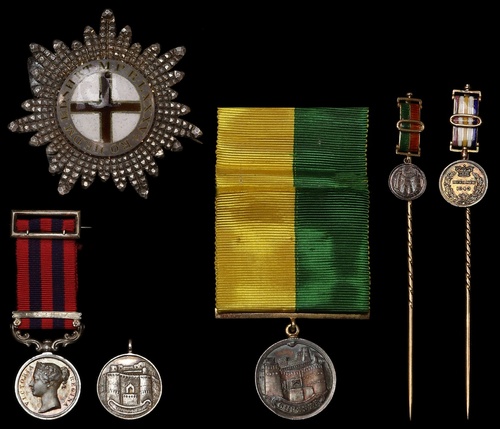
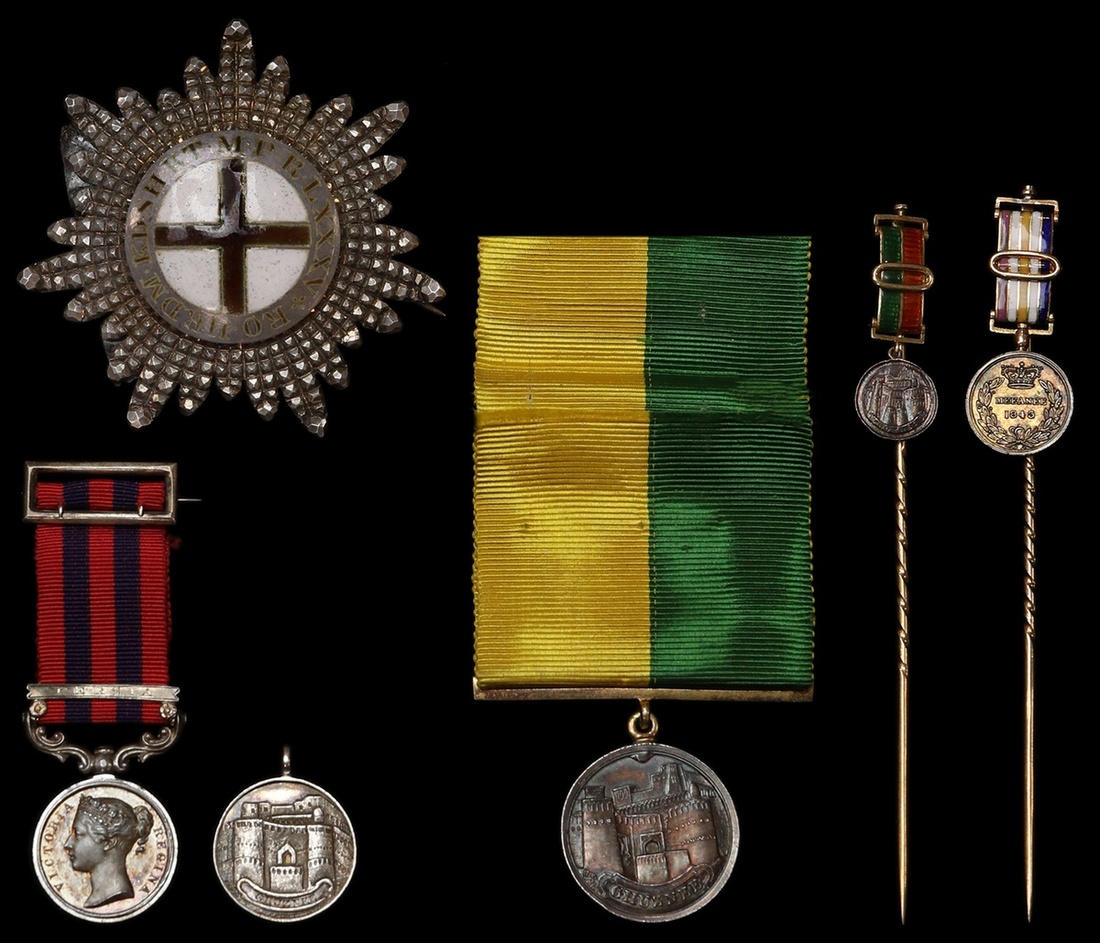
The miniature dress medals attributed to Sir James Outram, 1st Baronet Outram
Ghuznee 1839, 22mm diam., silver with gilt metal straight bar suspension to fit a full size riband, of good quality manufacture; India General Service 1854-95, 1 clasp, Persia, together with a Scinde Medal 1843, 13mm diam., with Meeanee 1843 reverse, attached to a yellow metal and enamel riband, this attached to a stick pin for wear and a similar style Ghuznee medal 1839, 10mm diam., together with two further yellow metal and one white metal miniature suspensions and an unrelated Knights Templar badge, very fine (Lot)
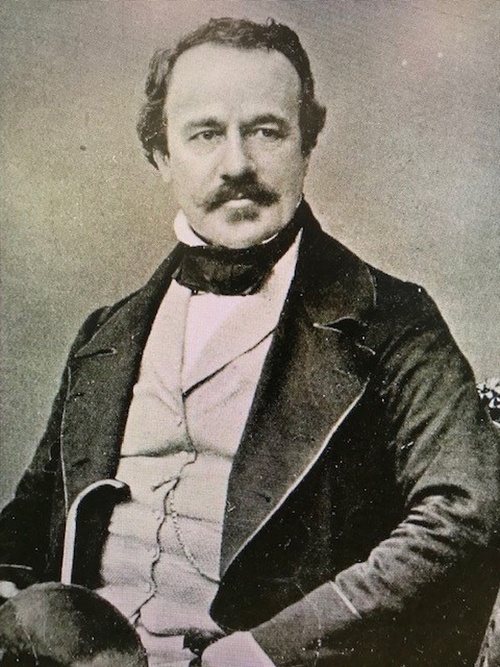
James Outram was the son of Benjamin Outram and Margaret Anderson and was born on 29 January 1803. He was educated at Udny school and then at the Marischal College, Aberdeen. He was given an Indian Cadetship in 1819 and in July 1820 he became acting adjutant to the first battalion of the 12th regiment on its embodiment at Poona.
In 1835 he was sent to Gujerat to make a report on the Mahi Kantha district and for some time remained there as a political agent. He was appointed to be extra aide-de-camp on the staff of Sir John Keane and went to Afghanistan on the outbreak of the First Afghan War. He conducted various raids against Afghan tribes and performed an extraordinary exploit in capturing a banner of the enemy before Ghazni. He was promoted Major in 1839 and appointed political agent in Lower Sindh, later being moved to Upper Sindh. During his time in Sindh, he strongly opposed the policy of his superior Sir Charles Napier which led to the annexation of Sindh into British India. However when war broke out, he strategically defended the residency at Hyderabad against 8,000 Baluchis irregulars, causing Napier to describe him as the 'Bayard of India'. On his return from a short visit to England he was, with the rank of lieutenant-colonel appointed to command in the Mahratta country, and in 1847 he was transferred from Satara to Baroda.
In 1854 he was appointed resident at Lucknow, in which capacity two years later he carried out the annexation of Oudh and became the first chief commissioner of that province. Appointed in 1857, with the rank of lieutenant-general, to command an expedition against Persia during the Anglo-Persian War, he defeated the Persian forces in February 1857 after an attempted ambush by their commander Khanlar Mirza at Khushab. Outram conducted the campaign with such rapid decision that peace was concluded by the Treaty of Paris in March 1857, his services being rewarded by the Grand Cross of the Order of the Bath (G.C.B.).
From Persia he was summoned in June to India, with the brief explanation "We want all our best men here". It was said of him at this time that a fox is a fool and a lion a coward by the side of Sir J. Outram. Immediately on his arrival in Calcutta he was appointed to command the two divisions of the Bengal army occupying the country from Calcutta to Cawnpore; and to the military control was also joined the commissionership of Oudh. Already hostilities had assumed such proportions as to compel Henry Havelock to fall back on Cawnpore, which he held only with difficulty, although a speedy advance was necessary to save the garrison at Lucknow. On arriving at Cawnpore with reinforcements, Outram, in admiration of the brilliant deeds of General Havelock, conceded to him the glory of relieving Lucknow, and, waiving his rank, tendered his services to him as a volunteer. During the advance he commanded a troop of volunteer cavalry, and performed exploits of great brilliancy at Mangalwar, and in the attack at the Alambagh; and in the final conflict he led the way, charging through a very tempest of fire. The volunteer cavalry unanimously voted him the Victoria Cross, but he refused the choice on the grounds that he was ineligible as the general under whom they served. Resuming supreme command, he then held the town until the arrival of Sir Colin Campbell, after which he conducted the evacuation of the residency so as completely to deceive the enemy. In the second capture of Lucknow, on the commander-in-chief's return, Outram was entrusted with the attack on the side of the Gomti, and afterwards, having recrossed the river, he advanced through the Chattar Manzil to take the residency, thus, in the words of Colin Campbell, putting the finishing stroke on the enemy. After the capture of Lucknow he was gazetted Lieutenant-General. While in Lucknow he employed a code whereby letters were transliterated using the Greek alphabet, which was a common practice in the military at the time.
He received thanks from both Houses of Parliament in February 1858 and later that year a Baronetcy. Outram returned to England in 1860 on account of poor health and received a public testimonial and erections of statues in London and Calcutta. He died at Pau, in the South of France on 11 March 1863 and was buried in the nave of Westminster Abbey on 25 March 1863.
Please see lot 359 for the Baronet's badge to his grandson.
Subject to 20% VAT on Buyer’s Premium. For more information please view Terms and Conditions for Buyers.
Estimate
£400 to £600
Starting price
£320
Watch, listen and bid as if you were in the room. Now available for auctions worldwide.
Click here to bid live
An exclusive and confidential service for the discerning collector or vendor.
View the Gallery
Download every Spink catalogue on your iPad, iPod or iPhone using free Spink app.
Download From iTunes© 2026 Spink & Son. All rights reserved.