Auction: 26003 - Orders, Decorations and Medals
Lot: 335
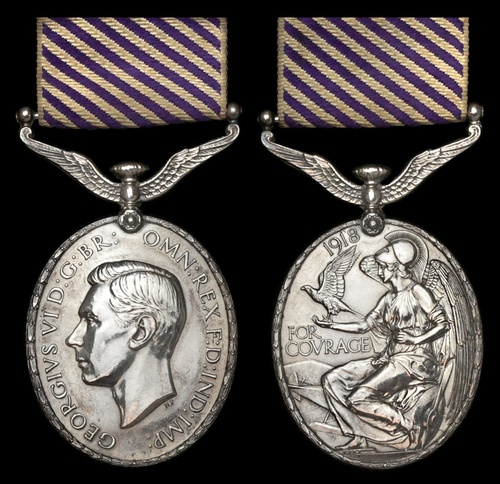
A superb Immediate 1943 D.F.M. awarded to Flying Officer J. Elliott, Royal Canadian Air Force Volunteer Reserve, No. 427 (Royal Canadian Air Force) Squadron, Royal Air Force, who was forced to cut a hole in the fuselage of his aircraft to extinguish a fire on the wing, later taken Prisoner of War on 6 September 1943
Distinguished Flying Medal, G.VI.R. (1479954 Sgt. J. Elliott. R.A.F.), with pin for wear and in its original box of issue, good very fine
Purchased Spink Numismatic Circular circa 1980.
D.F.M. London Gazette 10 September 1943, the original joint citation states:
'One night in August, 1943, these airmen were captain, flight engineer and wireless operator/air gunner respectively of an aircraft detailed to attack Mannheim. Shortly after bombing the target the aircraft was attacked by a fighter. Although the enemy aircraft was eventually shot down, the bomber sustained extensive damage. A fire broke out in one of the wings but Sergeant Elliott after making an aperture in the side of the fuselage with an axe, was able to put out the flames with an extinguisher. The aircraft became exceedingly difficult to control, requiring almost superhuman efforts to maintain a level flight. Despite this, Flight Sergeant Biggs battled on to reach this country. The aircraft was so badly crippled, however, that a landing could not be effected but the crew were able to leave the bomber by parachute. Flight Sergeant Biggs displayed great courage and a fine fighting spirit throughout, while Sergeants Elliott and Moyler, though the latter was wounded, displayed great devotion to duty and rendered valuable assistance.'
Jack Elliott served with No. 427 Squadron, Royal Canadian Air Force and took his first flight over Dusseldorf on 11 June 1943 as a Sergeant. It was not long before he was thrown into action proper when the Allies launched the Battle of the Ruhr, with Elliott flying four missions in seven days, the last being the 28 June raid over Cologne, the largest of the Battle.
After a month-long break from flying he returned to service, this time as part of Operation Gamorrah, an enormous effort against the German industrial city of Hamburg. After their final participation in this raid Elliott's crew flew the mission which resulted in his award on 9 August 1943, the relevant combat report states:
'When leaving the target while on operations to Mannheim, Halifax Bomber "P" E.D. 247 of 427 Squadron was attacked by enemy fighter identified as a F.W. 190. Position approximately 49° 10' N, 08° O' E, at 02.07 hours. The Halifax was flying a course of 296° N, at 17,000 feet altitude. T.A.S. 204 m,p.h. Visibility was good with half moon, 10/10ths cloud below at 6000 feet.
The enemy aircraft was first noticed when it fired a long burst of fire from starboard quarter below at 500 yards range. Combat manoeuvre was ordered by the Rear Gunner in the way of a diving turn to starboard. The Rear Gunner at the same time opened fire and the enemy aircraft replied with a short burst damaging the controls of the Halifax and starting fires in the starboard wing. The enemy broke off his attack to port.
There was illumination by means of searchlights on the clouds. The enemy aircraft was evidently operating around the target.
The Rear Gunner fired 200 rounds from all four guns and hits were observed on the enemy aircraft as it broke away, enveloped in flames and exploded while diving towards the ground. The Mid-upper Gunner did not fire any rounds. Our aircraft had to be abandoned over England.
The Rear Gunner, Flight Sergeant Fisher trained at No. 3 A.G.S. and No. 26 O.T.U.'
Several more missions followed this effort, with Elliott commissioned Pilot Officer on 5 September 1943 the same day as a raid over Mannheim. The next day they launched a raid on Munich and Elliott's Halifax was lost, one of two from the squadron brought down on the raid.
Elliott survived the downing, one of only three of the crew to do so. He was imprisoned at Muhlberg camp and despite his capture was later promoted Flying Officer on 5 March 1944; sold together with copied research.
Subject to 20% VAT on Buyer’s Premium. For more information please view Terms and Conditions for Buyers.
Estimate
£1,000 to £1,400
Starting price
£800

Watch, listen and bid as if you were in the room. Now available for auctions worldwide.
Click here to bid live
An exclusive and confidential service for the discerning collector or vendor.
View the Gallery
Download every Spink catalogue on your iPad, iPod or iPhone using free Spink app.
Download From iTunes© 2026 Spink & Son. All rights reserved.