Auction: 26003 - Orders, Decorations and Medals
Lot: 331
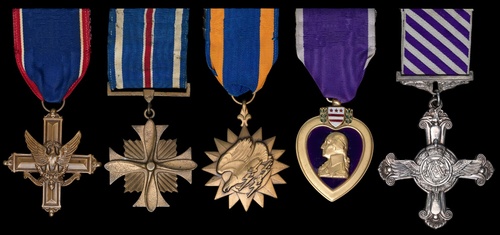
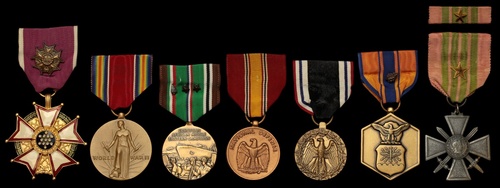
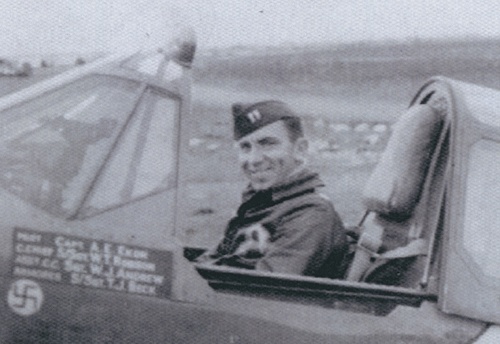
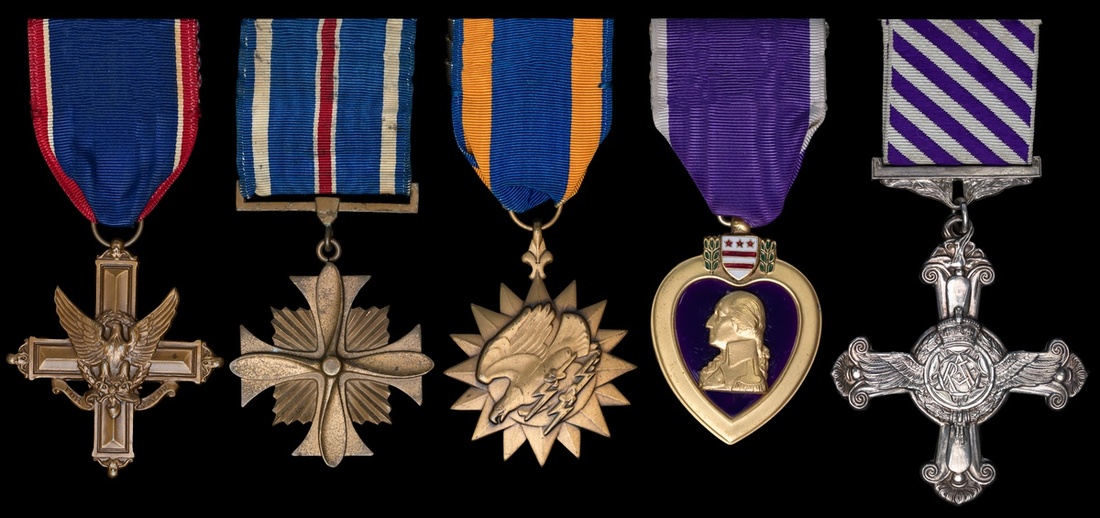
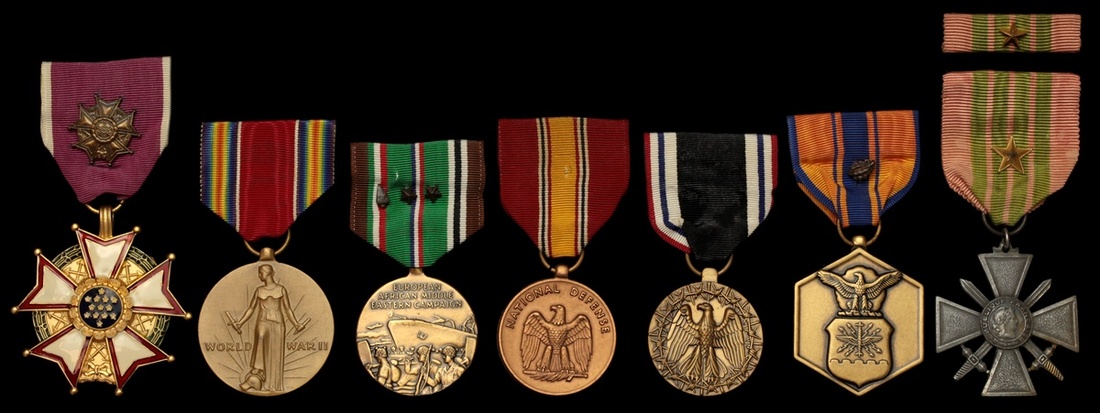
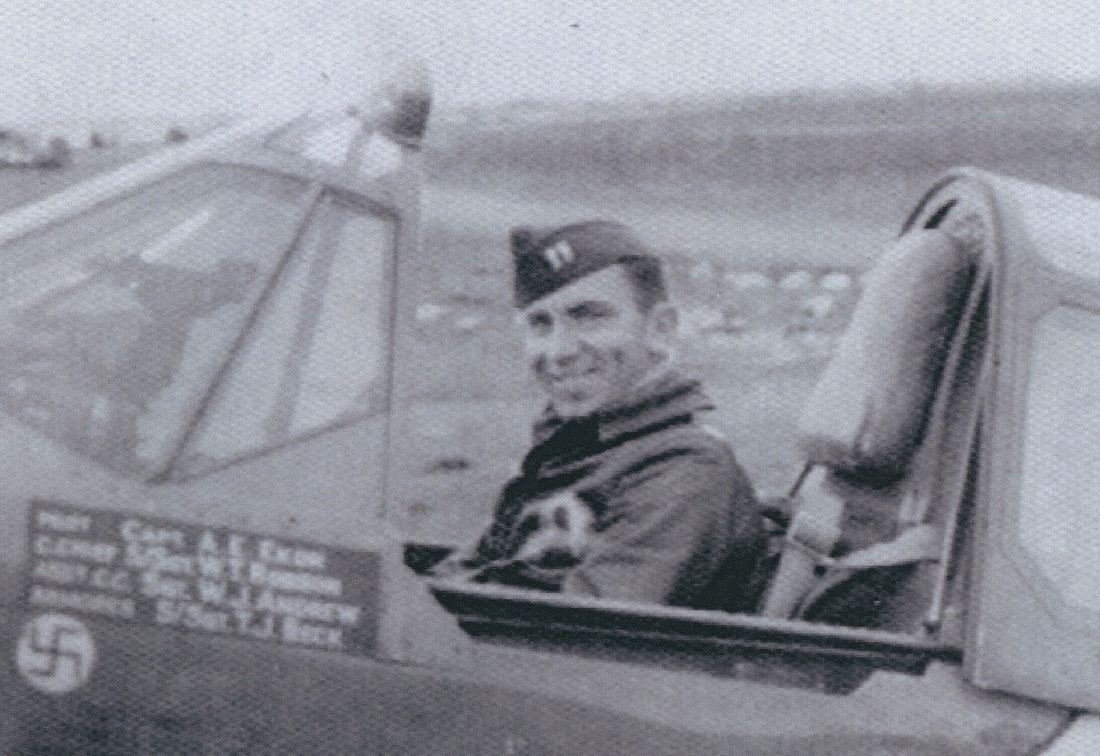
The 1944 United States D.S.C., D.F.C. and Honorary British D.F.C. group awarded to Brigadier-General A. E. Exon, United States Air Force
A skilled Pilot with some 135 combat Ops to his name, he is confirmed with at least three kills & one damaged - all of these Me109's - besides one ship sunk and several trains destroyed, including '...the most successful train-wrecking missions in the history of fighter-bombers'
Forced to bale out in April 1944 and spent time at Stalag Luft III (scene of 'The Great Escape'), he thence served in Korea and Vietnam, besides being the most Senior Officer to report on the 1947 'Roswell Incident' and was Chief of Ballistic Missiles in Germany during the Cuban Missile Crisis
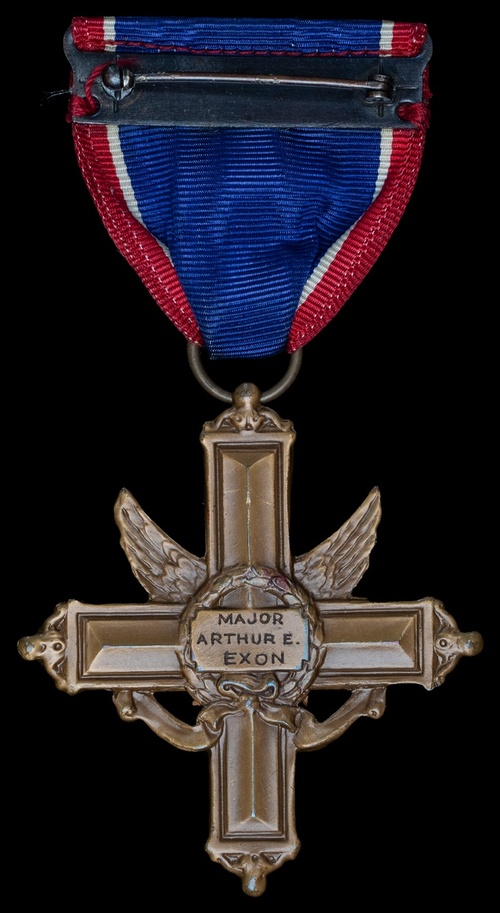
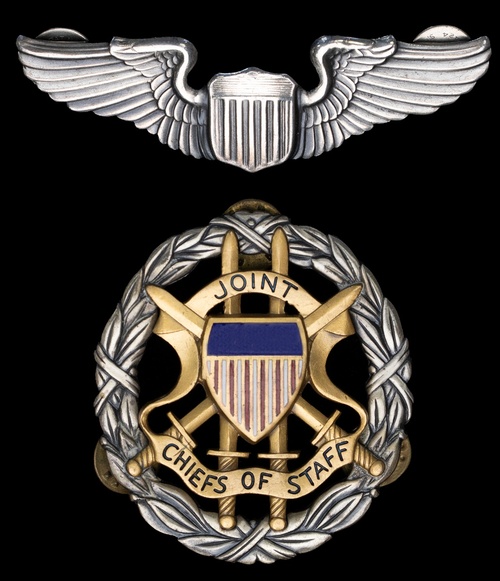
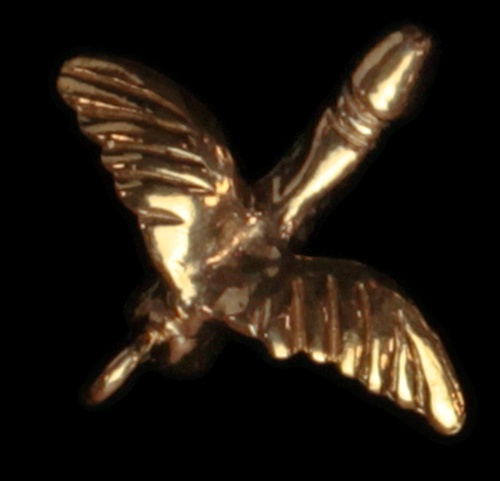
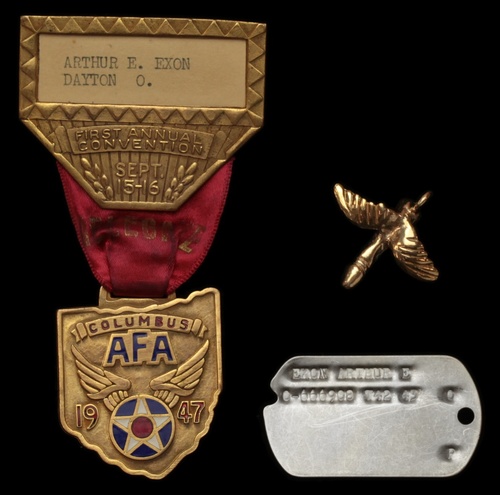
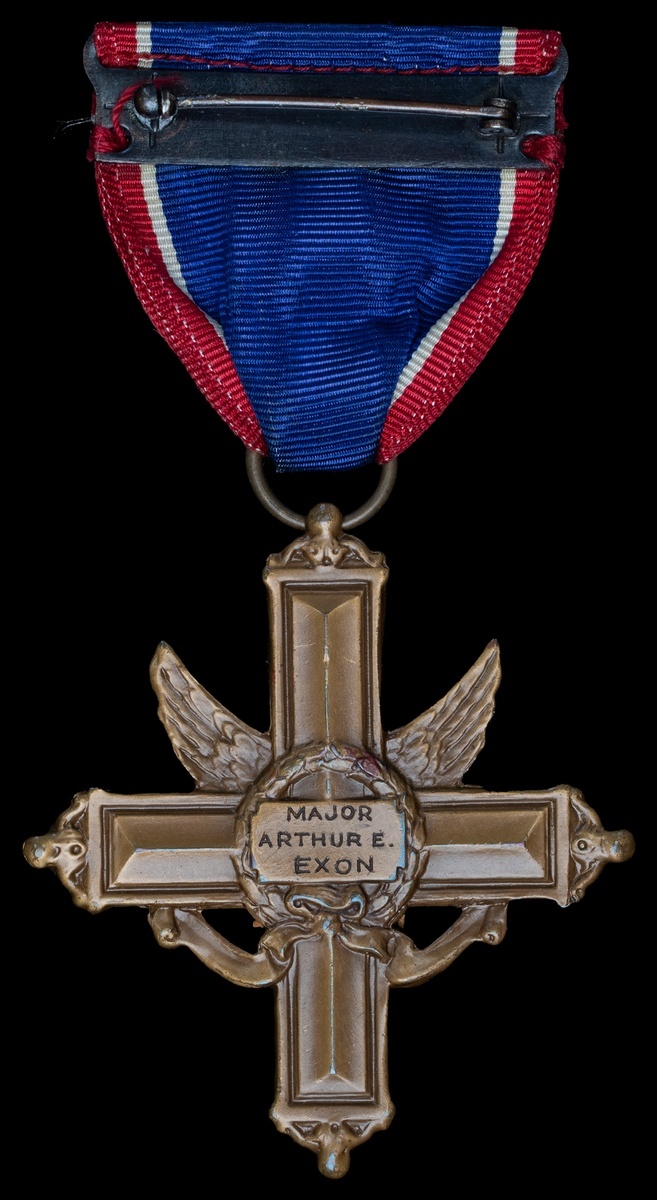
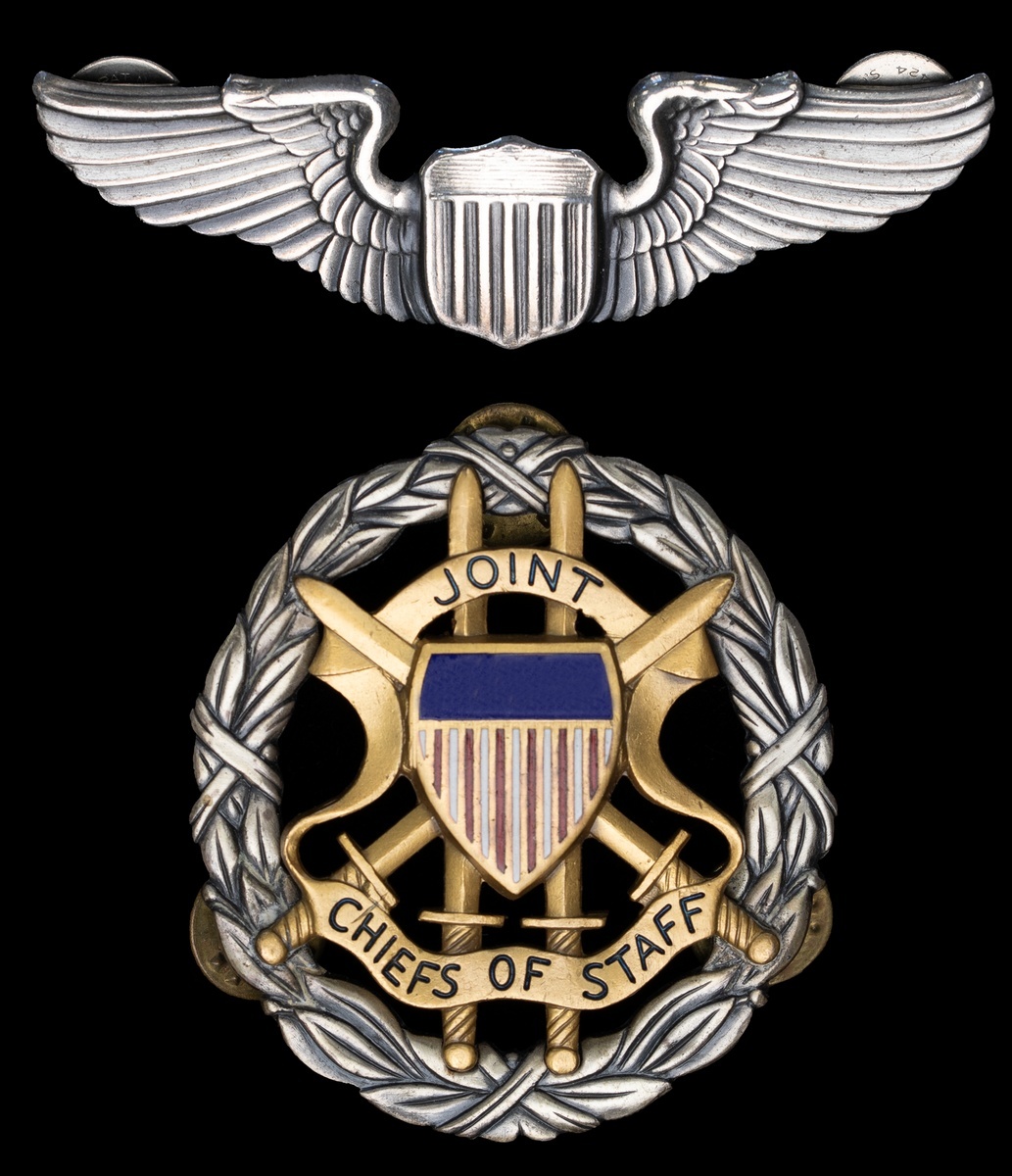
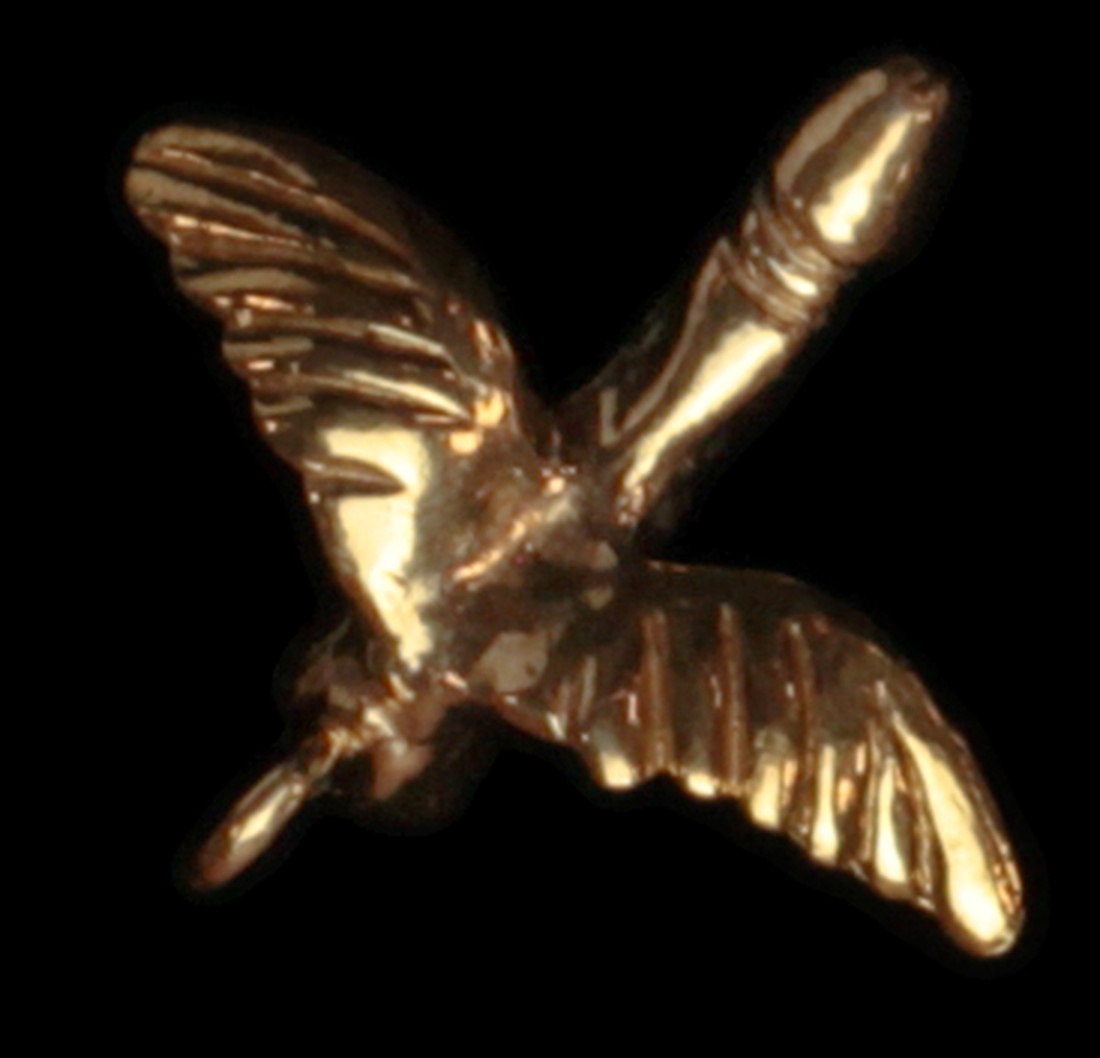
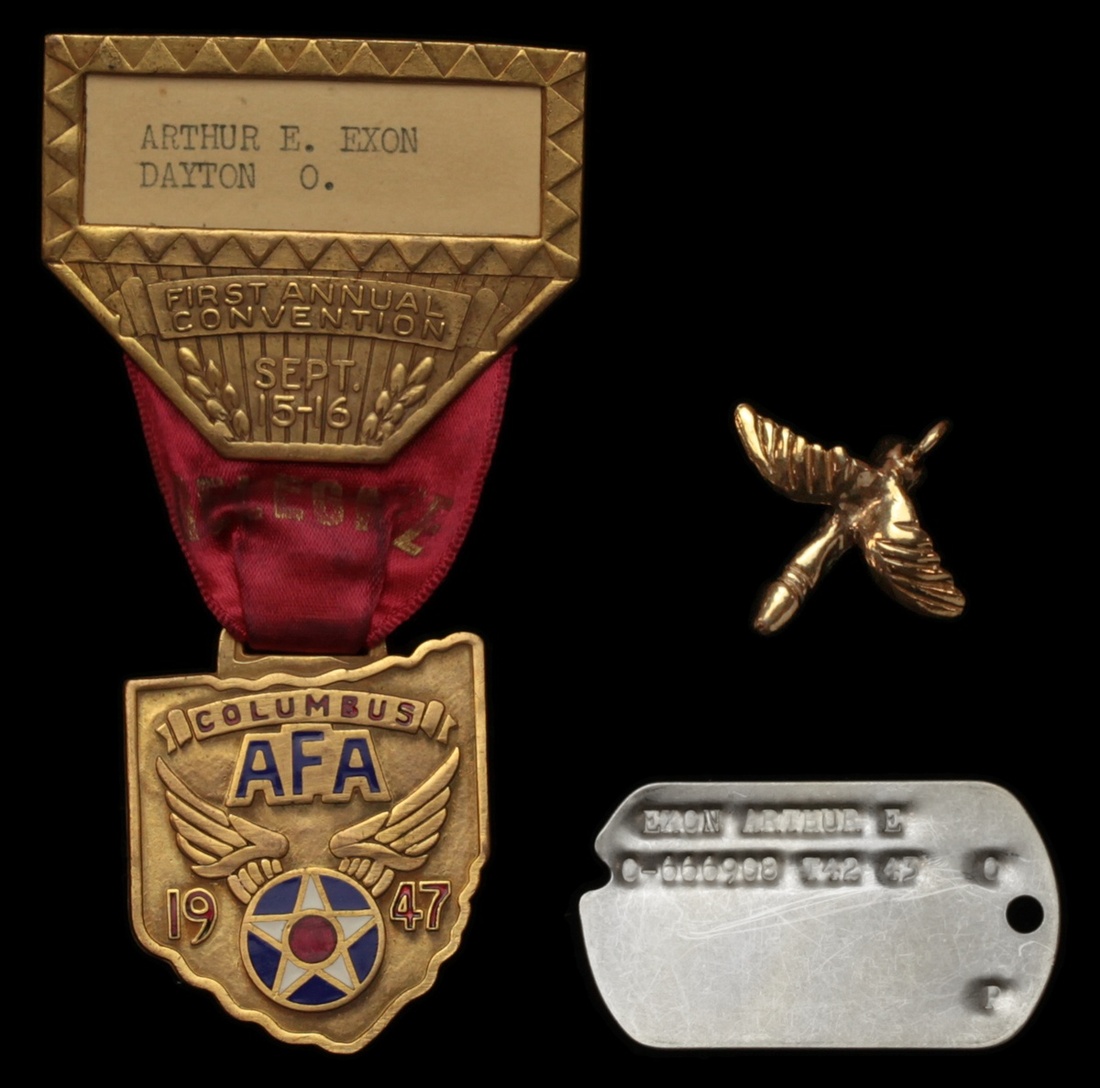
United States of America, Distinguished Service Cross, the reverse engraved 'Major Arthur E. Exon', in its case of issue; Legion of Merit; Distinguished Flying Cross, in its case of issue; Air Medal, in its case of issue; Purple Heart, in its case of issue; Air Force Commendation Medal; Defence Service Medal; European, African, Middle Eastern Campaign Medal; Prisoner of War Medal; Victory Medal; United Kingdom, Distinguished Flying Cross, G.VI.R., the reverse officially dated '1944'; France, Republic, Croix de Guerre, reverse dated '1939-45', with Gold Star, good very fine, together with his identity tag, Columbus AFA Convention 1947 & Tripoli Twerps 1948 name tags, Joint Chiefs of Staff Badge, silver, the reverse stamped 'H.L.P. G.I. Sterling', riband bars and a most interesting flying charm, in the form of a winged phallus, silver-gilt, stamped '925', this last a rare survivor (Lot)
U.S.A. D.S.C. approved 29 September 1944:
'...for extraordinary heroism in connection with military operations against an armed enemy while serving as Pilot of a P-40 Warhawk fighter airplane in the 64th Fighter Squadron, 57th Fighter Group, Ninth Air Force, in aerial combat against enemy forces on 22 October 1943 in the Mediterranean Theater of Operations.
Major Exon was piloting a P-40 Warhawk while leading his squadron on a strafing attack against German communications and supply lines near Ancona, Italy. He spotted 2 supply trains and his squadron attacked. The intensity of the squadron’s concentrated fire resulted in an explosion that destroyed a railway station, a locomotive and more than 50 freight cars. Additional heavy damage created road blocks in the railroad yards and on an adjoining highway.
As Major Exon pulled up from the target, he noted that one of his planes was missing from the formation. He ordered all pilots away from the danger zone and returned alone to search for the lost P-40. While flying at low level over the wreckage, he used his outstanding flying ability when another explosion nearly blew his fighter out of control. He then reformed his squadron and, in the face of intense anti-aircraft fire, strafed a large motor convoy, destroying two staff cars, three reconnaissance cars and three trucks.
Major Exon’s unquestionable valor in aerial combat is in keeping with the highest traditions of the military service and reflects great credit upon himself, the 9th Air Force, and the United States Army Air Forces.'
U.S.A. D.F.C. approved by General Orders No. 22, Hqrs. 12th Air Force, 29 February 1944 with similar citation to his D.S.C..
U.S.A. Legion of Merit for Vietnam:
'...for exceptionally meritorious conduct in the performance of outstanding services to the Government of the United States. The singularly distinctive accomplishments of General Exon culminate a long and distinguished career in the service of his country and his dedicated contributions in the Service of his Country reflect the highest credit upon himself and the United States Air Force.'
U.S.A. Purple Heart as per General Order No. 30 of 17 July 1952.
U.S.A. P.O.W. Medal:
'...was forced to bail out of his damaged airplane over enemy-occupied territory on 20 April 1944, was captured by German forces, and was held as a Prisoner of War until his return to U.S. Military Control at the end of hostilities in May 1945.'
United Kingdom D.F.C. approved 21 August 1944 via AIR 2, the recommendation itself states:
'Major Exon has commanded the 64th Fighter Squadron since August 1943 and has proved himself to be an exceptionally capable and inspiring leader, evincing on many occasions a complete disregard for his own safety in order to complete the task assigned to him. On 20th October 1943, Major Exon led his Squadron on one of the most successful train-wrecking missions in the history of fighter-bombers. This resulted in the destruction on the railway south of Ancona of one railway station, one engine and 30 goods trucks, as well as the blocking of a road and the destruction of three reconnaissance cars, two staff cars, and three other vehicles. Major Exon has destroyed two enemy aircraft.'
Exon himself recalls the act for which he was decorated slightly differently however:
'...General Cannon, the 12th Air Force Commander, called our Group Commander and asked for volunteers to go after some German ships heading into Split Harbour...I volunteered my Squadron and led a formation of four P-40's against four ships. We each carried four 250lb bombs, I hit my target and turned for home. The ship sank.
General Montgomery later called and promised Colonel Knight that he would make sure that when he returned to England, he would put me in for a British DFC. The General kept his word, and after the War was over, I was awarded the British Distinguished Flying Cross for sinking that German supply ship.'
Perhaps the best biography of Arthur Ernest Exon is offered by the US Air Force itself:
'Brigadier General Arthur Ernest Exon is director of the defense contract administration services region, Defense Supply Agency, Los Angeles, Calif.
General Exon was born in Geddes, S.D., in 1916. He attended high school in Fairfax, S.D. and Southern State Teachers College at Springfield, S.D. He was principal of the Junior High School at Fairfax, S.D. for four years before entering military service in January 1942.
In March 1942, General Exon entered aviation cadet training and received his pilot rating in November of the same year. His first duty assignment following flight school was with the 57th Fighter Group in the European-African-Middle Eastern theater of operations. He flew 135 combat missions in Africa, Sicily, Italy, Corsica and Southern France with a total of 325 combat hours. During a mission over Cecina, Italy, in April 1944, his aircraft was severely damaged by an exploding ammunition depot and he was forced to bail out. Captured by the Germans, he remained a Prisoner of War [at Stalag Luft III] until June 1945.
In 1948, following completion of a two-year industrial administration course at the Air Force Institute of Technology at Wright-Patterson Air Force Base, Ohio, he was assigned to Air Materiel Command Headquarters, as chief of the Maintenance Data Section. From August 1951 until April 1952, he was deputy director of maintenance engineering at the Middletown Air Materiel Area, Olmsted Air Force Base, Pa.
Following two years of duty as deputy for operations for the Far East Logistics Force, Japan, he returned to the United States in July 1954 to attend the Air War College at Maxwell Air Force Base, Ala.
He later was assigned to the Pentagon for five years where he held various procurement assignments, among them deputy for procurement and production, deputy chief of staff for materiel. In 1960 he became chief of ballistic missiles within the Directorate of Operations, Headquarters U.S. Air Forces in Europe, and was responsible for establishing the Jupiter Ballistic Missile system for the North Atlantic Treaty Organization in Italy and Turkey.
He departed Europe in July 1963 for duty as deputy commander, Middletown Air Materiel Area, Olmsted Air Force Base, Pa. In August 1964 he was assigned as commander, Wright-Patterson Air Force Base, Ohio. He assumed duties in January 1966 as director, Defense Contract Administration Services Region, Los Angeles, Calif.
His decorations include the Distinguished Service Cross, Legion of Merit, Distinguished Flying Cross, Air Medal with 15 oak leaf clusters, Air Force Commendation Medal with oak leaf cluster, British Distinguished Flying Cross, Croix de Guerre (France), with Palme and Star.'
Roswell UFO incident
In 1947, Exon was stationed at Wright Field, Dayton, Ohio and is recorded as the most senior figure to accept the incident had happened. That June, a Rancher named 'Mac' Brazel discovered scattered metallic objects and sections of rubber on his ranch. Exon himself flatly stated that they had to have been objects from space and '...heard that bodies were recovered.' He is said to have reported to have been denied access to some of the base where the investigations were taking place and that '...everyone from the White House on down knew that what we had found was not of this world within 24 hours of finding it.'
Either way, the conspiracy theories exist to this day, even though it is officially recorded as a crashed high-altitude weather balloon train that had been used to spy on the Soviet Union; sold together with various maps and insignia, besides copied research.
With thanks to Air Commodore Graham Pitchfork for his assistance in accessing the original records in AIR 2 - with much more to follow in his forthcoming work The British D.F.C. to Americans.
Subject to 20% VAT on Buyer’s Premium. For more information please view Terms and Conditions for Buyers.
Estimate
£1,500 to £2,000
Starting price
£1200
Watch, listen and bid as if you were in the room. Now available for auctions worldwide.
Click here to bid live
An exclusive and confidential service for the discerning collector or vendor.
View the Gallery
Download every Spink catalogue on your iPad, iPod or iPhone using free Spink app.
Download From iTunes© 2026 Spink & Son. All rights reserved.