Auction: 26003 - Orders, Decorations and Medals
Lot: 329
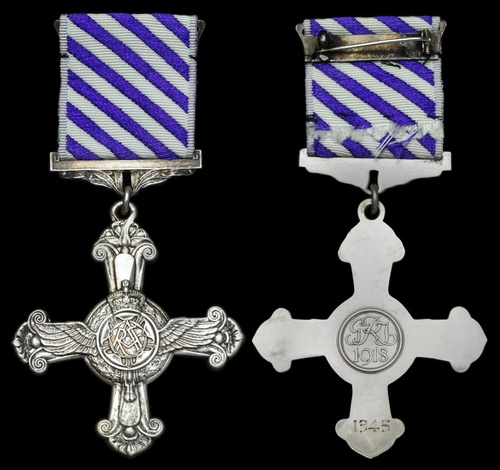
(x) The Second World War D.F.C. attributed to Flying Officer D. E. Richmond, 428 Squadron, Royal Canadian Air Force
Distinguished Flying Cross, G.VI.R., reverse officially dated '1945', in Royal Mint case of issue, good very fine
D.F.C. London Gazette 19 January 1945: the original recommendation states:
'The above-mentioned officer has completed numerous operations against the enemy with fortitude, courage and devotion to duty.'
Douglas Elgin Richmond was born at Parry Sound, Canada on 12 January 1925. He enlisted in the Royal Canadian Air Force and flew in 428 Squadron known as the 'Ghost' squadron.
No 428 Squadron was the ninth long-range heavy bomber squadron and the 26th RCAF squadron formed overseas during the Second World War. It was formed at RAF Dalton in Yorkshire, England on November 7, 1942. The squadron was initially assigned to No. 4 Group RAF Bomber Command. With the creation of No. 6 Group RCAF, the squadron was reallocated on January 1, 1943, operating with it until April 25, 1945.
The squadron was originally equipped with Vickers Wellington Mk III and X, and its first operational mission was on January 26-27, 1943, when five Wellingtons bombed the U-Boat base at Lorient in Brittany, on the Bay of Biscay. In the early part of June 1943, the squadron moved to RAF Middleton St. George, Durham where it remained for the remainder of the war. Around this time the squadron was converted to Handley Page Halifax's (Mk Vs, and later supplemented by Mk II Series IIA). In January 1944, Halifax bombers from No. 428 Squadron participated in the first high-level mining raid "Gardening", when mines were dropped by parachute from 15,000 feet (4,570 m) over Brest on 4/5 Jan and Saint-Nazaire on 6/7 Jan 1944. The squadron flew its last sortie with the Halifax on June 12, 1944, then converted to the Canadian-built Avro Lancaster Mk X, the first sortie taking place on June 14, 1944.
For the final phase of the air campaign against Germany, the squadron took part in day and night raids, with its last operational sortie taking place on April 25, 1945, when 15 Lancasters bombed anti-aircraft gun batteries defending the mouth of the Weser, on the Frisian Island of Wangerooge. The squadron remained in service in the United Kingdom until the end of May 1945, then flew to Yarmouth, Nova Scotia. The squadron was intended to be part of the "Tiger Force" to carry on the war against Japan, but the Japanese surrender led to the disbandment of the force. The squadron was disbanded at Yarmouth in September 1945; sold together with a copy letter from the Royal Canadian Air Force Central Air Command HQ dated 21 March 1949 forwarding the DFC to Richmond.
Subject to 5% tax on Hammer Price in addition to 20% VAT on Buyer’s Premium.
Estimate
£700 to £900
Starting price
£550
Watch, listen and bid as if you were in the room. Now available for auctions worldwide.
Click here to bid live
An exclusive and confidential service for the discerning collector or vendor.
View the Gallery
Download every Spink catalogue on your iPad, iPod or iPhone using free Spink app.
Download From iTunes© 2026 Spink & Son. All rights reserved.