
Auction: 26003 - Orders, Decorations and Medals
Lot: 284
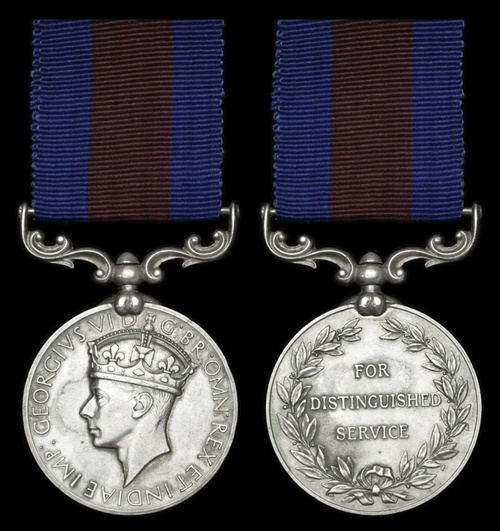
The North-West Frontier 1937 I.D.S.M. awarded to Bahadur S. Gul, O.B.I., 15th Punjab Regiment
India Distinguished Service Medal, G.VI.R. (Jemdr. Sahib Gul, 3-15 Punjab R.), very fine
I.D.S.M. G.O.I. 25 December 1937.
[O.B.I.] G.O.I. 1945.
[M.I.D.] London Gazette 1 April 1941.
Sahib Gul enlisted into the 27th Punjab Regiment on 18 March 1918 and trained at the Regimental Depot at Ferozepur, where he was later posted to the 2nd Battalion. One of his first deployments with them was operations at Afghanistan between May - August 1919.
Several years later on 1 May 1935, Gul commissioned Semedar and, now serving with the 3/15th Battalion, partook in the operations at Waziristan in 1937. Promoted Subedar, he was then awarded this I.D.S.M. for gallantry for these operations, indeed the only individual in the battalion to receive such an honour. The award was almost certainly in relation to his work at Shakti Valley in November 1937, which was a key offensive and one where the Punjabis saw active, frontline action. The following year, Gul was appointed Acting Subedar Major - the senior Viceroy's Commissioned Officer of the 3/15th on 1 July 1938.
At the beginning of 1939, the battalion was initially selected as an Imperial reserve to be formed in Southern Command, and yet the plan was abandoned and put on ice at the outbreak of the Second World War. The 3/15th Battalion finally began to see action in July 1940, when they left India to join the fight defending British Somaliland against Italian attack. The British position in Somaliland at the time was precarious, and the Punjab Regiment, along with the Black Watch, were sent to meet a far larger Italian force made up of two divisions with tanks, aircraft and heavy artillery. Against such a barrage of offense, British Somaliland was lost in August 1940 to the Italians.
But the fight was not yet over. Over the following months, Gul, with the 3/15ths withdrew to Berbera port. The fight was particularly perilous due to frightening dive-bombing, and one company of the 3/15 Punjab, holding out against concentrated enemy assault, became isolated and feared lost, later skilfully evaded the enemy and rejoined the rest of the Battalion two days later. The assault launched on the Italians was brutal, and with Berbera later recaptured, the number of Italian graves shows their casualties to have been some 20 for every one Imperial. And indeed, Gul was one of only three men in his regiment Mentioned in Dispatches for the Somaliland campaign.
Gul and the battalion then returned to Aden before then leaving for Persia in June 1942, and later Iraq in January 1943. At this time, the 3/15th had joined the 21st Indian Infantry Brigade of the 8th Indian Division. By the end of the year in September, the battalion disembarked at Alexandria for Italy. Over the coming months, the battalion was present for the crossing of the River Trigno by capturing Celenza and Terrebruna. In the November, the 3/15th took part in the full scale assault crossing the River Sangro, which broke the German Winter Line. The battalion played a vital role in the cross of the River Moro and took part in the 8th Indian Division's slow advance to the River Arielli, where it remained until April 1944, when the Division moved across the Apennines up into Cassino.
The 3/15th then served in the reserve Brigade in the attack on the Gustav Line on 11 May 1944, and later crossed the Rapido River on 14 May, from where it carried out two successful attacks and thus outflanked Pignataro to the West. The 8th Indian Division was then relieved by the 1st Canadian Division here and was then sent to protect the 13th Corps at Piedmonte. With the help of New Zealand tanks, here they outflanked the German strongpoint at Rocca d'Arce.
The battalion remained in Italy, patrolling Florence and in September, penetrated the German Gothic Line defence system. In October, Gul helped patrol around Marradi and captured Roce Danielle, and later Casolo Valsenio. Then, in a final push in 1945, the 3/15ths moved across the Serchio Valley to help the Americans. Once this was completed, they then moved to the River Senio in late February, and by the beginning of April, saw heavy fighting before succeeding in crossing it. The last action of Gul's war was the crossing of the River Po and on 3 May 1945, the German forces in Italy finally capitulated. The battalion then embarked for India, where it commenced work on the Burma campaign.
At the end of such a varied military career, Gul was awarded the Order of British India, 2nd Class, and finally retired in 1945; sold together with copied research, including the write up included in this catalogue description.
Subject to 20% VAT on Buyer’s Premium. For more information please view Terms and Conditions for Buyers.
Estimate
£500 to £700
Starting price
£400

Watch, listen and bid as if you were in the room. Now available for auctions worldwide.
Click here to bid live
An exclusive and confidential service for the discerning collector or vendor.
View the Gallery
Download every Spink catalogue on your iPad, iPod or iPhone using free Spink app.
Download From iTunes© 2026 Spink & Son. All rights reserved.