
Auction: 26003 - Orders, Decorations and Medals
Lot: 278
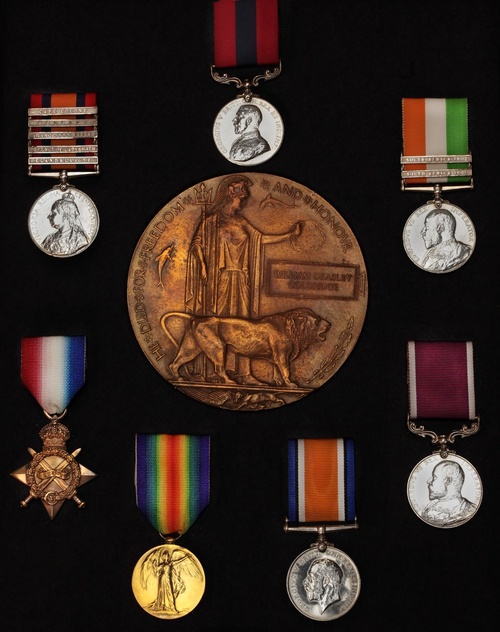
The poignant 1918 D.C.M. group of eight awarded to Regimental Sergeant-Major W. D. Coldridge, 5th Royal Irish Lancers, attached Bedfordshire Yeomanry
A veteran of the Charge at Elandslaagte, he was promoted for gallantry at Rietfontein three days later; during the Great War he died of heart failure, the result of Spanish flu, on 21 July 1918
Distinguished Conduct Medal, G.V.R. (L-12533 T.R.S.Mjr: W. D. Coldridge. 5/Lrs:); Queen's South Africa 1899-1902, 5 clasps, Elandslaagte, Defence of Ladysmith, Orange Free State, Belfast, Cape Colony (3884. S.S. Maj: W. D. Coldridge. 5/Lcrs.); King's South Africa 1901-02, 2 clasps, South Africa 1901, South Africa 1902 (3884 Qr:Mr:-Serjt: W. D. Coldridge. 5th Lancers); 1914-15 Star (5L-3884 Sq.S.Mjr.- A.S.Mjr. - W.D. Coldridge. 5-Lrs.); British War and Victory Medals (5L-3884 A.W.O. Cl. 1 W. D. Coldridge. 5-Lcs.); Army L.S. & G.C., E.VII.R. (3884 Q.M.Sjt: W. D. Colridge. 5/Lrs); Great War Bronze Memorial Plaque (William Deasley Coldridge), mounted in an attractive glazed frame with his Condolence Slip pasted to the reverse, light contact wear, overall good very fine (8)
D.C.M. London Gazette 2 June 1918, the original citation quoted on 21 October 1918 states:
'For conspicuous gallantry and devotion to duty. This W.O. has at all times set a high example of discipline and courage, especially during operations of nearly two months, when he was indefatigable in maintaining communications between Regimental H.Q. and forward squadrons under fire of every description.'
William Densley Coldridge was born at St. Sidwells, Exeter, Devon in 1868, the son of Charles and Amelia Coldridge. Attesting at Exeter with the 5th Lancers on 5 November 1890 he listed previous services with the 1st Volunteer Battalion, Devonshire Regiment.
Posted to India to join the Regiment on 2 September 1891 he left with them in 1898 for the Cape where they were to join the gathering British forces in Natal prior to the outbreak of war. By this time Coldridge was serving in the rank of Orderly Room Sergeant and he was performing this role at Pietermaritzburg when the war began in October 1899.
The pyrrhic victory at Talana saw General Sir George White order his men to withdraw and reform at Ladysmith however Boer forces blocked the route from Dundee to Ladysmith forcing White to go on the offensive. He faced down General Kock's commando at Elandslaagte where the infantry attacked the Boer positions and with a heroic effort managed to push into hand-to-hand combat.
With the infantry forcing the Boer's from their positions the cavalry where able to perform the role for which they had been created, the official report on the action at Elandslaagte refers:
'With levelled lances and bared sabres the two squadrons dashed forward and rode over and through the panic-stricken burghers. As soon as the latter heard the thud of the galloping horses and cries of the troopers, they opened out and tried to save themselves by flight… For a mile and a half the Dragoons and Lancers over-rode the flying enemy. Then they rallied and galloped back to complete the havoc and to meet such of the fugitives as had escaped the initial burst'.
After the action General White was to say that the British cavalry had 'the satisfaction of knowing that they took part in the one real cavalry charge of the campaign'.
Three days later the army was in action again at Rietfontein, the role of the 5th Lancers in the action was a key one, as they seized the ridges on the British right, protecting their flank. Unfortunately the infantry were unable to make headway and in the face of Boer reinforcements White ordered a withdrawal at the end of the day. It was here that Coleridge was advanced Quartermaster Sergeant 'for distinguished service in the field' on 24 October 1899.
The unit saw heavy action during the Siege of Ladysmith not just during the major actions but also undertaking several reconnaissance patrols. They would later see action with the British columns throughout the guerilla phase of the war with Coldridge being advanced Squadron Sergeant Major on 1 February 1901.
Returning to Britain on 20 September 1902 he served there for some time, marrying in Yorkshire in 1911 and having a daughter in Ireland, presumably when he was posted to Dublin. Eventually Coldridge transferred to the Bedfordshire Yeomanry on 1 April 1914 as Regimental Sergeant Major, he replaced R.S.M. Elliot late of the 7th Hussars there. He proved a towering figure in the unit earning great praise from his Colonel, O.C. Bedfordshire Yeomanry a statement by Colonel S. Peel CB DSO TD refers:
'No account of the regimental HQ would be complete without a mention of RSM Coldridge. He was one of the casualties of war as he died of heart failure after an attack of pneumonia in 1918. He was an absolutely perfect superintendent of the orderly room though he could fight as well as anyone if the occasion arose. He had a perfect command of the military language and knew how to interpret it. I used to say "Mr C, what does such-and-such an army order mean?", "Sir it means so-and-so" (a quite lucid explanation". "That's not what they say", "no Sir, that is what they mean" and it always turned out that he was right. He was an invaluable organiser and had in addition beautifully clear handwriting. The only thing that could tear him away from his orderly room business was the prospect of fishing. During the intervals of the battle of the Somme we used to be billeted in villages bordering on the lower Somme where there are many marshes and ponds. Orderly room business would be cleared up with extraordinary dispatch, and if you went to the right place you would find Mr C, all sergeant major severity gone but still quite correctly dressed, sitting on the bank, eagerly watching his float. I did no remember that he ever caught any fish except on one occasion where I found him in the act of landing 4 inch roach, but perhaps I'm exaggerating his lack of success.'
Coldridge entered the war in France on 9 September 1915 with the Bedfordshire Yeomanry. The Regiment saw heavy action during the Somme Offensive, at Cambrai in 1917 and during the Hundred Days. It was during the final campaign the strain of the conflict and the spread of Spanish Flu saw Coldridge finally struck down. Having survived a bought of influenza he was left weakened and died of heart failure on 21 July 1918, he is buried at Abbeville Communal Cemetery Extension; sold together with copied research.
Subject to 20% VAT on Buyer’s Premium. For more information please view Terms and Conditions for Buyers.
Estimate
£2,000 to £3,000
Starting price
£1800
Watch, listen and bid as if you were in the room. Now available for auctions worldwide.
Click here to bid live
An exclusive and confidential service for the discerning collector or vendor.
View the Gallery
Download every Spink catalogue on your iPad, iPod or iPhone using free Spink app.
Download From iTunes© 2026 Spink & Son. All rights reserved.