
Auction: 26003 - Orders, Decorations and Medals
Lot: 276
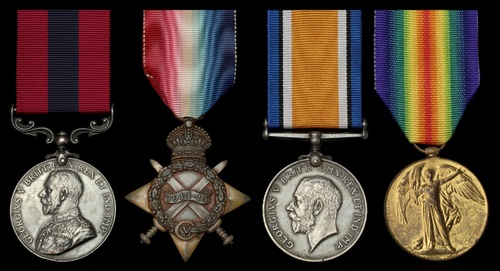
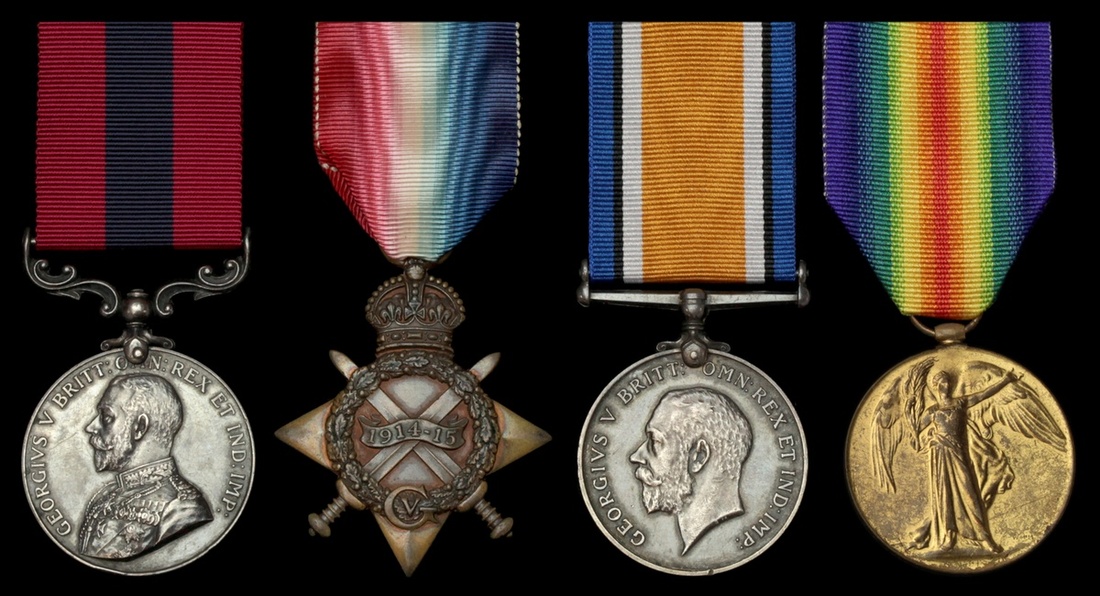
The Third Battle of Ypres 31 July 1917 D.C.M. group of four awarded to Private E. Jones, Prince of Wales's Leinster Regiment (Royal Canadians)
Distinguished Conduct Medal, G.V.R. (6-584 Pte. E. Jones. 2/Leins: R.); 1914-15 Star (584. Pte. E. Jones. Leins. R.); British War and Victory Medals (584 Pte. E. Jones. Leins. R.), good very fine (4)
D.C.M. London Gazette 22 October 1917. The citation followed on 26 January 1918:
‘For conspicuous gallantry and devotion to duty. When the sole survivor of his gun team, he got into a trench with the two front companies, collected their guns and the remnants of their teams, and, taking up a commanding position on the left flank, opened fire on the enemy, who were massing, and dispersed them with heavy loss. His prompt and gallant action assisted the two leading companies to push on.’
Annotated gazette states: ‘East of Ypres, 31 July 1917.’
Edgar Jones was a native of Clydach Vale, Rhondda, South Wales, and first entered the war in the Balkans with the Leinster Regiment on 9 July 1915, probably with the 6th Battalion, and afterwards served in France with the 2nd Battalion, Leinster Regiment.
Narrative of Operations undertaken by 2nd Battalion, The Leinster Regiment on the 31 July 1917.
'At Zero Hour (3.50a.m.) our barrage came down and the leading wave closed up on the barrage. It was then very dark. The hostile barrage was very quick in response and came down on our front line and vicinity almost immediately. It lengthened to MT.SORREL and CANADA STREET about Zero + 10 minutes.
As soon as our barrage permitted the three leading Coys. pushed forward as arranged, but the darkness and the wide extension of the leading two lines made it very difficult to keep touch. A few of the enemy were encountered lying in shell holes less than 100 yards from our front line, but these offered no resistance, and surrendered freely. The first opposition met was at the hostile front trench about ILIAD RESERVE and ILLUSIVE RESERVE where there was some fighting, a few Germans being killed and about 20 prisoners taken. After about 5 minutes delay, our Companies then pushed forward towards their first objective. The ground to be crossed was extremely muddy and was much broken up by our heavy preliminary bombardments. It was found that the pace of the barrage was much too quick and our men were unable to keep up to it from the start. The enemy's main line of resistance was in LOWER STAR POST and on the ridge running NORTH and SOUTH of this. This high ground was strongly garrisoned, and the well concealed well protected fire positions were provided a clear sweep of fire for their garrison down the valley along which the right Company of the Battalion had to advance.
A few minutes after ZERO HOUR the right of the advance came under s very heavy M.G. and Rifle fire from this ridge and from LOWER STAR POST itself, and many casualties were caused. All the Officers of this Company fell and only one Sergeant remained. To avoid this fire-swept valley the survivors seemed to have turned Northwards and crossed the high ground on their left, so joining in with the left Company who were themselves suffering severely from enfilade and frontal M.G. and Rifle fire. Similarly on the extreme right flank of the Battalion the effect of this hostile fire from the LOWER STAR positions was to turn the 7th NORTHAMPTONSHIRE REGT. to their right so as to avoid the same valley. An Officer and about twelve men of my Battn. accompanied them.
By the time the left of the advance reached the Western edge of the wood North of LOWER STAR POST casualties had been very severe, and only isolated groups of men were available to push on to the assault of the enemy trenches in front of the BLUE LINE. The left of the Battalion was now in touch with 17th BRIGADE, and the survivors of the three leading Companies were collected and organised for a further advance in conjunction with the 1st ROYAL FUSILIERS. Our barrage at this time was out of sight, the wood was thickly wired with low trellis wire which was quite intact, and the enemy were resisting strongly from a group of loopholed concrete dug-outs in the BLUE LINE. After much delay, and after several unsuccessful efforts made by small parties in a most gallant manner had added considerably to the list of casualties, these dug-outs were eventually carried by a double flanking movement, and we obtained possession of the enemy trench.
We were now practically in possession of the BLUE LINE, and in touch with the 17th BRIGADE, but a large gap existed on the right flank and it was impossible to clear this up without reinforcement of men, ammunition and bombs.
Consolidation of the captured line was commenced and it was decided not to make any further advance. Enemy fire was still very active from the front and from the right flank, but a patrol was pushed out to try to get touch on the right and to collect any stragglers. This patrol did not return.'
Sold with copied research including War Diary extracts covering the battalion operations of 31 July 1917.
Subject to 20% VAT on Buyer’s Premium. For more information please view Terms and Conditions for Buyers.
Estimate
£1,400 to £1,800
Starting price
£1200

Watch, listen and bid as if you were in the room. Now available for auctions worldwide.
Click here to bid live
An exclusive and confidential service for the discerning collector or vendor.
View the Gallery
Download every Spink catalogue on your iPad, iPod or iPhone using free Spink app.
Download From iTunes© 2026 Spink & Son. All rights reserved.