Auction: 26003 - Orders, Decorations and Medals
Lot: 260
Sold by Order of a Direct Descendant
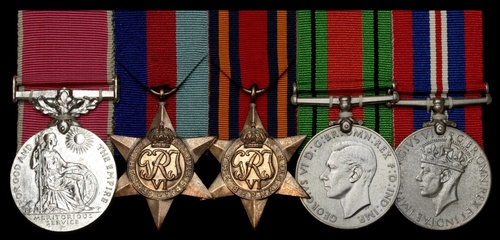
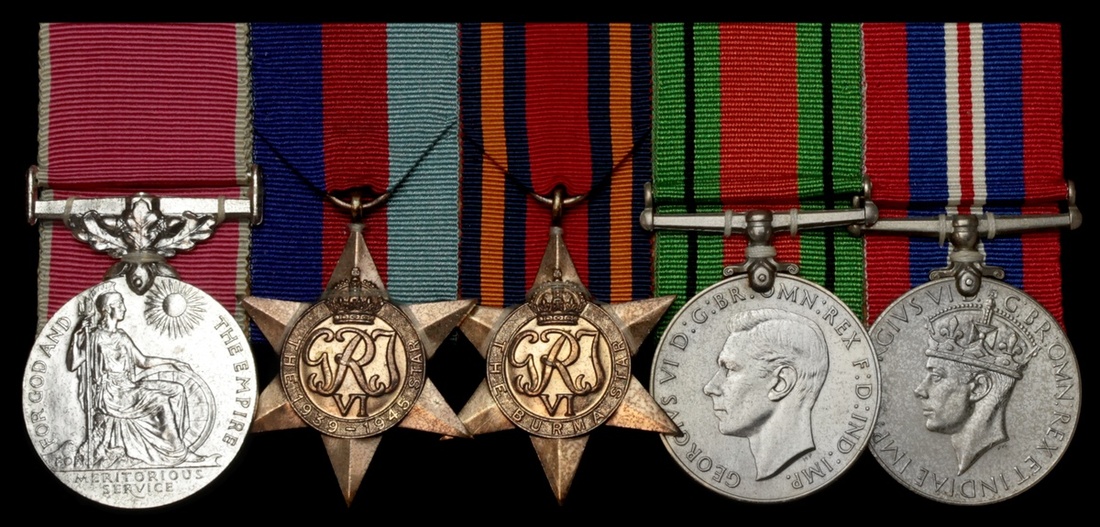
The fascinating 'Secret Service' 1943 B.E.M. group of five awarded to Captain A. R. Miller, Royal Signals, for service with M.I.6. Section VIII, also a member of Special Communications Unit 4 (SCU 4) "Richard Gambier-Parry's Mob"
British Empire Medal, Civil Division, G.VI.R. (Albert Reginald Miller), officially engraved naming; 1939-45 Star; Burma Star; Defence and War Medals 1939-45, sold together with riband bar, mounted as worn, very fine (5)
No entry into the London Gazette has been located at present, however, there is a copy of the Presentation Order at Buckingham Palace for the 2 November 1943, where Miller is awarded his Medal. It states that he is a former employee of the Foreign Office, despite this not being apparent from any of his previous records - no doubt as a result of the secretive nature of his work.
Albert Reginald Miller - or 'Bert' to his friends and comrades - was born in Birmingham on 14 December 1898 to parents William, a Coachman, and Anne Elizabeth Smith. He was the second youngest of five children, attending a local school until 1913.
Miller, like many young men of this period, lied about his age to join the military, at only 15 years old. He enlisted as a Boy II and trained aboard H.M.S. Impregnable and Vernon, with his first posting being aboard H.M.S. Blake at the rank of Telegraphist. He ended his Great War service aboard H.M.S. Dolphin, having briefly served at the rank of Leading Telegraphist.
After the war, he continued to serve in the Royal Navy, first aboard H.M.S. Foxglove at the rank of Leading Telegraphist. By 1933, he had reached the rank of Petty Officer Telegraphist, being a senior rate responsible for all communications aboard a vessel.
In 1938, mysteriously left the Royal Navy to become a reservist, according to his records. Interestingly, the 1939 Census shows his residence and occupation as being at Bletchley Park as an Engineer for the War Office. In 1940, he was serving with the Gibraltar Defence Force and was transferred to the Royal Signals and appointed Sergeant, 1 June. A letter from the Under Secretary of State from 1947 states that his appointment as Sergeant was conferred by the Commander-in-Chief, Gibraltar, interestingly, with no records of a commission. This strengthens the idea that Miller was provided with this position as a means to hide his involvement with the S.I.S..
On 24 August 1943, he was discharged from the Royal Signals in order to receive a commission as Second Lieutenant with the Royal Signals. Shortly afterwards, in November, he is awarded a civil division B.E.M., despite being an active serving military officer. This sheds more light on his clandestine service at Bletchley Park and abroad. A note from Brigadier Gambier-Parry, the man who established the Communications Section of M.I.6. at Whaddon Hall, states that;
'Miller is the other man we have chosen to strengthen the training side of the organisation. He also is one of the old hands. He is a man of outstanding strength of character and personality, and has done work overseas which has been recognised by the grant in the recent Honours List of the British Empire Medal.'
Miller was headhunted by Gambier-Parry and was assigned to Special Communications Unit No. 4, a part of M.I.6. Section VIII. Throughout the later periods of WW2, Miller is repeatedly granted lengthy periods of leave for the reason, 'private'. By 1947, he had been promoted to Captain. During this time, a picture of the officers at Whaddon Hall was produced, with Miller seated alongside Brigadier Gambier-Parry. Miller's descendants recall his friendship with Gambier-Parry in later life, showing the link between Miller and the senior members of the communications branch of M.I.6.. Members of this branch were often given cover as ordinary soldiers within the Royal Signals to hide their involvement with M.I.6.. The role of the branch was to go behind enemy lines to interrupt communications and intercept messages to aid the cause of the war.
A letter sold together with this lot is from Gambier-Parry to the Miller at the British Embassy in Moscow, passing on congratulations for the work their team had accomplished during the war. The vagueness of the letter leads to speculation as to what role he played while at the Department for Wireless Services at Hanslope.
It is unclear when he left M.I.6., or if he ever did, but he continued to live in Bletchley with his children and grandchildren. He died 29 March 1973, at 75 years old. Sold together with a large archive, including;
i)
Medal ribband, cap badge for Sommerset Light Infantry, and Burma Star Association badge.
ii)
Photographs of Miller.
iii)
Service and pay books.
iv)
Original letter correspondence from Brigadier Gambier-Parry.
v)
Original box for B.E.M.
vi)
Extensive copied research.
Subject to 20% VAT on Buyer’s Premium. For more information please view Terms and Conditions for Buyers.
Estimate
£600 to £800
Starting price
£480
Watch, listen and bid as if you were in the room. Now available for auctions worldwide.
Click here to bid live
An exclusive and confidential service for the discerning collector or vendor.
View the Gallery
Download every Spink catalogue on your iPad, iPod or iPhone using free Spink app.
Download From iTunes© 2026 Spink & Son. All rights reserved.