Auction: 26003 - Orders, Decorations and Medals
Lot: 258
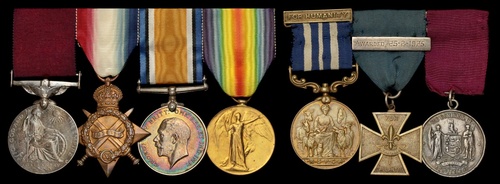
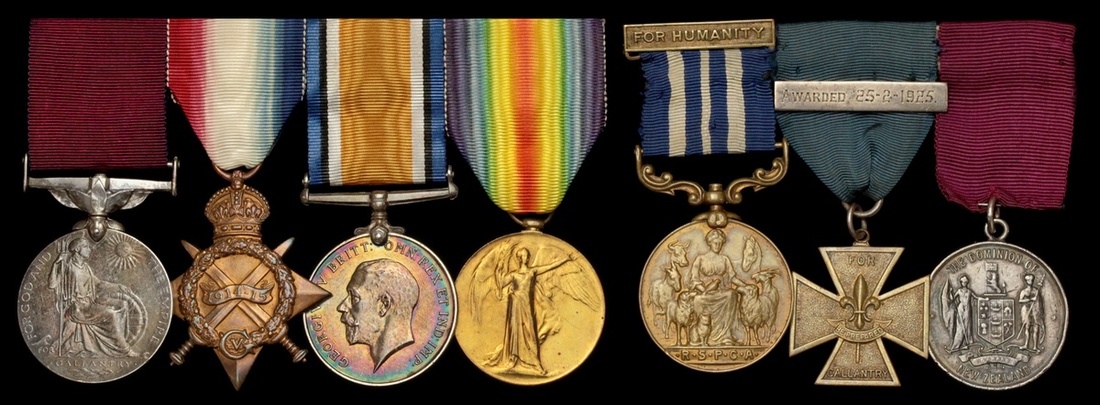
(x) The rare inter-war E.G.M. group of six awarded to James 'Jack' Burke, a Superintendent Fire Officer at the Armstrong Whitworth Engineering Works in Manchester, who had earlier seen action as a gunner in the Royal Marine Artillery - he is considered the holder of the George Cross following the conversion of these awards
Empire Gallantry Medal, G.VI.R., Civil Division (James Burke); 1914-15 Star (R.M.A. 10632 Act. Br. J. Burke.); British War and Victory Medals (R.M.A. 10632 Gr. J. Burke.), these four mounted as worn; Royal Society for the Prevention of Cruelty to Animals, Lifesaving Medal, bronze, with 'For Humanity' brooch bar, 'Awarded to Mr. James Burke, 1919'; Boy Scout Association, Silver Cross, with Bar, the reverse of the Cross inscribed, 'Instructor Jas. Burke 302nd M.F. Troop. 16 Jan. 1920', and the Bar inscribed, 'Awarded 25-2-1935', together with a Dominion of New Zealand commemorative for H.M.S. New Zealand's visit in 1913, silver, engraved in capitals on pre-prepared ground, 'R.M.A. 10632 Gnr. Jas. Burke', obverse silver on the Boy Scout's award worn away and the H.M.S. New Zealand commemorative with edge bruising, polished overall, nearly very fine or better (7)
E.G.M. London Gazette 3 June 1925:
'The KING has been graciously pleased, on the occasion of his Majesty's Birthday, to approve the award of the Medal of the Civil Division of the Most Excellent Order of the British Empire to the undermentioned:
For Gallantry
John Burke. In recognition of his action in stopping runaway horses on two occasions at great personal risk.'
James Burke was born in Willenhall in the West Midlands on 21 April 1887 and enlisted in the Royal Marine Artillery in October 1903.
Posted as a gunner to the newly commissioned battlecruiser H.M.S. New Zealand in November 1912, he remained similarly employed until March 1915, commencing with her pre-war tour to the Dominions. Whilst visiting New Zealand in April-June 1913, the ship was estimated to have been visited by almost half the country's population, one of whom was a Maori chieftain. He presented the captain of the ship with a Maori piupiu - a warrior's skirt - and a greenstone tiki pendant which were intended to ward off evil, with the injunction that they were always to be worn by the captain when the ship was in action. Their efficacy was to be proved when the ship saw action at the battles of Heligoland Bight on 28 August 1914, Dogger Bank on 24 January 1915 and Jutland on 31 May 1916.
At Dogger Bank, command of the British squadrons fell to Rear-Admiral Moore of the New Zealand when Beatty's Lion was badly damaged by three 12-inch shells from the Derfflinger, and as a consequence she was directly engaged in the three hour duel that resulted in the loss of the Blucher. Having witnessed those momentous events, Burke was invalided ashore to the R.N.H. Haslar in April 1915, his service record noting that the causes were 'attributable' to his war service and that he was awarded the King's Certificate in October 1921.
On being discharged from hospital, Burke saw out the war as a Police Constable and then joined Armstrong Whitworth Ltd. as a fire officer.
In respect of his subsequent award of the E.G.M., the first runaway horse incident occurred at the company's works at Openshaw, Manchester, on 3 December 1919, when he caught the horse in Ashton Old Road and was dragged several hundred yards before bringing it to a standstill. And on 8 December 1924, he caught another runaway horse which had run amok in nearby Whitworth Street.
Burke's gallantry was further recognised by the R.S.P.C.A. and the Scout Association, who awarded him their Silver Cross and Bar, which distinction was presented to him at a ceremony held in Manchester on 2 April 1925.
Towards the end of the decade, he moved to Metropolitan-Vickers - later the General Electrical Company - at Trafford Park, where he was likewise a member of the company's fire brigade.
With the introduction of the George Cross in September 1940 - and in exchange for his E.G.M. - Burke received the new award from the King at Buckingham Palace on 23 September 1941. He died in Salford on 29 June 1963, where he was buried in an unmarked grave in the Northern Cemetery at Agecroft.
Subject to 5% tax on Hammer Price in addition to 20% VAT on Buyer’s Premium.
Estimate
£2,500 to £3,000
Starting price
£2000

Watch, listen and bid as if you were in the room. Now available for auctions worldwide.
Click here to bid live
An exclusive and confidential service for the discerning collector or vendor.
View the Gallery
Download every Spink catalogue on your iPad, iPod or iPhone using free Spink app.
Download From iTunes© 2026 Spink & Son. All rights reserved.