Auction: 26003 - Orders, Decorations and Medals
Lot: 254
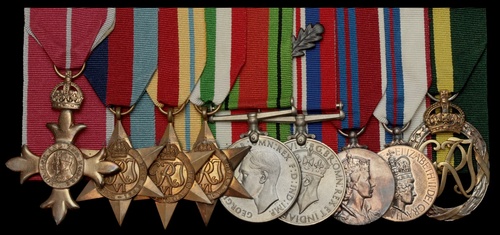
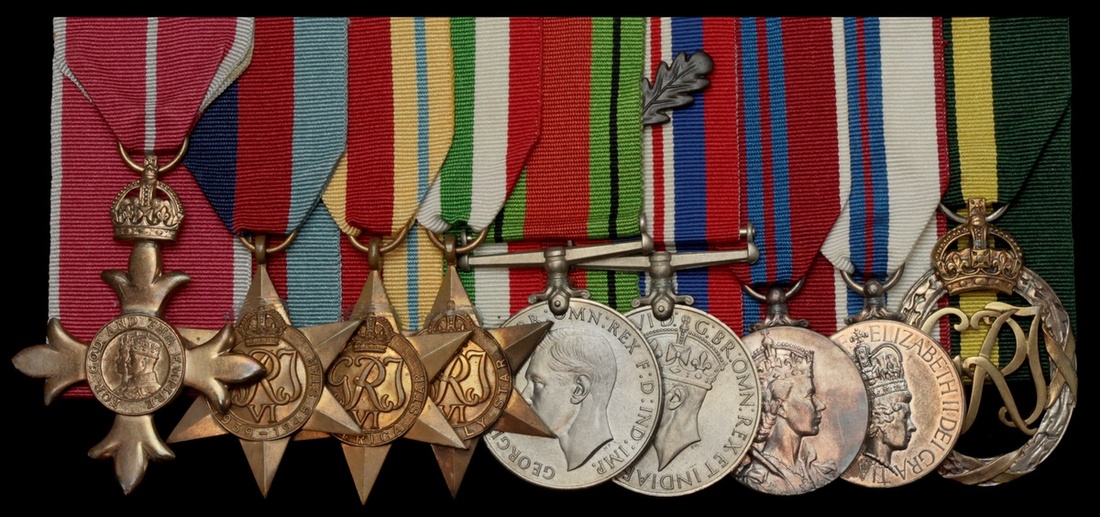
The 1945 O.B.E. group of nine awarded to Colonel C. W. Hurley, Royal Artillery, having previously earned the M.B.E. for his 'total disregard for his personal safety' during the Salerno landings
The Most Excellent Order of the British Empire, Military Division, Officer's (O.B.E.) 2nd Type, breast Badge, silver-gilt; 1939-45 Star; Africa Star; Italy Star; Defence and War Medals 1939-45, with M.I.D. oak leaf; Coronation 1953; Jubilee 1977; Efficiency Decoration, G.VI.R., 1st issue, Territorial '1946' engraved to the reverse, sold together with attributed dress miniatures, mounted as worn, nearly extremely fine (9)
O.B.E. London Gazette, 13 December 1945, the original recommendation states:
'As A.A.G., H.Q. No. 1 District, this officer has shewn constant and unabated energy, determination and enthusiasm in all his work, which has at all times been of the highest order. This District being the maintenance area immediately behind Eighth Army has had an extremely heavy responsibility including the receiving and holding of many thousands of Prisoners of War at the shortest notice or without notice, the arrangements for the receiving of thousands of Ex-Prisoners of War of many nationalities and also the passing through this District of large numbers of Refugees. The responsibility for this has fallen on Lt Col Hurley. That these personnel were dealt with so expeditiously was largely due to his forethought and organisation and the fact that he has at all times kept control himself, though this entailed his working long hours and often far into the night for a considerable period.
In the many other problems which have arisen in "A" over the past 4 months Lt Col Hurley has at all times shewn sound commonsense and a conscientious devotion to duty. His cheerful manner and determination to see the job through has been an example to all.'
M.B.E. London Gazette, 24 August 1944, the original recommendation states:
'From the time of landing on the beach on the morning of D day in the Bay of Salerno, Major Hurley showed total disregard for his personal safety; often under machine gun, shell and mortar fire his extreme devotion to duty was an example and inspiration to "all ranks". Between 11th and 23rd Sept 43 he worked in Salerno continuously under shell and mortar fire during which time his office received three direct hits. During this period he made the journey between Salerno and Pontecagano every day; the road was under enemy observation and his vehicle was shelled or mortared each journey. The highly meritorious performance of his duties under these trying circumstances contributed in no small degree to the successful functioning of his branch. Major Hurley's conduct and work has been of the highest order throughout the operations.'
M.I.D. London Gazette, 19 July 1945.
Clement Woods Hurley was born in Longbenton, Northumberland on 10 July 1915, to parents Theodore, a Distiller's Agent from Ireland, and Mary Beatrice from Scotland. He attended Douai School, Berkshire and upon leaving school, undertook the clerkship examination, passing on 12 January 1932. From here, Hurley was an apprentice in Northumberland County Council as a Junior Clerk, passing the Intermediate Law Examination to become a Solicitor in March 1934.
After five years of service, he was appointed as a full staff member of the Council. With war looming Hurley commissioned Second Lieutenant in the 72nd (Northumbrian) Field Brigade, Royal Artillery on 19 April 1938. This was a Territorial Force that was quickly posted to France in January 1940. They were evacuated at Dunkirk in June, returning to home defence. One of his comrades in his Brigade detailed the experiences of evacuation in a 2004 interview:
'Soldiers were lying on the sand completely exhausted. Vehicles were stranded. Boats that had tried to evacuate troops had been blown out of the water. Soldiers were lined up on the moat (pier) waiting for ships to come and take them aboard. The navy were excellent - constantly trying to get destroyers or other vessels to the soldiers.
We lay there thinking that this was the end until the Colonel came and said our only chance of getting off the beach was to unload a small Dutch cargo vessel that had Bully Beef and hard Tack Biscuits on board. We all set to and formed a human chain, passing cases from one to the other, at times up to our necks in water. When the tide was too high, we used a raft from the boat and continued working for hours all the time the Germans were bombing and strafing. I'm sure someone up there was looking after us. We had a German prisoner with us and he worked as hard as anyone. Eventually, we unloaded the boat and scrambled aboard. We all fell asleep absolutely exhausted. We hoped that when we woke up we would be on our way to England. We awoke at daybreak only to find that we were stuck on a sand bank and had to wait for the next tide to lift us off. We all said "That's it - we've had it". Miraculously, the boat eventually got under way and hours later we arrived at Margate. We were treated like heroes.'
(BBC WW2 People's War - My Dunkirk Experience: 72nd Field Regiment Royal Artillery)
The 72nd Brigade were attached to the 50th (Northumbrian) Infantry Division, arriving at Port Tewfik, Egypt in June 1941. They served in the defence of Egypt, later moving to Cyprus in July. By November, the Brigade had reached Libya, taking part in capturing Axis munitions, and disrupting enemy supplies. They took part in the harrowing Battle of Gazala, in late May 1942, in which a massive defeat for the Allies occurred. Defensive positions were overrun, and the Axis captured circa 33,000 P.O.W.s, with a further 20,000 casualties. Hurley escaped this with only minor injuries to his feet. The Brigade continued throughout North Africa, until July 1943.
Later, the 50th Infantry Division was involved in the Invasion of Sicily in July 1943. It was here that Hurley was recommended for the M.B.E. on 23 October 1943 for his unrelenting gallantry in the Sicily Campaign. Following this recommendation, on 16 October 1943, he was immediately promoted to Captain. The continued invasion of Sicily saw huge success, pushing the Italian position further into the mainland. By November, the 50th Infantry Division were extracted to Northern Europe for the Allied invasion. They participated in the landings at Normandy, and fought through Europe. It was here that Hurley was recommended for the O.B.E. He was subsequently awarded this after the war, as shown by a letter included with this lot dated 4 February 1947. Hurley remained in the Territorial Army until January 1961, attaining the rank of Colonel. He returned to Northumberland County Council in 1948 as Deputy Clerk, a position he held for 21 years, becoming Clerk of Peace in 1968, and Chief Executive of the Council in 1973. On the 1 June 1971, Hurley was given the title of Deputy Lieutenant to the Duke of Northumberland, the certificate being included within this lot.
Hurley retired in 1976, and died in November 1997, at 82 years old. Sold together with an archive of original material, including:
i)
Two Letters Patent to Hurley for M.B.E. and O.B.E..
ii)
Two examination certificates.
iii)
Commission for 72nd Field Brigade.
iv)
Letters from Buckingham Palace for receipt of awards.
v)
Photograph and newspaper clippings of Hurley.
vi)
Attributed miniatures.
Subject to 20% VAT on Buyer’s Premium. For more information please view Terms and Conditions for Buyers.
Estimate
£200 to £300
Starting price
£160
Watch, listen and bid as if you were in the room. Now available for auctions worldwide.
Click here to bid live
An exclusive and confidential service for the discerning collector or vendor.
View the Gallery
Download every Spink catalogue on your iPad, iPod or iPhone using free Spink app.
Download From iTunes© 2026 Spink & Son. All rights reserved.