
Auction: 26003 - Orders, Decorations and Medals
Lot: 239
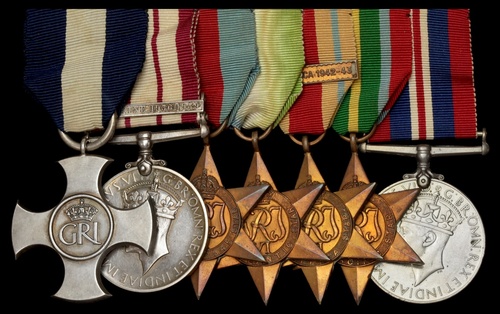
A fine Second War 'Dunkirk operations' D.S.C. awarded to Lieutenant Commander R. W. Clare, Royal Navy who was decorated for his gallantry whilst serving aboard H.M.S. Grenade when she was bombed by Stukas alongside the harbour at Dunkirk
On fire and out of control she was towed out of the harbour by a trawler where she sunk
Distinguished Service Cross, G.VI.R., reverse officially dated '1940', hallmarks for London 1939; Naval General Service 1915-62, 1 clasp, Palestine 1936-1939 (1756 Gnr. R.W. Clare, D.S.C, R.N.); 1939-45 Star; Atlantic Star; Africa Star, 1 clasp, North Africa 1942-43; Pacific Star; War Medal 1939-45, mounted for wear, good very fine (7)
D.S.C. London Gazette 27 August 1940, his Commanding officer's recommendation made in the after-action report, states:
'Especially I should like to mention Mr Clare and Leading Stoker Stables. I consider that the former acted with great coolness and courage taking complete control of the after end of the ship, giving the order to close and flood the magazine at the correct moment, thus preventing what might have been a much more serious disaster. He also remembered to try and blow up the dome. The latter as right-hand man to Mr Clare, taking charge of the younger stokers and by his calm bearing dispelling all tendency to panic.'
Reginald William Clare was born at Wisbech, Cambridgeshire on 27 October 1907 and joined the Royal Navy as a Boy second class on 27 October 1925. Posted to Ganges for training he served at a variety of shore and ship-based appointments. Serving with Nelson from 1936-37 during the Coronation Fleet Review with the rank of Petty Officer he was posted ashore in January 1937 where he qualified as Gunner.
Advanced to Temporary Gunner on 1 April 1938, he was serving aboard Grenade when she was deployed to Dunkirk on 28 May 1940 as one of the destroyers attempting to extract troops from the mole. The Nine Days of Dunkirk refers to her service, stating:
'The loss was disregarded, the work went on and, as the day drew out, the reinforcements of destroyers came swiftly in. The ships that began the lifting from the East Mole have already been named. Codrington, Grenade, Gallant, Jaguar and Javelin (picking up the survivors of the Abukir on the way) reached the harbour in the later part of the morning under heavy air attack. Harvester, Esk, Malcolm, Express, Shikari and Scimitar came in. With extraordinary speed the rate of loading rose. Codrington berthed at the East Mole and lifted 700 men. Grenade lifted another 700.'
Returning the next day she came under air attack alongside the destroyers Jaguar and Gallant but managed to avoid damage. It was not until later in the day that she came under a more concerted air attack that the destroyer suffered serious damage. Several bombs hit aft, cutting her mooring lines and causing her to drift into the channel, Clare was at his post, ordering the guns manned and directing all those not firing them into cover.
As the damage worsened, Clare leapt into action, with the after-action report stating:
'A certain number of ratings had jumped over the side but on being ordered to return, they did so. Mr Clare then ordered the ready-use lockers to be closed. On hearing the order from the Bridge to take cover he got as many men as possible into the after lobby, telling those remaining on the Quarter Deck to lie down. Then came the bomb which hit X gun and burst in the water alongside the ship. The concussion was very severe; it parted all the stern wires and gave the impression that the stern was under water. Many of the ratings on the Quarter Deck, especially those who had been injured, were either blown or washed over the side.
Mr Clare then gave orders for all magazines and shell rooms hatches to be closed. It was then reported to him that the ship was on fire in the vicinity of the Ward Room and he ordered the magazine to be flooded. This was eventually done in his presence by Leading Stoker Stables. He then heard the order to abandon ship. He superintended getting out Carley floats and then went forrard to try and blow up the Asdic Dome. He could not get past the fire in the Canteen Flat. By this time GRENADE had drifted alongside the POLLY JOHNSON and he transferred to her.'
The report on the sinking gives us far greater details of Clare's actions which must have gone a long way towards delaying the sinking of Grenade and allowing the crew to abandon ship. Lieutenant-Commander E. C. Peake recalls devastation the Grenade's sinking, stating:
'The morning of 29 May was beautiful, warm, with brilliant sunshine, and a flat, calm sea. On the way over, there was heavy enemy air activity. And ample evidence of their success. Wreckage, corpses. I shall never forget a red-headed woman who floated face-down. Her handbag was beside her, right on station. We arrived at Dunkirk during the forenoon and berthed at the landward end of the pier, so that other small ships such as trawlers could berth astern of us. We expected to load and get back to England as soon as possible. But for some unknown reason whilst other ships filled up with troops we were kept empty. There was a rumour that the evacuation was to be called off, and that we were being kept to take off the General Staff. We remained alongside all the afternoon whilst other ships came and went. There was intense air activity the whole time, particularly from dive bombers ... The general level of noise was incredible - not only from gunfire and explosions but from hundreds of stray dogs which had been driven to the waterfront. They were a pathetic sight. All of them were terrified. We suffered a few casualties on board during the afternoon, but no damage to the ship. At about 4 p.m. Stukas made a most determined attack on us and we were hit by a stick of bombs simultaneously. Two hit aft and one went straight down the foremost funnel, not touching the funnel casing and burst in Number One Boiler. I cannot remember where the fourth hit. Number One Boiler was directly below the bridge, and its bursting caused havoc on the bridge. Onlookers ashore told me afterwards that all went up about twelve to fifteen feet. I can assure anyone that being blown up is comparatively painless. It's the coming down that hurts! As a result of the bombs, the ship was badly on fire and the engines out of action. I went round the ship to estimate the extent of the damage and reported to the captain that in my opinion, we should abandon and then cut her adrift. There was a strong tide running under the pier, and she would drift away from the pier. He agreed ... We abandoned ship and cut her adrift and, as I knew she would, she drifted to the other side of the harbour, grounded and eventually blew up ... Altogether, aboard Grenade, we had nineteen men killed and an unknown number wounded ...'
Promoted Lieutenant with seniority from 31 December 1940 Clare later served in the destroyers Kelvin, Penn, Undine and lastly the escort carrier Speaker ending the war aboard her. He continued his naval service after the war, earning a promotion to Lieutenant and eventually retiring with the rank of Lieutenant Commander on 27 October 1952. Clare died at Winchester on 15 June 1961; sold together with copied research including the report on the loss of Grenade by Commander R V Bole.
Subject to 20% VAT on Buyer’s Premium. For more information please view Terms and Conditions for Buyers.
Estimate
£1,400 to £1,800
Starting price
£1100

Watch, listen and bid as if you were in the room. Now available for auctions worldwide.
Click here to bid live
An exclusive and confidential service for the discerning collector or vendor.
View the Gallery
Download every Spink catalogue on your iPad, iPod or iPhone using free Spink app.
Download From iTunes© 2026 Spink & Son. All rights reserved.