Auction: 26003 - Orders, Decorations and Medals
Lot: 236
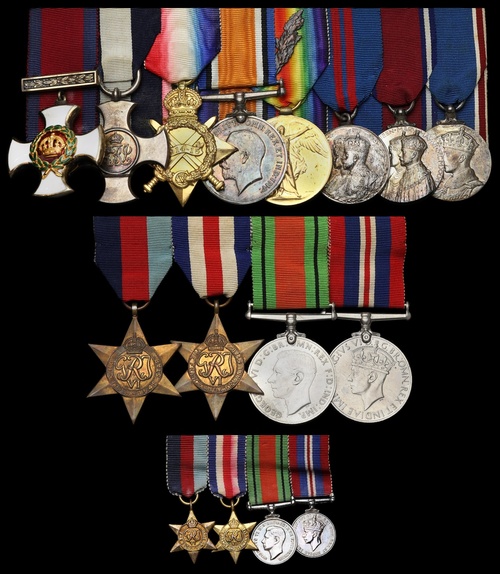
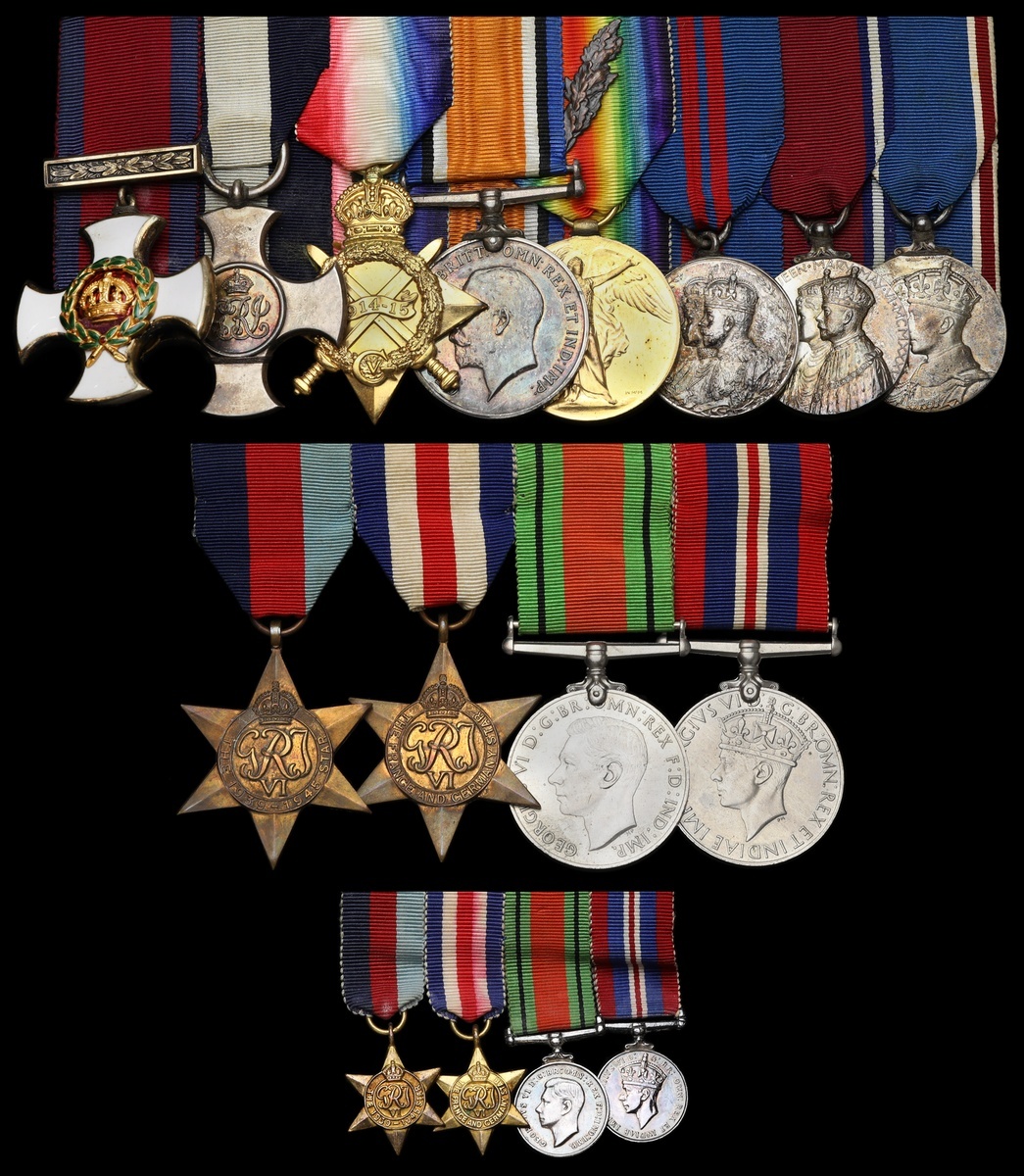
(x) The superb Harwich Force D.S.O., D.S.C. group of eight awarded to Paymaster Captain K. E. Badcock, Royal Navy, who served as Admiral Sir Reginald Tyrwhitt's Secretary for twenty years, as a consequence of which he was present at a number of notable actions fought by the Harwich Force: at Heligoland Bight in August 1914, he attended the Admiral on the bridge of the cruiser H.M.S. Arethusa throughout the action and was mentioned in despatches
Distinguished Service Order, G.V.R., silver-gilt and enamel; Distinguished Service Cross, G.V.R., hallmarks for London 1917; 1914-15 Star (Asst. Payr. K. E. Badcock, R.N.); British War and Victory Medals, M.I.D. oak leaf (Payr. Lt. Cr. K. E. Badcock, R.N.); Coronation 1911; Jubilee 1935; Coronation 1937, mounted court-style as worn, obverse centre of the D.S.O. slightly recessed, otherwise good very fine (8)
The group of four Second World War medals attributed to Acting Sub. Lieutenant C.F. Badcock, Royal Naval Volunteer Reserve, son of Paymaster Captain K. E. Badcock, Royal Navy, who served on HMS Melbreak
1939-45 Star; France and Germany Star; Defence and War Medals 1939-45, mounted as worn, good very fine (4)
D.S.O. London Gazette 21 June 1919, the original citation states:
'For distinguished services as Secretary to Rear Admiral Sir Reginald Tyrwhitt, KCB, DSO throughout the war.'
D.S.C. London Gazette 14 September 1917, the original citation states:
' For services in the Harwich Force.'
M.I.D. London Gazette 21 October 1914, the original citation states:
'My Secretary who attended me on the bridge throughout the entire action.' (Heligoland)
Kenneth Edgar Badcock was born in February 1886 at Bishop Auckland, County Durham, the son of Frederick Badcock a solicitor and his wife Fannie and entered the Royal Navy as an Assistant Clerk in July 1903.
Badcock's first appointment to the staff of a senior officer came in February 1907 when he was posted to the light cruiser Hyacinth as Secretary's Clerk to Sir George Warrender, commanding the second cruiser squadron on the East Indies station. In 1910 Badcock joined the Bulwark as Secretary's Clerk to Rear Admiral Neville and in March 1911 he was appointed Secretary's Clerk to Admiral Sir Francis Bridgeman on the Neptune.
In December 1913 he was appointed secretary to Commodore Reginald Tyrwhitt, R.N and so began the long chapter of devoted and loyal service, for he remained similarly employed until Tyrwhitt hauled down his flag for a final time in May 1933, by which stage Tyrwhitt was an Admiral of the Fleet with a G.C.B. and D.S.O. to his credit. It is said that Badcock suffered from a stammer yet he stood up to his senior and spoke his mind. As Dick Witte observed in Fringes of the Fleet, 'the Admiral liked that.'
Battle of the Heligoland Bight
It would also be fair to say that the Admiral liked nothing more than getting to grips with the enemy, a contention admirably supported by the fact that he left a string of severely damaged flagships in his wake. An early case in point would be the memorable engagement fought in the Heligoland Bight on 28 August 1914, when Tyrwhitt, senior officer of the Harwich Force, was flying his flag in H.M.S. Arethusa, accompanied by another light cruiser, the Fearless, and around thirty ships from the 1st and 3rd Destroyer Flotillas. At the last moment, providentially as it turned out, the 1st Battle Cruiser Squadron under Vice-Admiral Beatty was ordered to join Tyrwhitt's force. Sea Battles, by Michael Sanderson, takes up the story:
'In the early morning haze Tyrwhitt began his sweep towards Heligoland but soon ran into trouble. The Germans had some inkling of the pending attack and, instead of sending out their usual patrols, concentrated all available forces. In a series of confused engagements between 8 and 11.30 a.m., Tyrwhitt was in hot action with six enemy light cruisers, which were later joined by two more. Although the Frauenlob was hit and retired, the Harwich Force was in danger of being overwhelmed when the Arethusa and three destroyers were repeatedly hit and damaged. At 11.25 a.m. Tyrwhitt sent out an urgent call to Beatty, who was forty miles north of Heligoland, unaware of the critical situation developing. Fortunately he decided to intervene and came south at full speed straight to the Bight. The arrival of the British battle cruisers on the scene at 12.40 p.m. proved decisive. The Koln (flagship of Rear-Admiral Maas), Ariadne and Mainz were crippled and later sank; the remaining German light cruisers quickly scattered. Shortly afterwards the British forces set course for home.'
Tyrwhitt described the battle with the Frauenlob to his sister: "I can only imagine what everyone on the upper deck was not killed. The air seemed thick with bursting shells and the sea was alive with splashes from shell and splinters.. My signal officer was the only man killed on the bridge.. He was talking to me at the time and had just pointed out that we were on fire.. I don't think I ever thought of the danger nor do I think anyone on board did. I was very agreeably surprised as I was under the impression that the first time, everyone bobbed their heads when the shells flew over them, etc but it was not the case."
Such was the extent of the damage sustained by the Arethusa that she had to be taken in tow; Badcock was duly mentioned in Tyrwhitt's despatch: 'My secretary who attended me on the bridge throughout the entire action' (London Gazette 21 October 1914, refers).
Badcock was one of those on the bridge whose sang-froid so impressed Tyrwhitt that he recorded in Badcock's annual report 'He is perfectly cool under fire and is of a cheerful disposition'.
Cuxhaven - Dogger Bank - loss of the "Arethusa" - the Lowestoft raid
The Arethusa repaired, Tyrwhitt led the naval force assigned to the Cuxhaven Raid on Christmas Day 1914, when our seaplanes were successfully deployed in the first ever carrier air strike. Next up was the action at Dogger Bank on 24 January 1915, when Tyrwhitt's Harwich Force was once more reunited with Admiral Beatty's 1st Battle Cruiser Squadron, another memorable action in which Rear-Admiral Hipper's flagship the Seydlitz was severely damaged and the cruiser Blücher sunk.
In fact, Tyrwhitt's deserved reputation for dash and daring was well-established before Jutland. A member of his staff stated that everyone in the Harwich Force 'would have done anything for him ... he would go hell for leather after the Germans.' It was a view probably shared by his faithful secretary but such daring came at a cost. Peter Liddle's The Sailor's War takes up the story:
'In February 1916, Tyrwhitt's flagship, Arethusa, struck a mine and actually broke in two. When an accompanying destroyer came alongside to render aid, Tyrwhitt shouted from the bridge, 'Go away I'm not sinking'. He wanted and achieved, remembered Pertwee [a member of his staff], an orderly, calm, abandoning of the ship. A month later with his Commodore's pennant transferred to Cleopatra, this light cruiser deliberately rammed and cut in two a German destroyer encountered with her sister ships at night. Damage to Cleopatra's stern from an accidental collision with a British ship in this incident necessitated a further transfer of his pennant to Conquest.'
As it transpired - predictably it might be said - the Commodore's battle-scarred pennant's sojourn in Conquest was short-lived, for he made a gallant foray against the German Battle Cruiser Squadron sent to bombard Lowestoft on 25 April 1916. The inferior Harwich Force - pitched against four German battle cruisers and six light cruisers - first encountered the enemy at 3.50 a.m. Having failed to draw the enemy cruisers after him, Tyrwhitt turned towards them and fought a ferocious 13-minute duel, the Conquest taking severe punishment in the process. Hit by five 12-inch shells, her casualties amounted to 36 officers and ratings killed or wounded. Lowestoft had suffered severely, too, but without Tyrwhitt's intervention the destruction would have been far worse.
His pennant was thereafter to flutter defiantly from the Carysfort, until a more suitable replacement ship could be spared, and the Harwich Force continued to lend valuable support. In mid-1916 the Harwich Force took on a new and arduous duty - the escort of regular convoys between the Thames estuary and Holland, which the sailors referred to as 'the beef trip', very often Tyrwhitt commanded the patrol personally.
On 11 September 1916 Tyrwhitt and his staff moved into the newly commissioned light cruiser Centaur, however she too joined the list of badly damaged flagships which Tyrwhitt left in his wake when she was badly damaged by a hurricane on 24 October 1917 when Centaur led a squadron to intercept some enemy destroyers which were reported making a dash from Zeebrugge to Germany. The Concord then became Tyrwhitt's flagship for a time.
Tyrwhitt was a fighting commander who believed that is place was on the bridge of his ship, not behind a desk and he would certainly have been grateful to have found in Badcock an efficient, responsible secretary who relieved him of much of the administrative burden of his command. Badcock too shared the risks of war; Tyrwhitt specifically noted that Badcock was on the bridge beside him at Heligoland and it is certain he would have been similarly employed in the other actions. Tyrwhitt appreciated Badcock's moral courage and recommended him for the DSC in 1917 and the DSO in 1919.
Post-Great War
Badcock remained employed as Tyrwhitt's secretary until May 1933, when the Admiral hauled down his pennant for a final time. As a consequence he served ashore in Gibraltar, at sea with the 3rd Light Cruiser Squadron in the Mediterranean and in China at the time of the disturbances with the Nationalist Government in the mid-1920s. Having then served throughout Tyrwhitt's time as C.-in-C., The Nore, he was advanced to Paymaster Captain in 1935 and placed on the Retired List shortly before the renewal of hostilities in 1939. He died at Chichester on 22 January 1947 and is buried at Westbourne Cemetery; sold together with a comprehensive folder of research and photographs.
Colin Francis Badcock the son of Paymaster Captain K. E. Badcock, Royal Navy, was born at Havant, Hampshire in October 1925. He was appointed an Acting Sub. Lieutenant in the Royal Naval Volunteer Reserve in April 1945 and ended the war with an appointment in the Hunt-class escort destroyer H.M.S. Melbreak. He died at Winchester on 12 March 2017; sold together with copied research and his corresponding miniature awards.
For family medals, please see Lot 173.
Subject to 5% tax on Hammer Price in addition to 20% VAT on Buyer’s Premium.
Estimate
£2,000 to £3,000
Starting price
£1800
Watch, listen and bid as if you were in the room. Now available for auctions worldwide.
Click here to bid live
An exclusive and confidential service for the discerning collector or vendor.
View the Gallery
Download every Spink catalogue on your iPad, iPod or iPhone using free Spink app.
Download From iTunes© 2026 Spink & Son. All rights reserved.