Auction: 26003 - Orders, Decorations and Medals
Lot: 234
(x) Sold by Order of the Family
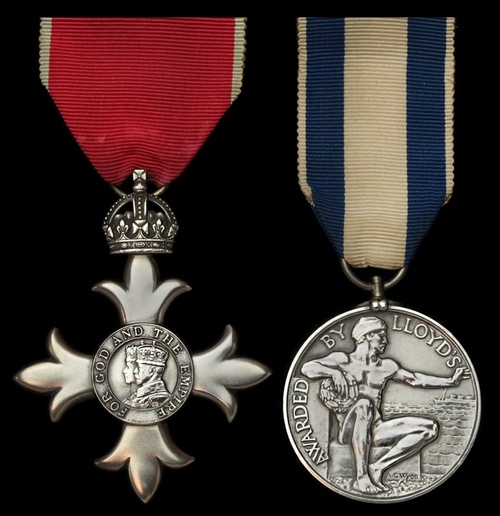
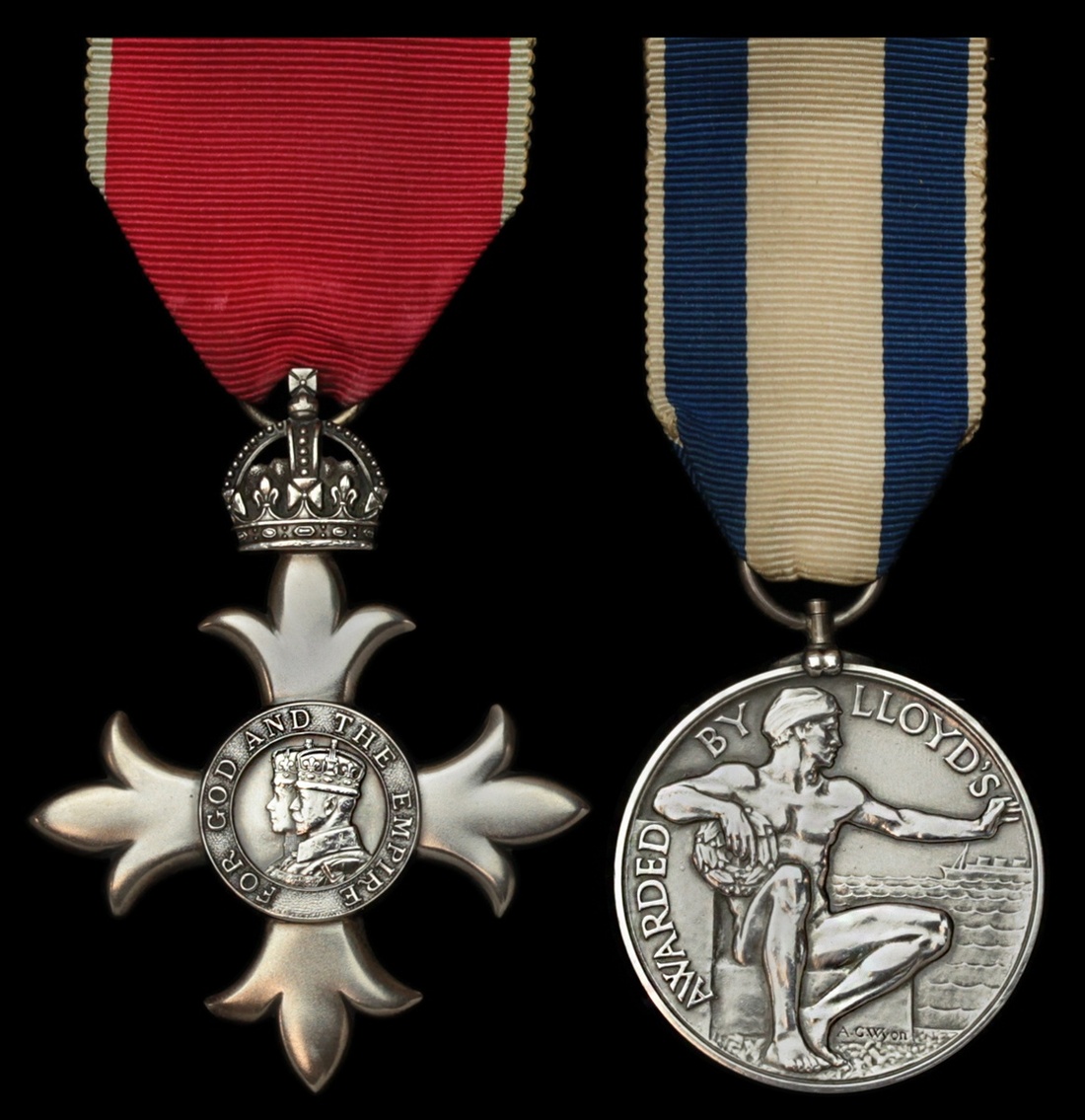
The 1945 M.B.E., Lloyd's Medal for Bravery pair awarded to 2nd Engineer Officer J. K. Lowrie, Merchant Marine, for his bravery in the sinking of the S.S. Orminster
The Most Excellent Order of the British Empire, Civil Division, Member's (M.B.E.) breast Badge, silver, with its Royal Mint case of issue; Lloyd's Medal for Bravery at Sea, silver (Second Engineer Officer J. K. Lowrie. S.S. "Orminster," 25th August 1944), in its fitted case of issue, nearly extremely fine (2)
M.B.E. London Gazette 23 January 1945, the original citation states:
'John Kilby Lowrie, Esq., Second Engineer Officer.
The ship, sailing in convoy, was compelled to reduce speed owing to engine trouble. Before she could rejoin convoy she was torpedoed and immediately began to sink. When it was realised that she could not be saved abandonment was ordered and most of the crew took to the boats. The remainder jumped into the water as the ship went down, ten minutes after being hit.
The Second Engineer Officer displayed conspicuous courage and devotion to duty. After the ship had been torpedoed he went into the engine-room, closed the water tight tunnel door and shut off main stop valves in the boiler-room, ignoring the grave risk of being trapped below. By this gallant action he did much to ensure a safe abandonment. He did not leave until satisfied that no one remained in the engine-room and stokehold.'
John Kilby Lowrie was born at South Shields, Durham on 1 May 1910, the son of Alfred and Florence Lowrie of 95 Osborne Avenue, Durham. Tragically his father passed away just the year after his birth, leaving his mother a widow on the 1911 census.
Lowrie was living in Bristol by 1939 and appears on the census at 125 Northville Road and working as an Aero Engine Tester. He was in fact living next door to his brother at the time who was working in the same field. It is unclear when Lowrie joined the Merchant Navy however his engineering background must have gone some way to securing him the rank of Second Engineer Officer.
Posted to the merchantman Orminster he was serving with her as she supported the Allied campaign in Normandy following the D-Day landings. During these operations she was assigned to convoy FTM-74 heading from Juno Beach towards the Isle of Wight to resupply when she developed engine trouble and fell behind the convoy.
Unfortunately this brought her under the sights of U-480 and veteran U-Boat Captain Hans-Joachim Förster which managed to torpedo her in the Channel. The Western Daily Press of 25 October 1945 takes up the story, stating:
'FILTON MAN'S BRAVERY
Risked Boiler Room Death to Save Comrades
SECOND Engineer Officer J. K. Lowrie, of 125, Northville Road, Filton, Bristol, has been awarded the Lloyd's War Medal for bravery at sea, which is bestowed on officers and men of the Merchant Navy and fishing fleet in cases of exceptional gallantry in war time.
The award, which is struck in silver with a ribbon in blue and silver, has been conferred on seafarers of various grades. Mr Lowrie was on the S.S. Orminster, when, owing to engine trouble, the ship was forced to reduce speed, and before she could rejoin the convoy she was torpedoed.
She immediately began to sink, and when it was obvious she could not be saved, the crew were ordered to leave the boat.
OUTSTANDING
Second Engineer Officer Lowrie showed outstanding courage and a high sense of duty. When the ship was hit he entered the engine room, closed the water tight tunnel door and shut off the main stop valves in the boiler room.
The successful abandonment of the ship was largely due to this brave action, which was carried out despite the great danger of being trapped below.'
Thanks to Lowrie's quick thinking and bravery 55 members of the crew were rescued from the disaster with seven men losing their lives- five in the initial attack and two more of their wounds. This number would have been much higher if Lowrie had not managed to slow the ship's sinking by braving the depths as they steadily filled with water.
He doubtless returned to service, going on to survive the war. In doing so he outlived the crew of U-480 who were sunk in a minefield in January 1945. Remaining in Bristol after the war, the Electoral Register even places Lowrie in the same home during that time. He died at Filton, Bristol on 26 April 1976; sold together with several original riband bar segments including the segment for a France and Germany Star and copied research.
Further entitled to the 1939-1945 Star; France and Germany Star with Atlantic clasp and War Medal 1939-45.
Subject to 5% tax on Hammer Price in addition to 20% VAT on Buyer’s Premium.
Estimate
£1,400 to £1,800
Starting price
£1100
Watch, listen and bid as if you were in the room. Now available for auctions worldwide.
Click here to bid live
An exclusive and confidential service for the discerning collector or vendor.
View the Gallery
Download every Spink catalogue on your iPad, iPod or iPhone using free Spink app.
Download From iTunes© 2026 Spink & Son. All rights reserved.