
Auction: 26003 - Orders, Decorations and Medals
Lot: 189
Sold by Order of the Family
'Whilst flying unidentified Firefly of 825 Squadron Ocean, off Korea on 27 August 1952, No. 3 in a section of four, carrying out RP attack on radar station in position XC752659 in Changyon/Sinchon area, suffered intense and accurate small arms fire, radiator hit, coolant leak, wheels-up landing in shallow water off Cho-Do, Cat ZZ. Both aircrew survived.' (Jacob's obituary refers, Fleet Air Arm Officers Association, Summer 2013).
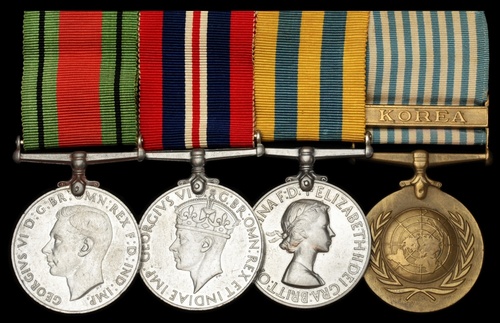
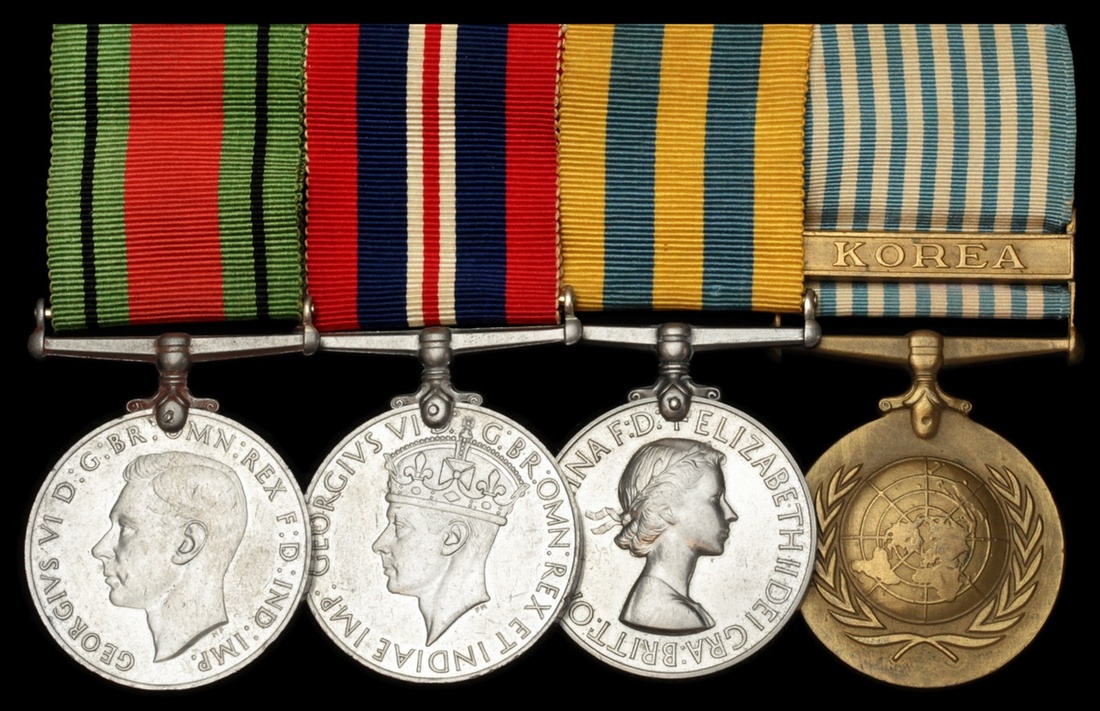
The Korean War group of four awarded to Lieutenant W. Le. G. Jacob, Royal Navy, who flew 160 missions, on one occasion flying the same mission twice, after being shot down by an enemy aircraft on the first attempt
Defence and War Medals 1939-45; Korea 1950-53 (Lieut. W. L. G. Jacob R.N.); U.N. Korea 1950-53, sold together with attributed dress miniatures, mounted as worn, very fine (4)
William Le Grand Jacob was born at Red House, the family home in Woodbridge, Suffolk on 26 July 1928. He was born to parents Lieutenant General Sir Ian Jacob, Director-General of the BBC, and Lady Cecile Treherne. Jacob was born into a military family with extensive credentials, his grandfather was Field Marshal C. W. Jacob in the Great War, thus determining his eventual occupation from birth.
Jacob attended Rottingdean School at thirteen before being sent to Britannia Royal Naval College, Dartmouth to be trained for a commission in the Royal Navy. Here, he developed his affinity for the Fleet Air Arm of the Royal Navy, learning to fly on the Tiger Moth at R.N.A.S. Gosport.
When he served in the Korean War, Jacob flew the Hawker Sea Fury, a late development of the Second World War, a propellor plane used by the F.A.A. until 1953. The Royal Navy at the time had incredibly primitive aircraft carriers that had no assistance for take-off or landing. It made the job perilous as every flight could end in disaster, even when returning to the base. He served with 812, 814 and 825 Squadrons.
Over his service in Korea, Jacob flew 160 missions into enemy territory, which all went very well, mostly due to his skill as a pilot. However, on 27 August 1952, Jacob was hit by enemy aircraft fire whilst attempting an attack on a Korean port. With just enough control he had to decide where to crash, changing his mind multiple times before his navigator, who had been in two previous crashes, implored him to decide, saying 'I don’t care which we do, just make up your mind!' (Fleet Air Arm Officers Association, Jacob's Obituary refers). In the end, he decided on ditching into the sea, where they were subsequently rescued by a U.S. Navy helicopter.
Jacob was tended to by a doctor aboard the aircraft carrier, provided with ample rum, and was then ordered to fly back out on the same mission later in the day. His commanding officer commented, 'at least you know the way there'.
Following his Korean War service, Jacob was made Aide de Camp to Air Chief Marshal Sir William Elliot, being sent out to Washington D.C. with him. Jacob arrived by boat in New York, where he was told to fly Elliot to Washington himself, despite Jacob never having flown the American aircraft before, and being oblivious to U.S. geography. Armed with a placemat sporting a map of the U.S., he made it to Washington D.C., despite flying directly through the path of the U.S. Navy's Aberdeen Proving Grounds where they were conducting anti-air munitions practice.
It was here in Washington that he met his wife, Rhonda McComas, at a debutante's ball on his first evening in the city. They later had two children and were married for sixty years. This was his final military posting, leaving the Navy in 1957 to pursue a career in industry and finance.
Jacob became the Chief Executive of Tubes Investments in the U.S., and later a Managing Director of BSA and Triumph Motorcycles. Upon his return to his home county of Suffolk in the 1980s, he became Chief Executive of East Anglian Securities Trust. In 1992, he was appointed High Sherriff of Suffolk, due to his involvement with numerous national and local charities. On 30 September 2013, he died at 85 years old.
For medals to his Father, Sir Ian Jacob, please see Lot 396.
For medals to his Grandfather, Field Marshal Claud Jacob, please see Lot 395.
For medals to his Grandfather, Major General Francis Treherne, please see Lot 403.
For medals to his 1st Cousin, 4x removed, Sir George Le Grand Jacob, please see Lot 127.
For medals to his 2nd Cousin, 3x removed, Captain Augustus Jacob, please see Lot 119.
Subject to 20% VAT on Buyer’s Premium. For more information please view Terms and Conditions for Buyers.
Estimate
£400 to £600
Starting price
£320
Watch, listen and bid as if you were in the room. Now available for auctions worldwide.
Click here to bid live
An exclusive and confidential service for the discerning collector or vendor.
View the Gallery
Download every Spink catalogue on your iPad, iPod or iPhone using free Spink app.
Download From iTunes© 2026 Spink & Son. All rights reserved.