
Auction: 26003 - Orders, Decorations and Medals
Lot: 161
(x) Family Collection
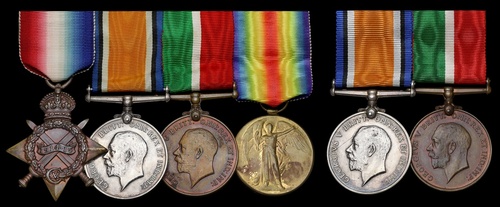
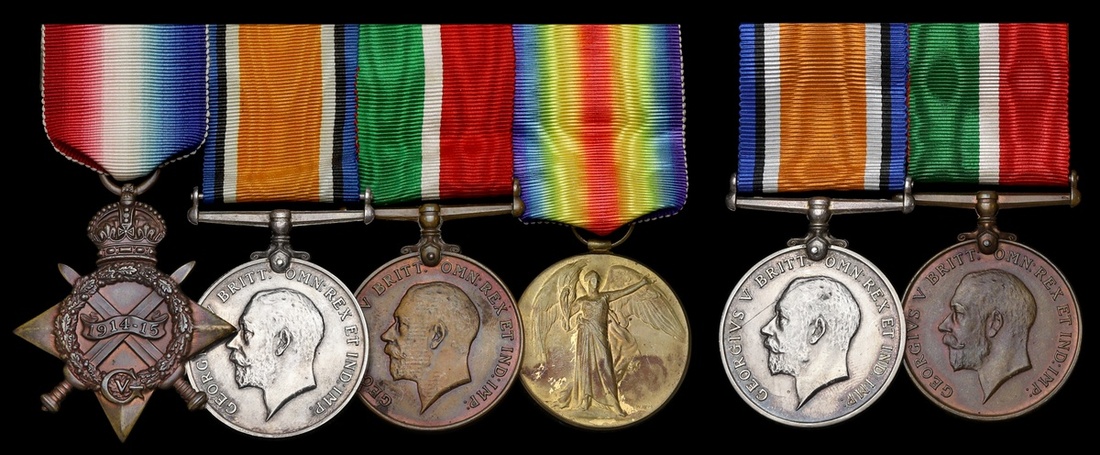
Pair: Captain R. H. Potter, Mercantile Marine, who survived the loss of his command, the S.S. Scottish Monarch, when she was torpedoed in 1915, he was later commended for "running over" an enemy submarine in the Irish Sea in 1918 subsequently sinking her with the merchant vessels' twelve pounder; a hollow victory following the loss of his third son, Midshipman P.B. Potter
British War and Mercantile Marine Medals (Robert H. Potter), the first with obverse surface scratch, otherwise nearly extremely fine (2)
Four: Midshipman P. B. Potter, Royal Naval Reserve, late Liverpool Scottish and Mercantile Marine, who was lost in the armed merchant cruiser India when she was torpedoed off Norway in August 1915
One of three sons of Captain R. H. Potter, all of whom were 'claimed by the sea'
1914-15 Star (Mid. P.B. Potter. R.N.R.); British War Medal 1914-20 (Mid. P.B. Potter. R.N.R.); Mercantile Marine War Medal (Percival B. Potter); Victory Medal 1914-19 (Mid. P.B. Potter. R.N.R.), the last with officially re-impressed naming, nearly extremely fine (4)
Kings Commendation London Gazette 17 March 1919.
Robert Harley Potter was born at Liverpool in 1859 and served his five-year apprenticeship in the Liverpool barque John Gambles, a vessel associated with the famous White Star Line, before becoming - in turn - Third, Second and Chief Officer, and remaining in her until he obtained his master's certificate at a very early age. His first command - the sailing ship Vallejo - lasted from 1887 to 1895, her worn condition and sickness among the crew nearly ending in disaster in the latter year, when her journey from the Gulf of Nicoya, Punta Arenas to England took 248 days - the ship was so long in passage that she had been given up as lost with all hands. Potter next commanded the Liverpool Barque Alliance until 1905 and then for the next five years the Mainwen, mostly employed on the Australian route.
In 1910, Potter joined the Monarch Steamship Company of Glasgow, and was appointed Master of the Irish Monarch, which steamer he still commanded on the outbreak of hostilities in August 1914. Then in April 1915 he became skipper of the Scottish Monarch, and it was on his first homeward bound voyage in her from New York to Manchester, carrying a cargo of sugar, that she was attacked and sunk by an enemy submarine:
'The Scottish Monarch was steaming homewards on 29 June 1915, and was forty miles south of the Ballycotton Light, County Cork, when the Third Officer spotted two submarines on the starboard beam at a distance of about two miles. There was no mistaking their nationality - the German ensign could clearly be seen. Captain Potter was immediately called to the bridge. Unfortunately, they were unarmed and there was nothing to do but run!
He ordered a turn to port to bring the enemy submarines astern of him, then ordered a zig-zag course to be steered at a speed of 11.25 knots. Only one of the enemy submarines gave chase, the other disappeared. The pursuing submarine quickly closed the gap and opened fire from about a mile distant. The first shell did little damage but the next three, fired from closer range, holed the port side of the vessel forcing the Captain to order the engines stopped and the boats lowered.
Captain Potter remained on board, although the submarine kept up a desultory barrage. With the decks awash, the Captain finally got into his own boat and three-quarters of an hour later, the Scottish Monarch sank.'
Potter's boat, with 19 of the crew, was picked up by the S.S. Miami of Glasgow about 30 miles south of Hook Point early on the morning of 30 June, and landed the same day. It was while recuperating at his Liverpool home when he received the news that his eighteen-year-old son, Percival, a Midshipman on HMS India lost his life when she was sunk by a German U-Boat. This was a terrible blow, for Percival was the last of his three sons, the other two also having been lost at sea.
Returning to sea as Master of the English Monarch, Potter received the thanks of the U.S. Government for his part in rescuing nine of the crew of the City of Memphis in March 1917, after she had been torpedoed.
His final wartime command was the War Queen, a vessel of Furness, Withy and Co., which firm he had joined in early 1918, and it was in her that his greatest adventure occurred, when she "ran over" a German submarine causing that vessel to surface. As a result, Potter was able to bring the War Queen's 12-pounder into action at about 600 yards range and gained several hits before the enemy submarine sank from view. He received a monetary award from the Merchant Ships Gratuities Committee and the King's Commendation.
Captain Potter retired from the sea and was then employed by the Merchant Marine Service Association becoming a travelling salesman, a position he held until 1934 when he finally retired at the age of 75. Potter died at Liverpool in April 1935, so ended a hard life with much personal tragedy illustrating the old adage 'Ships of wood and men of iron'; sold together with copied research.
See Hal Giblin's article, The Potter Saga, for full details (O.M.R.S. Journal, Spring 1980).
Percival Barber Potter, the third son of Captain Robert Harley Potter, a notable merchant seaman, was born at Liverpool in October 1896. Educated at Holt Secondary school he was a pre-war volunteer in the Liverpool Scottish, largely because his parents were against him pursuing a career at sea following the loss of his two brothers in maritime incidents. Robert Potter in 1910 and Reginald Potter in 1913.
With the outbreak of the Great War the young and insistent Percival, who had earlier joined the Moss Line and was at Toulon, France, obtained his parents' permission and joined the senior service on 3 April 1915.
Potter was appointed a Midshipman in the Royal Naval Reserve and joined the armed merchant cruiser India. Tragically, on 8 August that year, he was among those lost when she was torpedoed off the island of Helleover, near Bodo, Norway. Her Captain, Commander Kennedy, later reported that 'all efforts which were made to save life by means of the boats actually caused the greatest loss of life', and the majority of those who survived had dived directly into the sea as the ship sank, a process that took less than five minutes. Percival who was only eighteen is commemorated on the Chatham Naval Memorial; sold together with copied research.
See Hal Giblin's article, The Potter Saga, for full details (O.M.R.S. Journal, Spring 1980).
Subject to 5% tax on Hammer Price in addition to 20% VAT on Buyer’s Premium.
Estimate
£300 to £400
Starting price
£280

Watch, listen and bid as if you were in the room. Now available for auctions worldwide.
Click here to bid live
An exclusive and confidential service for the discerning collector or vendor.
View the Gallery
Download every Spink catalogue on your iPad, iPod or iPhone using free Spink app.
Download From iTunes© 2026 Spink & Son. All rights reserved.