
Auction: 26003 - Orders, Decorations and Medals
Lot: 146
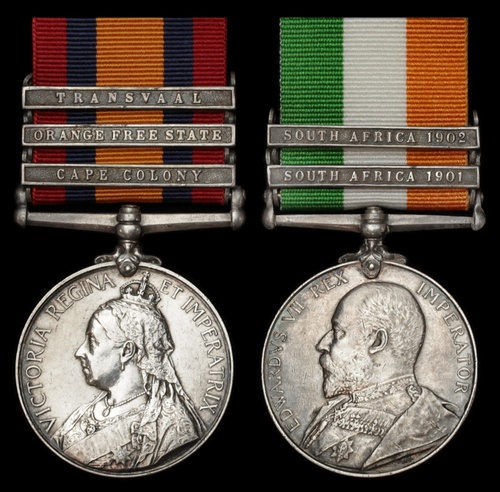
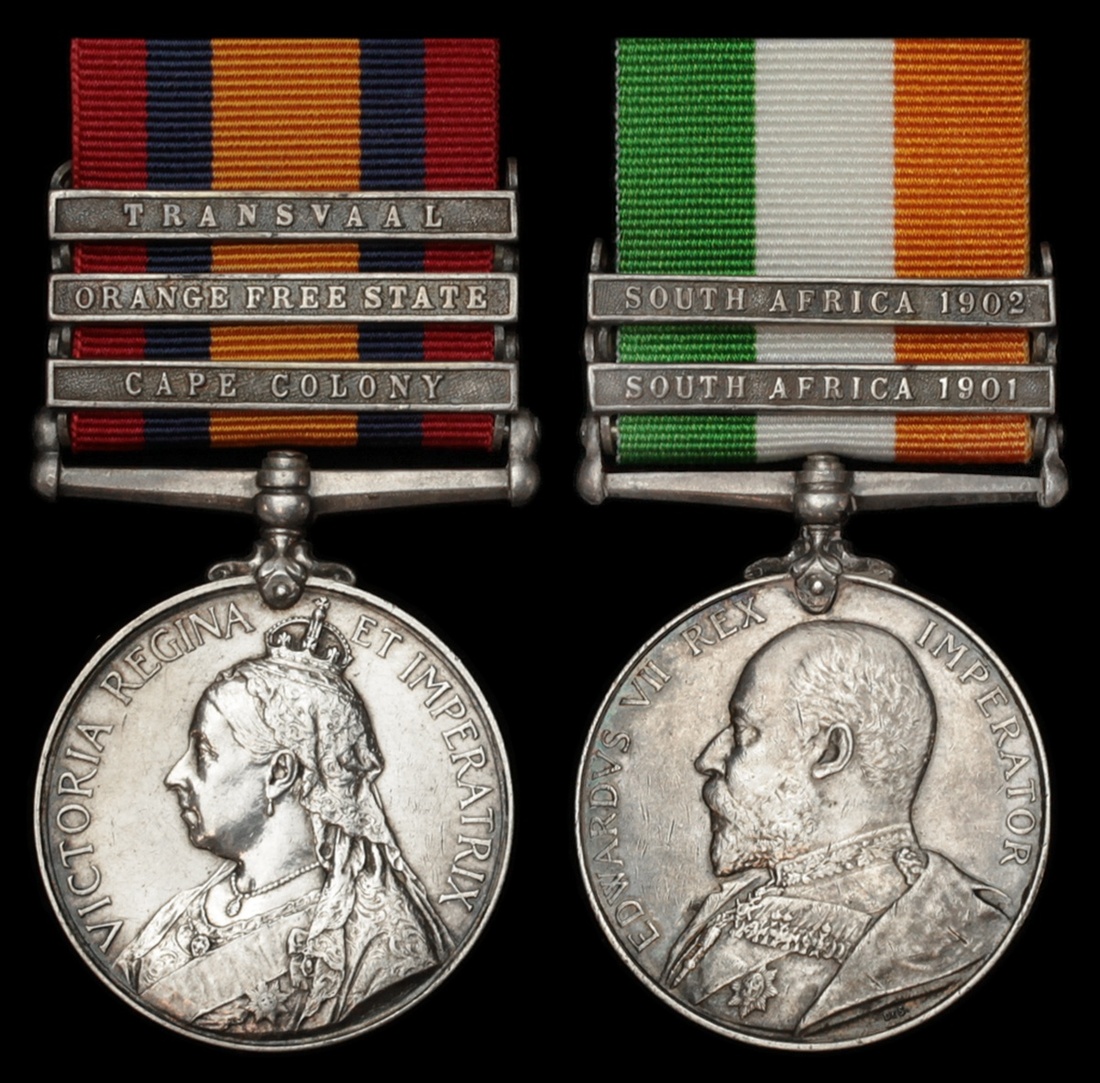
Pair: Lieutenant-Colonel A. V. Weir. Royal Irish Rifles, who was taken Prisoner of War during their famously bloody attack on the Stormberg
Queen's South Africa 1899-1902, 3 clasps, Cape Colony, Orange Free State, Transvaal (Capt. A. V. Weir. R. Ir. Rif.); King's South Africa 1901-02, 2 clasps, South Africa 1901, South Africa 1902 (Capt. A. V. Weir. Rl. Irish Rif.), minor contact wear, very fine overall (2)
Arthur Vavasour Weir was born at Ghizree, India on 20 December 1865, the son of Esther and Captain William Weir, 103rd (Bombay) Regiment. They left the subcontinent not long after his birth, likely due to ill health on his father's part. Tragically as soon after the family settled on the Isle of Man Captain Weir passed away aged just 28.
Initially commissioned into the Rifle Brigade in 1886 the young Weir transferred into the Royal Irish Rifles in November 1887 and was advanced Lieutenant in July 1889. Further promoted Captain in February 1897 he was serving in this rank when his regiment was posted to South Africa for service in the Anglo-Boer War. There they formed part of General Gatacre's Division, ordered to drive General Olivier's forces from Cape Colony.
Gatacre was concerned that he did not have the manpower to achieve the objective and as such he attempted a night assault on the Boer positions on the Kissieberg Hill near Stormberg. The march was mismanaged with the guides lost and the British unable to make their positions in time, finding themselves exposed below the Boer guns in the morning. Not only were they caught in the enemy's line of fire but they also found themselves in the wrong place, having to advance up a steep slope rather than the easier position they had hoped to storm.
The confusion of their position caused serious issues with one wing of the Royal Irish Rifles advancing past the mountain towards the north of the valley. The remaining companies- likely including Weir- joined the 2nd Battalion, Northumberland Fusiliers in advancing up the hill under heavy Boer fire from the crest. Their artillery managed to suppress the Boer fire and the infantry made good progress, however in several places the mountain was found to be impassable and eventually the Northumberland Fusiliers were ordered to withdraw.
This order did not reach three companies of the Regiment who remained with the Royal Irish Rifles as they attacked. They pushed on hard and nearly made the crest of the hill but the British artillery- confused by the partial withdrawal of the Fusiliers- believed their forces has withdrawn and began to drop shells onto their own troops assuming they were Boers. A shell burst seriously wounded Lieutenant-Colonel Eager, Royal Irish Fusiliers, the bulk of the remaining troops withdrew however some 600 still on the hillside did not receive the order and these men were killed or taken prisoner.
That included Weir who was taken prisoner of war and remained such until his release upon the fall of Pretoria on 6 June 1900. Appointed Adjutant of the Militia in 1902-1906 he continued to serve; local election registers recording him living at 107 Edith Road, Fulham not long later in 1914.
Upon the outbreak of the Great War Weir was still in service with the rank of Major and he was appointed to command the 7th Battalion, King's Shropshire Light Infantry after its Colonel died in January 1915. Returning to the Royal Irish Rifles he entered the war in France on 27 April 1915 and served for the duration of the conflict, being discharged on 11 November 1918 with a silver war badge.
Retiring to the Isle of Man Weir died there on 23 February 1937 with the rank of Lieutenant Colonel, his obituary in the Northern Whig, 3 March 1937 refers:
'Major A. V. Weir.
The death of Major Arthur V. Weir is reported from Ramsey, I.O.M., in his 71st year.
Major Weir was the son of Captain Wm. Weir, of the Royal Dublin Fusiliers. He entered the Army through the Militia, and served with the Royal Irish Rifles in the Boer War and the Great War. Upon his retirement he settled down at Sulby, I.O.M.
His wife survives him, and there are three sons : Captain F. S. Weir, R.A.O.C., Didcot ; Mr. J. P. V. Weir, in the Air Force, Gravesend ; and Mr. A. W. A. Weir, M.R.C.V.S., London.'
Further entitled to a 1914-15 Star Trio which he applied for in November 1923.
Subject to 20% VAT on Buyer’s Premium. For more information please view Terms and Conditions for Buyers.
Estimate
£280 to £320
Starting price
£220

Watch, listen and bid as if you were in the room. Now available for auctions worldwide.
Click here to bid live
An exclusive and confidential service for the discerning collector or vendor.
View the Gallery
Download every Spink catalogue on your iPad, iPod or iPhone using free Spink app.
Download From iTunes© 2026 Spink & Son. All rights reserved.