
Auction: 26003 - Orders, Decorations and Medals
Lot: 127
Sold by Order of the Family
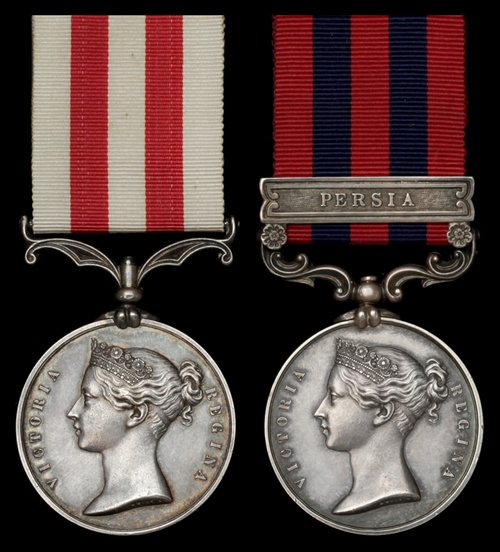
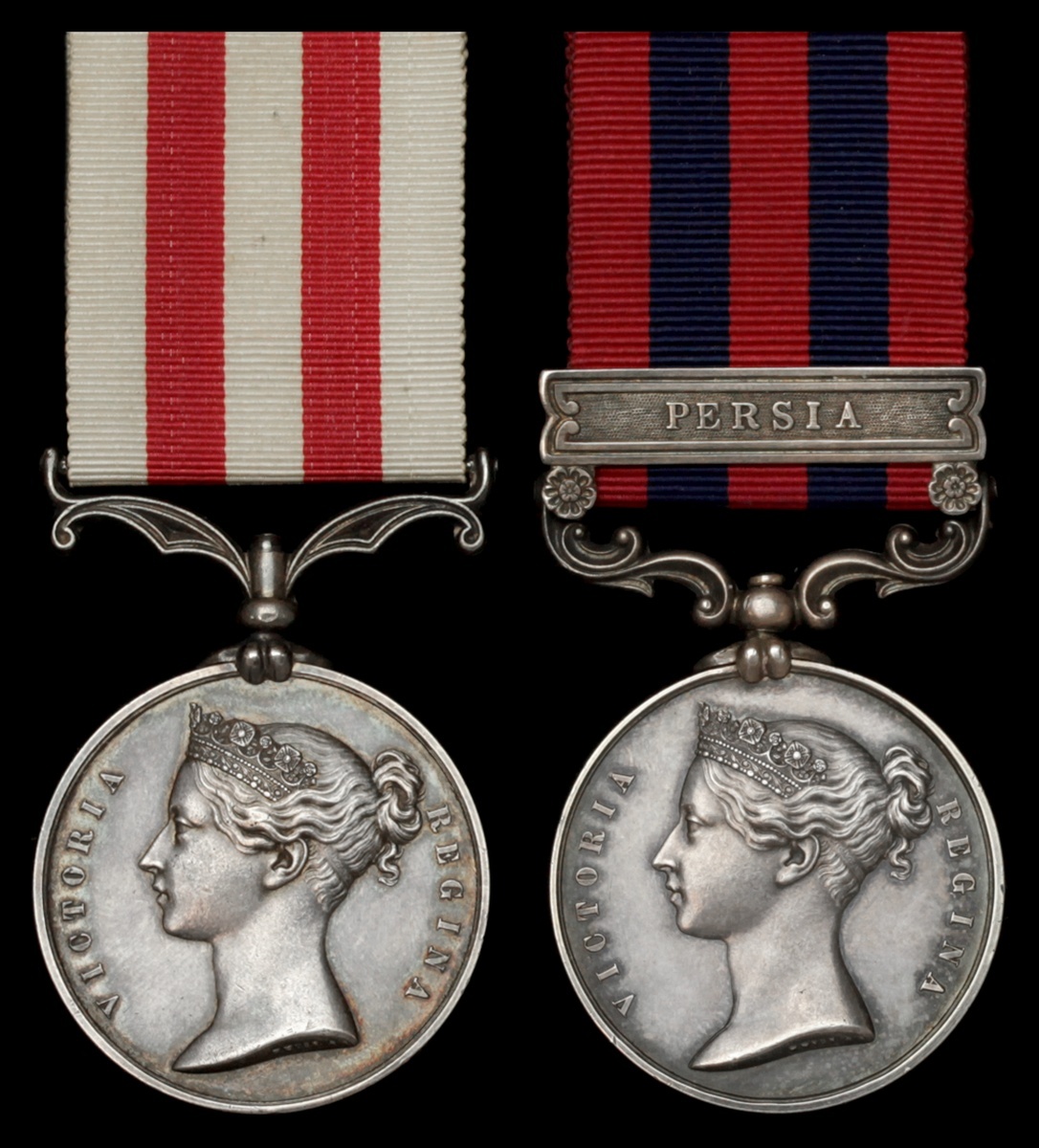
The campaign pair awarded to Major-General Sir George Le Grand Jacob, Bombay Army, who relieved the mutiny at Kolapore, and was a cousin of General John Jacob, inventor of the Jacob's Rifle
Indian Mutiny 1857-59, no clasp (Coll G. Le Grand Jacob.); Indian General Service 1854-95, 1 clasp, Persia (Col. G. Le G. Jacob, Comg. Lt. Bttn.), sold together with attributed miniature Mutiny Medal with clasp 'Central India', very fine (2)
George Le Grand Jacob was born at Roath Court, Cardiff on 24 April 1805 to parents John Jacob, an Antiquarian, and Mary Long. During his childhood, the family moved to Gurnsey, where Jacob was educated at Elizabeth College, as well as by private tutors from France and England. At 15 years, he was sent to London to learn Oriental languages from Dr John Borthwick Gilchrist. He became an interpreter for Hindi, Persian and Marathi. His education in Indian languages afforded him a great opportunity to join the Indian Army, enlisting as an Indian Infantry Cadet in 1820 and was posted as an ensign to the 2nd Regiment, Bombay Native Infantry (later Prince of Wales' Own) on 9 June 1821.
He was quickly promoted Lieutenant on 10 December 1823, seeing some action during his early service in the pestiferous Nerbudda jungles against the Bheels. He took a furlough back to England in 1831, and in 1833 was briefly an Officer at the East India Military Seminary in Addiscombe. He worked on the translation of texts from India, including the Ajab-al-Tabakat (Wonder of the Universe) which is now held in the library of the Asiatic Society, London. On 18 June 1835, he married Emily Utterton, the daughter of Colonel Utterton, but quickly returned to India afterwards.
On the way to India, his wife died at sea, so when he arrived, he was in an unfit state. He recuperated with his brother William Jacob, who was an officer in the Bombay Artillery. He became a Political Assistant in Kattywar, eventually taking full control of the politics from 1839-43. In 1853, he was moved to the 27th Bombay Native Infantry at the rank of Lieutenant-Colonel, later rising to Brevet-Colonel during the Anglo-Persian War.
He briefly took leave due to faltering health in 1855, visiting China, Java and Sarawak. The Overland Mail states his experiences as;
'Keeping his eyes and ears ever on the alert, always reading, writing, or inquiring—mostly smoking—winning men by his geniality and women by his courteous bearing.' The Overland Mail, 6 May 1881.
He intended to retire upon his return but on the ship back, ran aground in the Torres Straits, being saved from the cannibal natives by a Dutch shipping vessel. On the return to Bombay, he changed his mind on retirement and served in the Anglo-Persian War, taking command of the Native Light Battalion in the division under Henry Havelock.
The outbreak of the Indian Mutiny in May 1857 spread to Bombay in August, with Jacob's battalion, the 27th Native Infantry, mutinying on 14 August. Contemporary news reports state the scene as such;
'This at first was considered by the European officers to be a quarrel between some of the sepoys; but the Native Adjutant and two Havildars (Sergeants) running up to the mess and other officers' quarters, soon disabused them of this false idea, by begging of them to fly for their lives; as the regiment was in open mutiny, and determined to have their lives'
'Their next step was to surround the Jemedar Adjutant's (a Jew) house, with a view to kill him but not finding him at home, they contented themselves with shooting his mother, and looting his house of everything. The Subedar Major's (a Mussulman) and another Subedar's (also of the true-believer caste) houses were subjected to like treatment they then attempted to get the drummers and buglers (all Christians) to sound the "Alarm" in order to shoot their European officers as they came on parade but fortunately they had thrown away their instruments and ran for their lives. The mutineers headed by Ramjee Shessut, a Mahratta, a man of immense stature, and who had been reduced from the rank of Havildar for insolence to a superior, proceeded to the mess house and officers' lines with a view to carry out their murderous designs.' excerpt from The Perth Gazette, 6 November 1857, page 3.
Jacob arrived a fortnight later with orders to retake the garrison at Kolhapur from the mutineers. He formed the 31st Bombay Native Infantry with the loyal Sepoys and European soldiers remaining. His small force made quick work of the rebellion, blowing open the gate with explosives and rapidly overpowering the mutineers. He dispensed justice with drumhead court martials, executing 21 Sepoys - eight blown from canons, two hung and eleven shot.
Jacob was commended for his actions in preventing the spread of rebellion through his quick actions. He was subsequently promoted to Brigadier General. He was expected to continue to rise through the ranks, but he retired his command in 1859, and left India. He retired 31 December 1861 at the rank of Major General, later being made a Knight Commander of the Order of the Star of India in June 1869.
His later years were spent in Bayswater, speaking his mind on the poor running of India after its incorporation into the British Empire. He wrote a book on his experiences with the help of his niece due to his growing blindness, titled India Before and After the Mutiny. He died 27 January 1881 and was buried in Brookwood Cemetery. His legacy remains in India, as the University of Mumbai retains the Sir George Le Grand Jacob Prize for competitive essays written in Marathi, with a prize of Rs 8000. There is also a major roundabout in Central Mumbai named Jacob's Circle after him.
For medals to his Nephew, Captain Augustus Jacob, please see Lot 119.
For medals to his 1st Cousin, 2x removed, Field Marshal Claud Jacob, please see Lot 395.
For medals to his 1st Cousin, 3x removed, Sir Ian Claud Jacob, please see Lot 396.
For medals to his 1st Cousin, 4x removed, Lieutenant William Le Grand Jacob, please see Lot 189.
Subject to 20% VAT on Buyer’s Premium. For more information please view Terms and Conditions for Buyers.
Estimate
£800 to £1,200
Starting price
£600

Watch, listen and bid as if you were in the room. Now available for auctions worldwide.
Click here to bid live
An exclusive and confidential service for the discerning collector or vendor.
View the Gallery
Download every Spink catalogue on your iPad, iPod or iPhone using free Spink app.
Download From iTunes© 2026 Spink & Son. All rights reserved.