
Auction: 26003 - Orders, Decorations and Medals
Lot: 119
Sold by Order of the Family
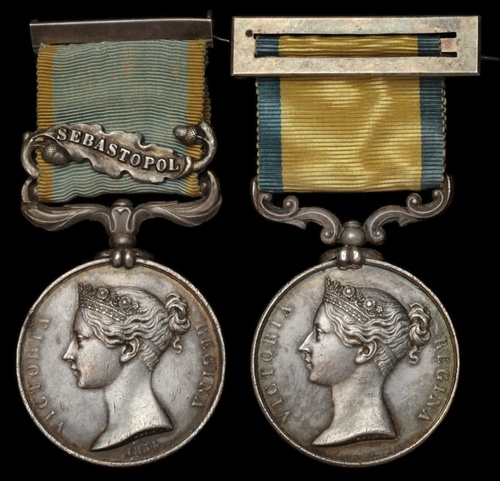
The campaign pair awarded to Captain A. Jacob, Royal Navy, for service aboard H.M.S. Leopard, taking part in the destruction of 10 Russian guns and a fortification on the Kuban River
Crimea 1854-56, 1 clasp, Sebastopol (Augustus Jacob Mid. H.M.S. Leopard), engraved naming; Baltic 1854-55, both with riband bars as worn, very fine (2)
M.I.D. London Gazette, 30 June 1854:
'For Valorous bouts at Uleaborg and Tornea.'
Augustus Jacob was born at Crawley, Hampshire on 20 August 1839 to parents Philip Jacob, an Archdeacon for Crawley, and Anna Sophia Noel. Little is known about his early life, but on 12 August 1853, aged 13 years, he became a Naval Cadet, recommended by his cousin Augustus Stafford, the Secretary of the Admiralty. He served aboard H.M.S. Termagent, later joining the H.M.S. Leopard where he would see service in the Crimean War.
The Leopard sailed to the Baltic Sea in Early 1854, and was part of Admiral Plumridge's Navy Division tasked with securing the Gulf of Bothina to prevent Russian Naval Ships heading towards the North Sea. The Leopard was an 18-gun wooden frigate, launched in 1850, making it relatively new to the fleet. Plumridge instructed the Captain of the Leopard, George Giffard, to secure the closure of the gulf by any means necessary. The War Minister, the Duke of Newcastle, advised against the destruction of defenceless ports, but nonetheless, the Leopard, along with the French ship Foulton, bombarded Russian placements along the coast, destroying 10 guns and preventing the ports from being used by the Russian Navy.
Jacob was personally gazetted on 30 June 1854, for operations in the Gulf of Bothnia for service on the second cutter. The service at Uleaborg was on the coast of Finland at a Russian trade post, and Tornea where the border between Russian-Controlled Finland and Sweden lay a vital port for the Russian Navy. His actions aboard the second cutter of the Leopard prevented Russian dominance during the Battle of Åland.
Subsequently, the Leopard was sent to the Black Sea, after Jacob had been promoted to Midshipman, on the 12 August 1854. He participated in a night attack on Sebastopol to support the efforts of the beleaguered troops besieging the port. Jacob wrote of the sights in Balaclava in a private letter to his sister:
'We have just returned from Balaclava.... many ships wrecked outside of Balaclava...we went on shore to visit soldiers’ camp... the conditions were very poor... there is a talk of Lord Raglan being recalled... he is not thought very highly of out here, though the engagements we have had have been successful, but it has been more through hard fighting than good management' (Private letter from Jacob to his sister Isabel refers).
After the Crimean War, he maintained Naval service, being promoted Lieutenant on 26 November 1859, but was disenfranchised with the slow promotion process. In a letter from his sister Isabel, she writes:
'August seems to be thinking of leaving the navy and emigrating. I suppose he sees no chance of promotion and is tired of waiting and is tired of the Navy. Edda says he goes around the house singing 'Maryland, my Maryland'..... and 'Carry me back to Old Virginny'...An official document has informed him that there would be no more appointments to the Naval College and that has decided his course.'
He was eventually promoted to Commander on 29 December 1871 aboard H.M.S. Bruizer, where he was serving as a Captain. On 6 March 1872, he was presented Captain the Duke of Edinburgh at St. James' Palace. However, he retired on 11 October 1873, to live on a ranch in California. While on the retired list on 29 December 1886, he was promoted to Captain.
His life on the ranch was troubled by his drinking habits, and died in Canada, December 1893. The story of his death is no less intriguing than his previous escapades. He was trying to deliver food to men at a mine that he had taken ownership of, miles from the nearest town. He took the perilous journey alone and with the bitterly cold winters in Canada, he eventually succumbed to frostbite and died in the wilderness, aged 54 years.
For medals to his Uncle, Sir George Le Grand Jacob, please see Lot 127.
For medals to his 2nd Cousin once removed, Field Marshal Claud Jacob, please see Lot 395.
For medals to his 2nd Cousin, 2x removed, Sir Ian Jacob, please see Lot 396.
For medals to his 2nd Cousin, 3x removed, Lieutenant William Le Grand Jacob, please see Lot 189.
Subject to 20% VAT on Buyer’s Premium. For more information please view Terms and Conditions for Buyers.
Estimate
£300 to £500
Starting price
£240
Watch, listen and bid as if you were in the room. Now available for auctions worldwide.
Click here to bid live
An exclusive and confidential service for the discerning collector or vendor.
View the Gallery
Download every Spink catalogue on your iPad, iPod or iPhone using free Spink app.
Download From iTunes© 2026 Spink & Son. All rights reserved.