
Auction: 26003 - Orders, Decorations and Medals
Lot: 43
Sold by Order of a Direct Descendant
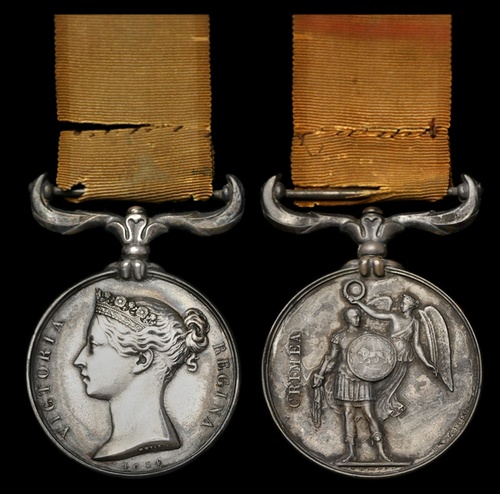
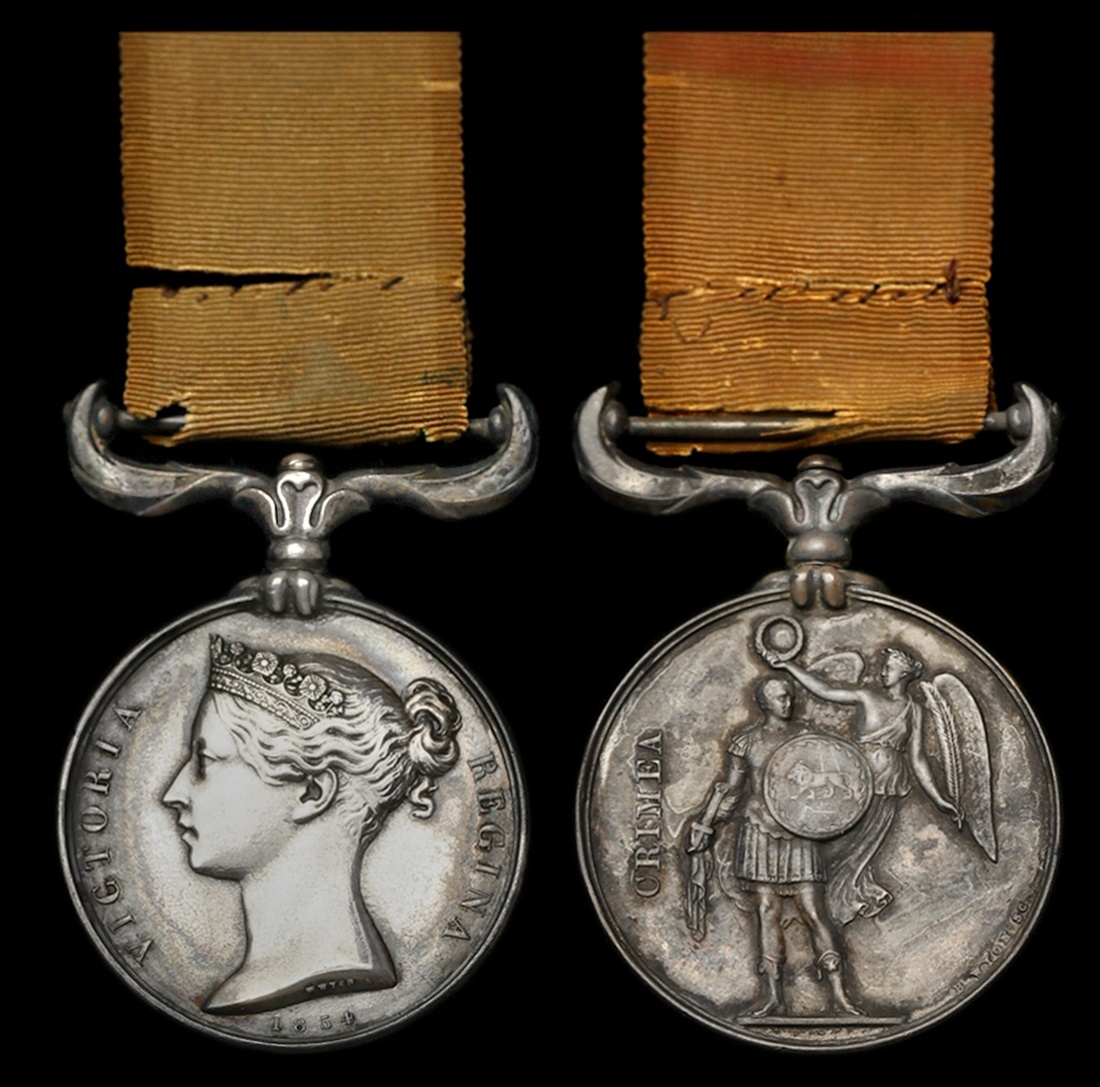
The Crimea Medal awarded to Lieutenant P. Chase, Royal Navy, for his service aboard Albion, who was killed during the Bombardment of Sebastopol when struck in the head by a piece of Russian shell; such was his vessel's part in the action for nearly two hours that it was said her damaged starboard side was 'riddled like a sieve'
Crimea 1854-56, no clasp (Lieut Parkhurst Chase. H.M.S. Albion), officially engraved naming by Hunt & Roskell, evidence of tarnished residue, obverse polished, about very fine
Parkhurst Chase was born on 6 October 1822 to Captain John Woodford Chase and Louis Ann Millicent Thomas. He was their third child and eventually one of 13 surviving children. The following passages are from the handwritten biographical account of the Parkhurst family history, which is included with the Lot:
'Parkhurst Chase joined the Royal Navy & he left behind various notes, books and diaries as accurately & neatly kept as those of his brother Drummond during his undergraduate life. From these it is quite easy to trace his career, in what vessels & on what stations he served, in fact he has noted the exact number of days spent in each port, on almost every voyage & there are most minute entries & descriptions of his various ships, size, dimensions, number of guns, size of sails' etc.
'Parkhurst received his first Commission at the age of 14 & served as Midshipman in H.M.S. "Russell" in the Mediterranean from Sep. 1836 to Jan 1839. He was next in the "Vanguard" & again in the Mediterranean from April 1840 to 1843. From August 1843 to April 1846 he was on the West Indian & North American Stations in the "Eurydice"... On coming home he joined the Royal Naval College & passed his examination for Lieutenant... and in that same year obtained a First Class Certificate in Gunnery with only 9 marks short of the highest obtainable. Next from June to Oct 1847 he served on board H.M. Yacht "Victoria & Albert" cruising unit H. Majesty & the Royal children round the coast of Scotland, & was promoted Lieutenant in October of that year aged 25.
In October 1847 he joined HMS "Asia" at Plymouth to flagship of Admiral Hornby who was going out to take the Command in the Pacific, as an additional Lieutenant. The incidents of the voyage give a curious glimpse of the day of the old sailing ships. The "Asia" sailed from Plymouth on Dec 1st having spent the time from October fitting out at Portsmouth but on 4th-6th she encountered such bad weather, sustained so much damage that they put back again to refit, & did not finally get under way till Jan 5th 1848. But again, that "Asia" met with misfortune splitting her Main yard in two so that she had to go into Lisbon for a new one which made further delay. The remainder of the voyage was more prosperous & they reached Rio de Janeiro.'
After retiring from Asia and a brief, and an apparently particularly miserable time on Constance, Chase then served aboard Albion from August 1850, the last vessel with whom he ever served. After a number of years on board, Chase's final mission in 1854 was to fight at Sebastopol, but on the way their ship, as well as several other British and French ships, was ravaged by Cholera. The biographer takes up the story by including a letter Chase wrote to his elder brother, Drummond:
'Albion off Buyck cruising, August 14th 1854
My dear Drummond,
I am sorry to say that Cholera has broken out violently on board the Allied Squadrons, and we are now at sea, trying what fresh sea freezes and change can do. I am afraid the "Albion" is at present the worst. It broke out on the 20th when two men died after a very short illness. The 11th we had 20 deaths but many cases, 12th-13th we had 12 deaths & several more in a very dangerous state. Of course the surgeons & medical men keep things as quiet as possible, but I believe we have at least 100 on the sick list. The great difficulty was to get the men when they first had looseness to go to the Doctor, but now they are beginning to find out the necessity. The French Squadron [are] much worse than us; I don't know the actual number of men dead, but the "Montebello" on the 9th had 240 sick, & the "Ville de Paris" one night lost 40. Our Squadron up to yesterday had lost 60. The Army on shore are losing great numbers particularly the French. We were to have embarked the troops on the 16th for Sevastopol, but I don't know how it may be now. Our men are very downhearted, we have this morning buried 3, & are now (10am) going to [have] died honourably for his country.'
However, three weeks later on the 4 September, Chase wrote to his mother saying 'the signal has just been made, "Prepare for sailing"'! With a crew still ailing with Cholera, on 17 October Albion along with 50 British and French ships engaged in a bloody and ruthless bombardment against the Russians, the Russians too suffered heavily, and yet, the Allies still weren't quite able to get through their batteries. Albion herself had pitiless battle, and was set alight three times, and suffered eleven casualties and 71 injured.
Chase's fate at the battle is recorded in the written history via a letter that the biographer recalls from Midshipman William Needham, Naval Instructor aboard Albion, writing to his mother (who would have known the Chase family and who lived locally):
'I write in a hurry. Main goes at 11am & I have plans & reports to make out for the Admiral. Our batteries opened fire yesterday. Fleet went down in tow of steamers & attacked the (Russian) batteries... All the rest of the fleet except "Agammemnon" & "Sans Pareil" engaged at considerable distance thinking our example would be followed we engaged close, & being alone in our glory we got it hot & strong. This ship has 12 killed, 50 wounded. I lament to say we have lost poor Chase... The ship's side above is riddled like a sieve. I tell you a simple fact when I say that after 1 1/2 hours of that work - with the shot yelling & screeching like animated imps of mischief all around, shells bursting, ripping up the decks, poor Chase laid low, Paul wounded near me, I began to look at the sun to see what it wanted of sunset, with some little anxiety. Poor Chase was killed by a piece of a shell hitting him on the head. Death almost instantaneous. I have picked up his eyeglass which is bent much. I shall bring it home with me.'
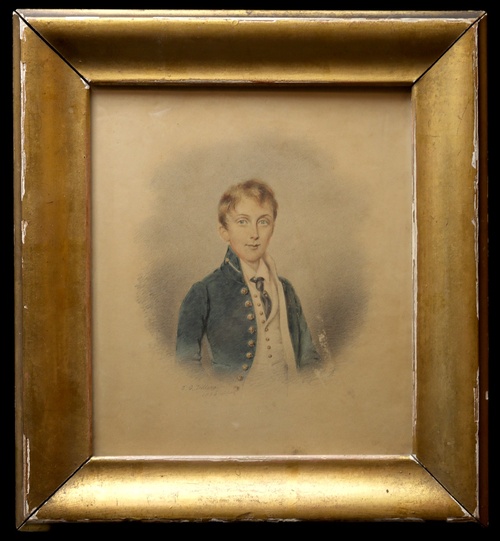
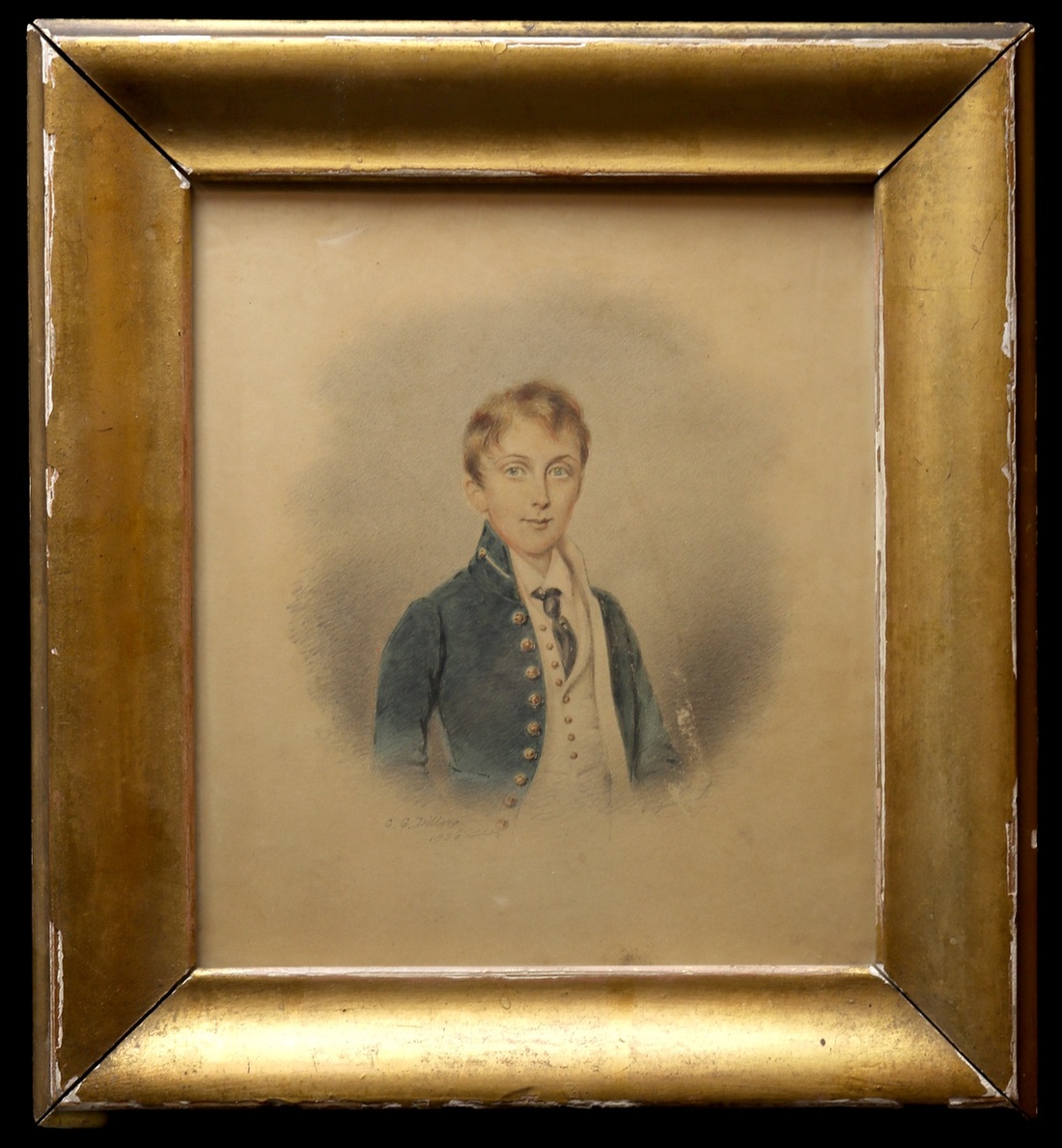
Sold together with a handwritten family history and a framed pencil sketch of Chase.
Subject to 20% VAT on Buyer’s Premium. For more information please view Terms and Conditions for Buyers.
Estimate
£600 to £800
Starting price
£480
Watch, listen and bid as if you were in the room. Now available for auctions worldwide.
Click here to bid live
An exclusive and confidential service for the discerning collector or vendor.
View the Gallery
Download every Spink catalogue on your iPad, iPod or iPhone using free Spink app.
Download From iTunes© 2026 Spink & Son. All rights reserved.