
Auction: 26003 - Orders, Decorations and Medals
Lot: 25
(x) 'We much regret to announce the death of Robert Atherton, Esq., Govt. Agent in Trincomalee, which event occurred on the 23rd instant. This gentleman was in early life in the Royal Navy, and his bravery and distinguished service were rewarded with a medal and the mention of his name on several occasions in the Admiral’s despatches.
As a Civil Servant of this Colony his duties have confined him to the Northern and Eastern Provinces. In both he was remarkable for the singular confidence reposed in him by the native inhabitants, a trust which he returned in the Batticaloa district by effecting the most marked improvements in the manners and morals of the inhabitants. A good man has gone to his rest. Requiescant in pace.'
Sunday Examiner of Ceylon laments the death of Robert Atherton, June 1855.
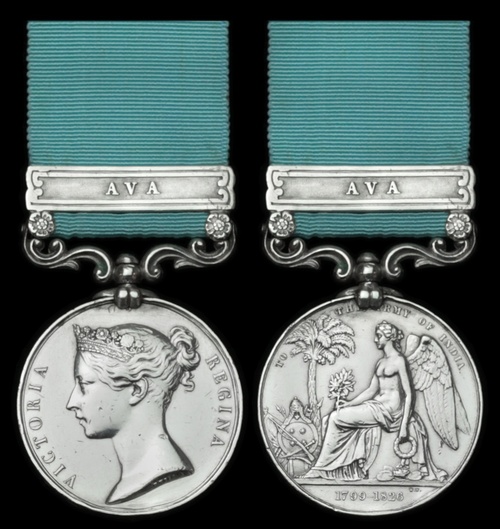
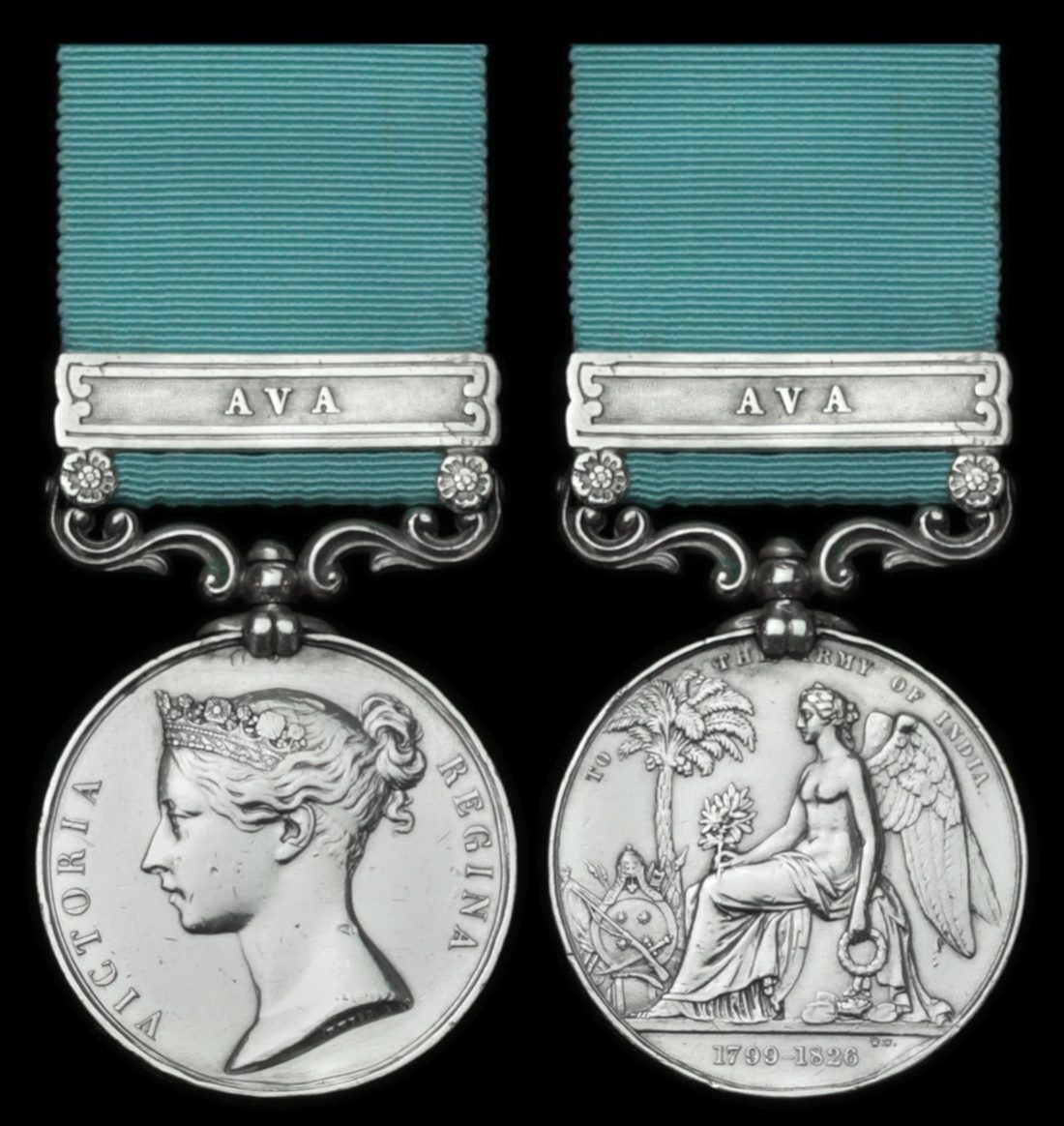
The Army of India Medal awarded to Purser R. Atherton, Royal Navy, later an important & long-served member of the Ceylon Civil Service
Atherton served aboard the Larne during the Anglo-Burmese War and was variously 'mentioned' for his gallantry and twice wounded in action
Army of India 1799-1826, short-hyphen reverse, 1 clasp, Ava (Purser R. Atherton.), edge wear and suspension claw tightened, nearly very fine
Robert Atherton was born in December 1801 at Walton on the Hill, Liverpool, the son of Colonel John Atherton of the Lancashire Fencible Light Dragoons: as a former regular soldier, Atherton senior had been captured by the French during the Revolutionary Wars, later released, and was appointed an Aide-de-Camp to King George III.
It was to be that young Atherton followed his elder brother Bertram Atheron into the Royal Navy, serving as Purser aboard Larne under the famous naval novelist and Napoleonic shipmate of Lord Cochrane, Captain Frederick Marryat. The 20-gun Larne would take an active role during the First Anglo-Burmese War, with Atherton thrice noted in The Burmese War for his '...gallantry, cool and intrepidity' and having received official 'mentions' for his '...active services in the boats.' Indeed, Marryat was full of praise for the endeavours and activity of the officers under his command during very difficult circumstances, noting on 11 July 1824 in a letter to Commodore Charles Grant which is worth reproducing here in full:
'I must now call your attention to the condition of H.M.S. Larne, whose crew I am sorry to say have been rendered quite inefficient by disease. Since we have been on this expedition, we have had 170 cases of cholera and dysentery. We have had thirteen deaths – we have now thirty patients at the hospital on shore, and twenty in the sick list on board; our convalescents are as ineffective as if they were in their hammocks; they relapse daily, and the surgeon reports, that, unless the vessel can be sent to cruise for a month, there is little chance of their ultimate recovery. When I sent away the expedition, under Lieutenants Thomas Fraser, on the 7th instant, I could only muster three officers and twelve men fit for duty. The conduct of Lieutenant Fraser, on the several expeditions which he has commanded, has been that of a gallant and steady officer; and I am under the greatest obligations to Mr. Atherton, not only for his active services in the boats, but for carrying on the whole duty of the ship, during the absence and sickness of the other officers. The behaviour of Mr. John Duffill, master’s-mate of this ship, and of Messrs. Winsor and Maw, midshipmen, lent from the Sophie and Liffey, has been very satisfactory, and I trust, that when future opportunities may occur, they will so distinguish themselves as to have a fair claim for promotion.'
Atherton was then landed on 11 January 1825 at the old Portuguese fort and the pagoda of Syriam (present day Thanlyin). Landed under the fort, Atherton and his comrades found themselves under an accurate fire and with the bridge across the nullah destroyed. Some 30 were killed and wounded - Atherton included - in the act of swimming planks across the creek in order to effect the storming. Their efforts were not in vain as the day was won.
Landing at Naputtah on 26 March, Atherton shared in the movement on 28 March at Thingang, when they intended to make their attack. As they formed up, an enemy canoe-man came forth and informed them they wished to make peace. This was accepted and terms were made with them, a force of 300 at Pumkayi, besides another party of 100 rebels. Atherton was again noted for his work, this time of a diplomatic nature. A sign of things to come.
His final act was being once again wounded in the attack on the stockades at Kemmindine on 3 June 1825. Atherton thence joined the Ceylon Civil Service, firstly being appointed in December 1825 as Superintendent of Stud, Sitting Magistrate, and Fiscal of Delft. Thence Superintendent of Delft Island, he joined the Ceylon Rifles and was married at Kayts in April 1826. Commissioner of Jaffnapatam during 1828, when the Colebrooke-Cameron Commission created the Legislative Council of Ceylon in 1833, Atherton was one of the first Acting Government Agents (A.G.A.) to be appointed by the Governor. Initially in the North of the island, he was made A.G.A. Eastern Province in 1835 and what followed was a period of service to the island, its people and development. He was also keen to promote and assist the work of Wesleyan Methodist Missionaries on the island.
Atherton died on 23 June 1855 at Trincomalee, aged just 54. A memorial was raised to his memory and tributes poured in for him.
Subject to 5% tax on Hammer Price in addition to 20% VAT on Buyer’s Premium.
Estimate
£1,400 to £1,800
Starting price
£1100
Watch, listen and bid as if you were in the room. Now available for auctions worldwide.
Click here to bid live
An exclusive and confidential service for the discerning collector or vendor.
View the Gallery
Download every Spink catalogue on your iPad, iPod or iPhone using free Spink app.
Download From iTunes© 2026 Spink & Son. All rights reserved.