
Auction: 26003 - Orders, Decorations and Medals
Lot: 18
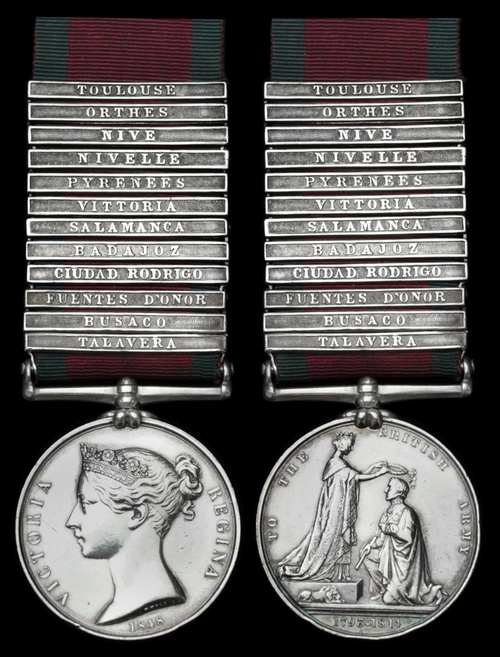
The remarkable 12-clasp M.G.S.M. to Private M. Bradley, 88th Regiment of Foot (Connaught Rangers), who was first captured and taken a Prisoner of War at Buenos Ayres; before fighting at Badajoz where, whilst scaling the wall, he was knocked back and fell from a great height
Although seriously injured in this attack, he was in action again at Vittoria (when he was wounded once more) before seeing further service in the Peninsula at the battles of the Pyrenees, Nivelle, Nive and Orthes
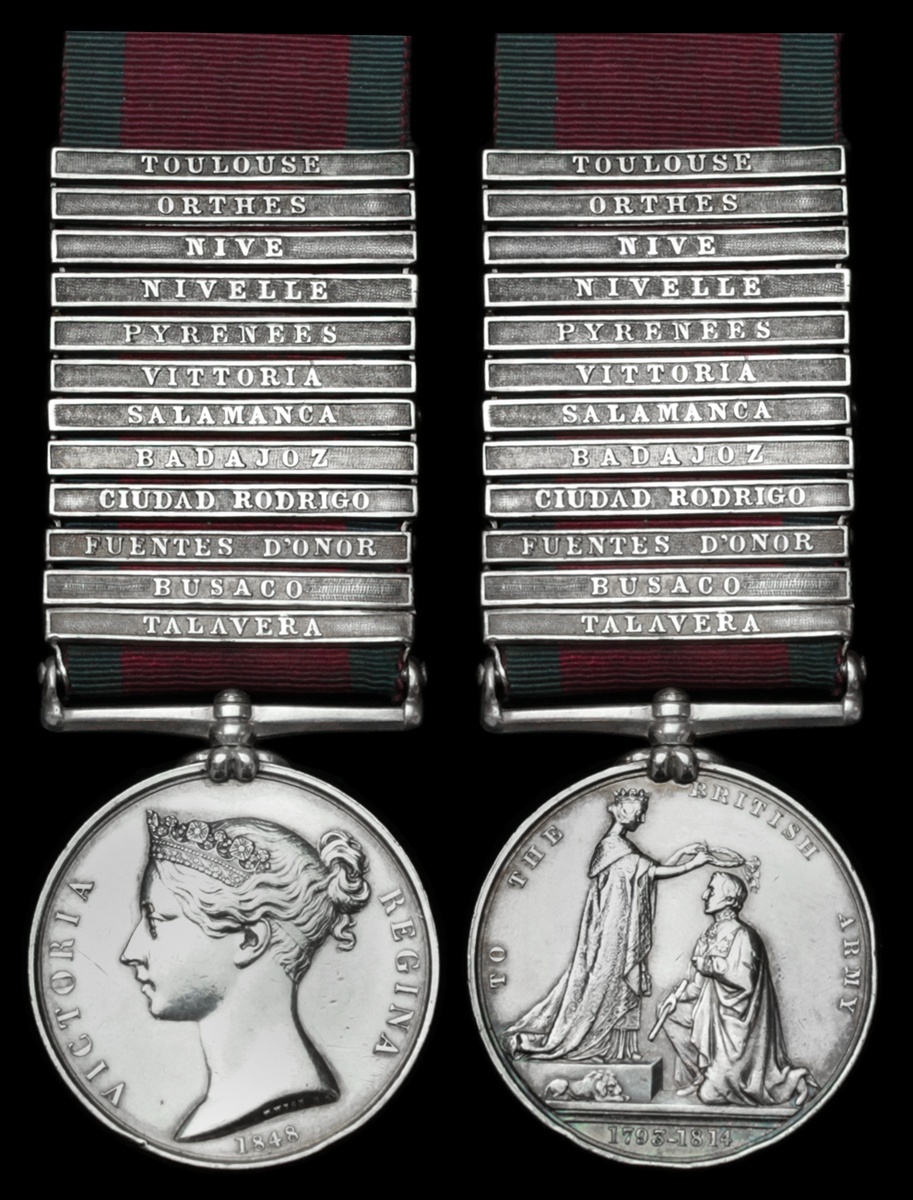
Military General Service 1793-1814, 12 clasps, Talavera, Busaco, Fuentes D'Onor, Ciudad Rodrigo, Badajoz, Salamanca, Vittoria, Pyrenees, Nivelle, Nive, Orthes, Toulouse (Michael Bradley, 88th Foot.), very fine
Ex-McKenzie (1873) & Dr. Murray (1926) Collections.
Fourteen medals with 12 clasps issued to the 88th Foot.
Michael Bradley was born in Tuam, Galway and enlisted into the 1st Battalion 88th Regiment of Foot (Connaught Rangers) in August 1805. Soon after enlistment, Bradley was thrown into action and in late 1806 the battalion was ordered to the Cape of Good Hope from Falmouth. After no less than eight months at sea, via South Africa, they finally made it to Buenos Aires in July 1807. There they partook in the disastrous campaign led by Lieutenant-General John Whitelocke and Commodore Sir Home Popham, in which the 88th Foot suffered heavily. Bradley himself fell with the rest of the wounded, being hit in the right leg, and was taken a prisoner of war. He, along with the others from his regiment taken prisoner, was released and, after an embarrassing surrender, a treaty was signed which saw the British abandon their plans to consolidate the Plate colonies. The 88th Foot were subsequently repatriated home.
Their rest and recuperation was not for long, however, as the 1st Battalion landed in Portugal in March 1809 and thus Bradley commenced his war in the Peninsula. The Irishmen of the Connaught Rangers fought many notable campaigns here including the Second Battle of Porto, in May 1809, where they were attached to William Beresford's right wing. A couple of months later, in July, they joined forces with the Spanish for the Battle of Talavera. The 88th played a decisive role in the action when the King's German Legion were attacked and forced back: the 88th, Bradley in their number, were a steadying force on Medellin Hill and in doing so, received high numbers of casualties. Often in the thick of the fighting, Talavera set a morbid record for the regiment, with 110 wounded and killed.
Bradley lived to fight another day and went on to see action at the Battle of Bussaco in September 1810: the fighting was again intense and included a bloody bayonet charge. Fairing even worse than at Talavera, the Connaughts sustained 132 casualties. The air was thick, and the rain torrential when they stood at the east of Torres Vedras and waited with bated breath for the French to attack. Upon arriving at the scene, Wellington saw the charge and commented to the Commanding Officer of the 88th, Lieutenant-Colonel John Wallace: 'I never saw a more gallant charge than that just made by your regiment'. Bradley was present for yet another charge in May 1811 when the 88th Foot led the fight at the Battle of Fuentes d'Onoro where the Allied army finally drove the French out of Portugal.
Bradley's next action proved fateful for him and dominated the rest of his military career. In April 1812, the 88th Foot achieved phenomenal success when they finally scaled the walls of the castle at Badajoz after multiple attempts and very heavy casualties - Bradley in their number. When scaling the wall himself, he was pushed back by one of the French defenders and fell from a great height: he was badly wounded in both legs and his right wrist, breaking a couple of ribs on the way down. As a whole, the battalion suffered a terrible 250 casualties.
Bradley took several months to recover from his wounds but rejoined his regiment in time for the Battle of Salamanca, where the 88th Foot were paramount in crushing General Macune's troops when they climbed the hill at Miranda de Azon. This was a pivotal battle in the Peninsular War and Bradley served right in the middle of it. The battle is famed for Wellington's masterful and perfectly-timed attack, where he was said to have 'crushed 40,000 men in a mere 40 minutes'. The 88th Foot also became famous for their heroics here, as the regiment took a prized 'Jingling Johnny' trophy from the band of a defeated French infantry regiment, which was marched at the head of its parades for numerous years.
High off the success of this last battle, the 88th were then present at the Battle of Vittoria in June 1813 where Bradley was wounded yet again, this time on his right side. Bradley was not alone in this, and the 88th Foot suffered enormously with 215 men killed and wounded. And yet, he recovered swiftly and fought at the Battle of the Pyrenees the following month and the Battle of Nivelle in the November. After fighting in the Battle of Nive in December, the 88th Foot fought their final battle of the Peninsular War in February at Orthes. The regiment suffered 85 casualties before then being sent to Upper Canada to defend the region against American invasion.
After serving with the regiment for several more years, Bradley was eventually discharged from service owing to injuries sustained during his numerous Peninsular War campaigns. He was 34 years old (having served for 16 years) upon his discharge at Christie Castle, Ireland on 11 September 1821. Bradley had fought in a remarkable 12 'general actions' during his military career.
Subject to 20% VAT on Buyer’s Premium. For more information please view Terms and Conditions for Buyers.
Estimate
£5,000 to £7,000
Starting price
£4000

Watch, listen and bid as if you were in the room. Now available for auctions worldwide.
Click here to bid live
An exclusive and confidential service for the discerning collector or vendor.
View the Gallery
Download every Spink catalogue on your iPad, iPod or iPhone using free Spink app.
Download From iTunes© 2026 Spink & Son. All rights reserved.