
Auction: 26001 - Orders, Decorations and Medals
Lot: 284
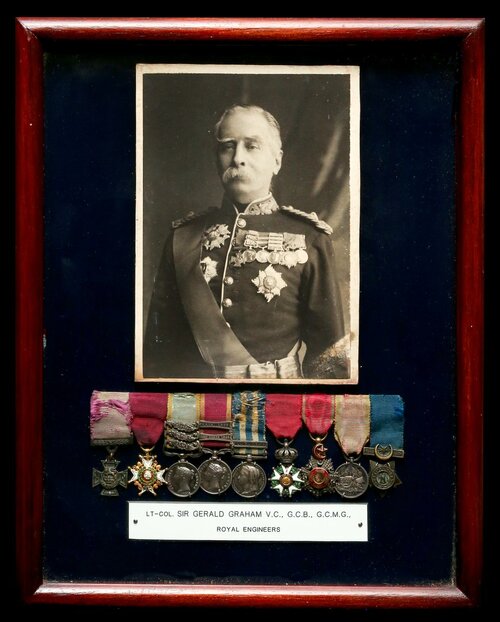
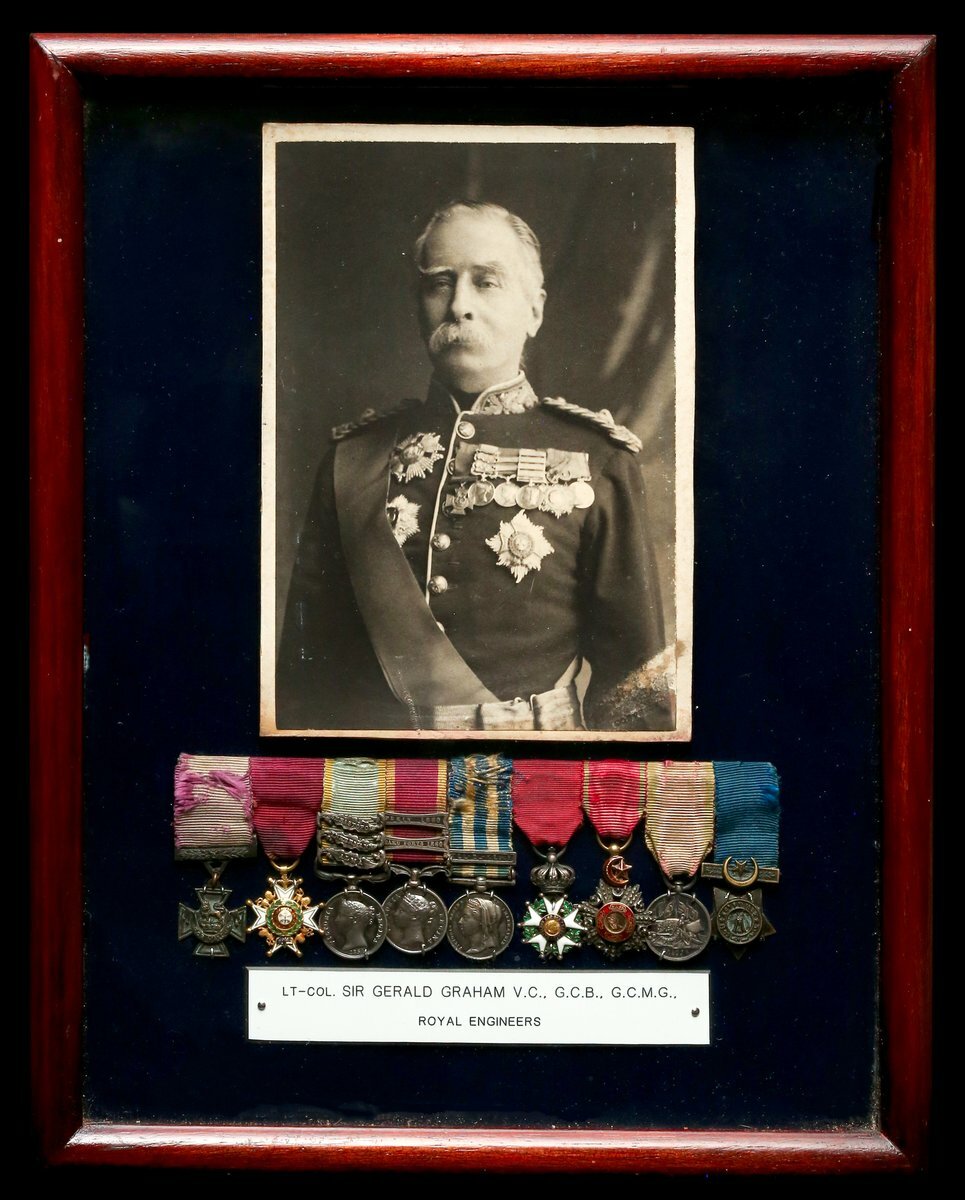
The mounted V.C., G.C.B. group of nine miniature dress medals worn by Lieutenant-General Sir G. Graham, Royal Engineers
Victoria Cross; Order of the Bath, Military Division, gold and enamel, fitted with ring suspension; Crimea 1854-56, 3 clasps, Alma, Inkermann, Sebastopol; China 1857-60, 2 clasps, Taku Forts 1860, Pekin 1860; Egypt 1882-89, dated reverse, 1 clasp, Tel-El-Kebir; France, Second Empire, Legion of Honour, Chevalier’s Badge, silver, gold and enamel; Turkey, Order of the Medjidie, silver, gold and enamel; Turkish Crimea 1855, British issue; Khedive’s Star 1882, mounted as worn with faded ribbons, in a glazed mahogany display case with a fine original portrait photograph of the recipient in the display case, in uniform and wearing medals, good very fine (9)
This group recently proudly featured on the front cover of Miniature Medals World, the quarterly magazine of the Miniatures Branch of the Orders & Medals Research Society.
V.C. London Gazette 24 February 1857.
‘Determined gallantry at the head of a ladder party, at the assault of the Redan, on the 18th June, 1855. Devoted heroism in sallying out of the trenches on numerous occasions, and bringing in wounded officers and men’.
G.C.B. London Gazette 20 May 1896.
G.C.M.G. London Gazette 25 August 1885.
M.I.D. London Gazette 21 December 1855, 15 February 1856 (Crimea), 4 November 1860 (China), 3 September, 19 September, 21 September, 6 October & 2 November 1882 (Egypt), 27 March, 11, 29 & 29 April & 6 May 1884 (Egypt), 23 June & 25 July 1885 (Egypt).
Gerald Graham was born at Acton, Middlesex on 27 June 1831 and was educated at a combination of Dresden, Wimbledon and Edinburgh, in 1847 he was sent to the Royal Military College, Woolwich. He was commissioned into the Royal Engineers on 19 June 1850 and subsequently completed his military training at the School of Military Engineering at Chatham, Kent.
Graham was promoted Lieutenant in February 1854 shortly before embarking for the Crimea. He served in the Battles of Alma and Inkermann and at the siege of Sebastopol and was twice wounded. He was awarded the V.C. for leading a ladder-party in the assault upon the Redan on 18 June 1855.
Extract from Life, Letters, and Diaries of Lieutenant General Sir G. Graham, by Colonel R. H. Vetch:
The attack on the Redan was made by several columns, to one of which, the Left or No.1 column, commanded by Major-General Sir John Campbell, Graham was attached to lead the ladder party. The column was composed and ordered to move as follows:-
Royal Sappers and Miners (10).
Covering party of skirmishers, "Rifles" (100).
Ladder and woolbag parties (120) and (50).
Storming party, 57th Regiment (400).
Reserves, 17th and 21st Regiments (800), with working party (400).
Lieutenant James Murray, R.E., was with the Royal Sappers and Miners guiding the column with the skirmishers. Graham commanded and led the woolbag party and the ladder party, composed of an equal number of sailors and soldiers. Major Bent, R.E., was with the storming party, and Lieutenant Charles G. Gordon, R.E., was with the reserve. The column assembled before the break of day under the papapet on the western side of the "Quarries", and when the concerted signal was given, the skirmishers and Sappers under Lieutenant Murray moved out, followed by the woolbag and ladder parties. A storm of grape and musketry fire burst from the western face of the Redan, and the Rifles, after advancing about fifty yards, took advantage of some natural cover, behind which they plied the Redan with fire. This temporary halt brought the ladder party also to a standstill, and men began to fall rapidly. Lieutenant Murray was mortally wounded, and Graham's ladder party lost several men, although Graham himself seemed to bear a charmed life. "The vast stature", says Kinglake, "of the young Engineer who directed their energies made him strangely conspicuous in the field, and it was on Gerald Graham and the sailors that the praise of observers converged".
At this moment up came Lieut.-Colonel Tylden, the Commanding Royal Engineer, fretting at the delay, waving his sword, and shouting to them to go on. Graham ran to meet him to obtain his approval to storm the Salient instead of the right flank of the Redan, which appeared to be impracticable. "Anywhere, so long as you get on," said the gallant colonel, and was almost immediately struck down. Throwing down his sword, Graham, with the help of Sergeant Coppin and Sapper Ewen of the 8th Company, Royal Sappers and Miners, raised the wounded Colonel from the ground, and carried him to a more sheltered spot fifty yards away. "Graham's cool courage," says Sir Evelyn Wood in 'The Crimea in 1854 and 1894,' "in these trying moments was evident from his being able to walk straight back to where he had thrown down his sword."
Having picked up his sword again and rejoined his men, the skirmishers moved towards the Salient, followed by the woolbag and ladder parties, which Graham halted in front of the advanced trench in order that the skirmishers might cover them before they moved on farther. The skirmishers might cover them before they moved on farther. The skirmishers were unable to advance under the formidable fire of grape and musketry from the Redan, and most of them moved to the west, whither some of the storming party had already gone. After remaining for some time in advance of the trenches exposed to fire, Graham ordered the escalading party to retire into the shelter of the advanced trench, which they did.
Some ten minutes later, Lord West, who had succeeded to the command of the column, Sir John Campbell having been killed near the Salient, came up and, telling Graham that he was about to lead out another skirmishing party, requested him to take out the ladders. Lord West intended to form another storming party out of the reserve, lying in disorder along the line of parapet and seeking cover from the furious fire of the enemy. Of the ladder party many of the soldiers were missing, but the sailors were eager for another try. Although some additional men were obtained from the reserve, Graham could only muster four bearers for each ladder instead of six, but with these he moved out under a murderous fire.
With their ladders beside them, Graham's party lay on the grass exposed to this tremendous fire while they awaited the skirmishers; but when ten minutes passed and neither skirmishers nor storming party appeared, Graham withdrew his party into the advanced trench.
Mr Kinglake says on this lead: "When after a while it was seen that the 'covering party' of skirmishers had not begun to advance, the sailors eagerly wished - making only an exception for Graham - to dispense with the aid of all soldiers. They had lost their naval commanders (Lieutenant Kidd killed, and Lieutenant Cane gravely wounded), but Mr Kennedy, mate, still remained to them; and delighted with their pilot, Gerald Graham - a giant intent on his work as though proof against grape-shot and fear- they wanted, if he would but lead them, to go and attack the Redan without asking any one other landsman to share in the bliss of the enterprise. Their 'pilot' of course could not humour them in this wild desire; and, on the contrary, he soon brought them back to find shelter under the parapet."
Graham in his official report calls attention to "the remarkable steadiness and gallantry of the officers and men of the Naval Brigade who formed part of the ladder party, and who suffered most severely on this occasion," and also to "the steady conduct of the party of Sappers".
Lord West wrote of Lieut--General Bentinck: "I wish I could do justice to the daring and intrepid conduct of the party of sailors.... Lieutenant Graham of the Engineers, who led the ladder party, envinced a coolness and a readiness to expose himself to any personal risk which does him the greatest credit."
The enterprise was abandoned, but, while waiting for instructions, an incident occured which is recorded by Kinglake and others, of Charlie Gordon (afterwards Major-General Gordon of Khartoum), who was attached to the reserve. Assuming that yet another effort would be made, he eagerly inquired of Graham what part in it would be assigned to him, now that Lieutenant Murray was hors de combat. Graham intimated that he supposed the affair was over, and there was nothing, therefore, for him to do. Gordon was so angry and disappointed that hot words ensued, which caused, for a short time, a little estrangement between the two friends.
On the night of the 8th to the 9th of July 1855 Graham and Captain G. J. Wolseley of the 90th Regiment (now Lord Wolseley), acting as an assistant Engineers, on account of the paucity of Engineers officers at the siege, were on Engineer duty in the trenches. Early on the morning of the 9th Graham was wounded in much the same way as before, only more seriously. The official 'Journal of the Siege of Sebastopol' shows how dangerous the work in the trenches was at this time, the enemy keeping up a continous fire of shell, grape, and light-balls, which greatly interfered with the work. So hot was the fire that the entry in the 'Journal' on this night runs: "Nineteen gabions were pushed on in the Right advance, fifth parallel; but Lieutenant Graham having been unfortunately struck in the face with some stones from a round-shot, and consequently forced to leave his party on the left advanced sap 'f', the officer of the 62nd Regiment who commanded the party withdrew his men, telling the sapper then in charge that he considered it too dangerous for Line-men." Graham's wound was a severe one, but he made light of it to his mother:-
"9 July 1855.
"MY DEAR MOTHER, - A friend of mine has kindly undertaken to write this from my dictation, as you will see from the paper. I was slightly wounded this morning in the trenches. The same thing happened to me then as on the former occasion - a cannon-ball struck the parapet just above my head and sent the earth into my face: my face is somewhat swollen and cut, and I am unable to open my eyes on account of the dirt driven into them, but the doctor assures me that the sight is not in the last degree injured, and that I shall be all right again in a day or two. The principal reason that I cannot open my eyes is that my cheeks are so much swollen. This letter must go off to-morrow morning. By the next mail I will write you a letter myself; in the mean time this will reassure you all. - Ever, &c., G. GRAHAM."
He was, however, incapacitated for duty for nearly two months, and had to go to Therapia, where he wrote the following letter to his father, who was anxious that he should return home:-
HOTEL D'ANGLETERRE, THERAPIA, 8th August 1855.
" MY DEAR FATHER, - Before you receive this you will perceive that you have overestimated the severity of my wound, and that there is no necessity for me to return home; and as I am determined not to return home without a necessity, I hope you will perceive the worse than uselessness of urging me to such a step .... You must disabuse yourself of the idea that there is such extreme peril in my remaining at the seat of war. I have now had my fair share of the blows, and according to an ordinary calculation of the chances of war, I should be pretty safe for some time to come. Besides that, I am pretty well acclimatised, having never been ill when in the Crimea. Altogether you may consider that I go back a seasoned veteran, with a much better chance of escape frrom danger or disease than the raw recruits. At present, my dear father, you see everything en noir, whereas I would much prefer you seeing things en couleur de rose, as you did last year. After all, the Russians must suffer next winter infinitely more than we shall. A few days' rain, such as we are having just now, is for them a virtual investment of the place... -Ever, &c.,
G. GRAHAM."
The next letter - to his sister - shows that his endeavours to overcome his father's reluctance to her marriage had been successful, and that the wedding had taken place:-
"HOTEL D'ANGLETERRE, THERAPIA, 25th August 1855.
"MY DEAR SISTER, - By the last mail I received your wedding-cards, giving me to understand that the great event had come off. Since then I have received an account of the wedding both from you and Richard. It certainly appears to have been a delightful wedding-party. Richard was greatly pleased with it, he says, and thought you looked very well and happy, as I have no doubt you felt. I suppose you have pitched your tent in the most picturesque part of the Pyrenees you could find, and lead a very romantic life together. I am now about to return to the Crimea, my health being fully re-established. I have lately received a very long-winded and rather facetious letter from Mr Packman, who has written at my father's request to advocate his notion that I should go home on sick leave. Mr Packman does this rather ingeniously by urging it as a generous measure for me to adopt, in order to allow some of my brother-officers to come out here and dis-? ex-tinguish themselves in my place....
"here the Turks are holding the feast of Bairam, and every Turk puts on his best clothes, so that one sees a great many bright-coloured jackets and waistcoats with gold embroidery, &c. I have not seen any of the sights at Constantinople yet. Yesterday I went to the mosque of S. Sophia, which is very splendid (vide 'Murray'). Another place we went to was the Bin-bir-derek or Thosand-and-one Columns. This is an underground vault, an old Roman cistern, the roof of which is supported by a great many columns. The inhabitants of this place, silk-spinners, set up a tremendous howl when they saw us for backsheesh, but, not getting any, they pelted us as we were going out. There is a remarkable photograph in the Exhibition of an Egyptian obelisk, which I have sent to our father. In the same box I sent some things for you: a photograph of myself, a few views of the Crimea, and a few Turkish things, including a pipe and dervish's cap for Reginald. The latter I thought appropriate on account of its sacerdotal character.
...-Ever, &c., G. GRAHAM."
Graham resumed duty in the Crimea on the 4th September, the day before the final bombardment, and took part in the operations of the 8th September, which resulted in another failure to take the Redan, but in the capture of the Malakhoff by the French and the immediate evacuation by the Russians of the south side of Sebastopol. On the 10th he writes to his mother, to assure her of his safety:-
"Camp before SEBASTOPOL, 10th Sept. 1855.
"MY DEAR MOTHER, - I can only write you a few lines to assure you of my being in very good health. I arrived here on the 4th, the day before the bombardment commenced. On the 8th the French took the Malakhoff by a coup de main. We failed in the Redan. The Russians, however, evacuated it during the night. They blew up their magazines and set the town on fire. It is still burning. Although we have no more trenches, yet we have still plenty of work, so I must conclude.-Ever, &c., G. GRAHAM."
Friends at home were eagerly watching young Graham's career. Warm had been the congratulations among them on his safety amid "the danger and slaughter of the Redan," and many anxious inquiries were made when the great news of the fall of Sebastopol reached England. One relative in Norfolk incidentally mentions that "there was a great to-do at Norwich" on receipt of the joyful intelligence, "and all the butchers and bakers burnt their baskets, and the old market-woman set fire to their own stalls, by way of illumination, the bells ringing merrily, and the people shouting themselves hoarse."
Graham returned to England and at the inaugural V.C. ceremony in Hyde Park, on 26 June 1857, Graham was personally decorated by Queen Victoria, who pierced his chest while pinning the Cross to his coat.
Following his return to England, Graham served as acting-adjutant at Aldershot until August 1858, when he was ordered to India due to the ongoing war of Indian Mutiny. However, by the time he arrived in Lucknow and assumed command of the 23rd Company of Royal Engineers the conflict was practically over and his outfit was then sent on to Canton in the autumn of 1859 in anticipation of war with the Qing Dynasty.
Graham's company joined the 2nd Division of the British army assembling at Kowloon, near Hong Kong island, under the command of Major-General Sir Robert Napier. During the storming of the Taku forts on 21 August 1860, Graham again demonstrated exceptional courage and skill under heavy fire. While commanding his sappers in the laying of a pontoon bridge across a defensive ditch, he was struck in the leg by a gingal-ball. Despite his wound, Graham mounted his horse and continued directing his men from horseback until his mount was also hit, finally forcing him to withdraw.
Once recovered, Graham rejoined his sappers for the march on Peking, where they occupied the Anting gate after the city's capture. He was present for Lord Elgin's entrance into Peking and attended the signing of the Convention of Peking on 24 October 1860. Here Graham again crossed paths with Charles Gordon, who would remain on in China and take command of the Ever Victorious Army in 1863.
Graham returned to England in 1861 and was made the Commanding Royal Engineer, a position he held for 16 years. He received the brevet of Lieutenant-Colonel in 1861 and Colonel in 1869. Appointed Lieutenant Colonel in 1876, in 1877 he was appointed assistant director of works for barracks at the War Office and was promoted to Major-General in 1881.
In 1882, Sir Garnet Wolseley was tasked with putting down the Urabi Revolt in Egypt and selected Graham to command the 2nd Infantry Brigade in the 1st Division of his expeditionary army. On 28 August 1882 Graham lead a vanguard force of 1,900 men, occupied the strategically crucial Kassassin lock and bridge following a two-day push from Suez along the Sweet Water Canal. Short on food and ammunition after their desert march, the British unit was caught in a surprise assault by a 9,000-strong force under Urabi Pasha. Despite being outmanned and outgunned and fielding only 4 artillery pieces to the Egyptians' 12 . Graham’s force held their position all day and, upon reinforcement by the Household Cavalry, drove the enemy back for an unlikely victory against greatly superior numbers.
Following Graham’s success, Wolseley consolidated the British position, amassing his entire army at Kassassin and repulsed an Egyptian counter-attack there on 9 September 1882. He then resolved to strike a decisive blow by marching – under the cover of night – on Urabi’s force entrenched at Tel-el-Kebir. The pre-dawn advance was organized with Graham’s 2nd Brigade leading the 1st of two columns, split by division.
Upon contact with the Egyptian lines at 5 a.m., Graham personally led his men over the works through overwhelming musket and artillery fire, pushing the enemy back. Once across the entrenchments, Graham directed his brigade against Egyptian forces amassing in the rear before reforming and marching in close order to secure high ground.
The British cavalry carried ahead another 65 miles to capture Cairo, completing the Egyptian rout and ending Urabi Pasha’s rebellion. In a dispatch dated 24 September, Wolseley summarized that, “The brunt of the fighting throughout the campaign fell to the lot of Major-General G. Graham, V.C., C.B., Commanding the 2nd Brigade, and it could not have been in better hands. To that coolness and gallantry in action for which he has always been well known he adds the power of leading and commanding others.” An army of occupation was formed under Sir Archibald Allison and Graham remained in Cairo to command an infantry brigade. Upon his return to England in June 1883, he was celebrated by the Royal Engineers at Chatham and dined with Queen Victoria at Osborne. For his service Graham was mentioned in dispatches five times, thanked by both the Houses of Parliament and House of Lords, received the Egypt Medal with clasp, the Bronze Star, the Second Class of the Medjidie, He was made a K.C.B. on 18 November 1882.
Graham returned to Egypt and in 1884 took to the battlefield against Osman Digna, whose army he defeated at El-Teb and Tamai. In the meantime he had urged a plan for the assistance of Gordon, which, however, was not accepted. Graham led a second Suakin Field Force which arrived at the port on 12 March 1885. Its purpose was to suppress Osman Digna's forces which were active in the area, and to supervise the construction of the Suakin-Berber Railway. The field force engaged in two actions: at Hashin on 20 March and at Tofrek on 22 March, before the British government changed its policies, shutting down the railway project and leaving the Sudan in May 1885.
In his book "The Battle of Tofrek, fought near Suakin, March 22nd 1885", written shortly after the battle for the purpose of correcting erroneous statements in both official and press reports of the battle, William Galloway was strongly critical of General Graham's planning of the Tofrek expedition on three counts:
Compared to the expedition to Hashin on 20 March which Graham commanded himself, which had been protected by four squadrons of British cavalry and a regiment of Bengal cavalry acting as scouts, the Tofrek expedition which he delegated to the command of General McNeill had only one squadron of Lancers plus a company of Mounted Infantry to provide warning of enemy activity; Whereas Graham had the protection of a battery of Royal Horse Artillery able to shell the enemy at long range, no artillery was assigned to McNeill's force; Whereas the ratio of men to transport animals had been over 5:1 in the earlier expedition, it was no more than 2:1 for the later one, resulting in greater difficulties in keeping controlling of the animals. Galloway was even more critical of Graham for a last-minute change to McNeill's marching orders. Instead of following an established track in a southwesterly direction towards Tamai as originally planned, Graham personally instructed McNeill to march westwards into uncharted territory, which turned out to be thickly covered by a jungle of mimosa bushes with long low-lying branches covered in sharp thorns. This caused progress to be both slow and difficult while affording the enemy excellent cover for the surprise attack that they launched later in the day.
For his services in the Sudan in 1884 and 1885 he was promoted Lieutenant-General, created a G.C.M.G. and awarded the Order of the Medjidie 1st Class. In 1888 he declined the Governship of Bermuda and on 14 June 1890 he was placed on the Retired List. In 1896 he was created a G.C.B. and in 1899 was appointed Colonel Commandant of the Royal Engineers. He died at Springfield, Bideford, North Devon on 17 December 1899 after a few days' illness and is buried in the East-the-Water Cemetery, Bideford.
Sold together with the following archive:
(i)
The original Warrant for the Knight Grand Cross of the Order of the Bath (Military), with original signature of Queen Victoria, dated 20 May 1896, in Order of the Bath envelope.
(ii)
The forwarding letter from the Registrar & Secretary of the Order, Albert W. Woods.
(iii)
An original edition of Life, Letters, and Diaries of Lieut.-General Sir Gerald Graham V.C., G.C.B., R.E., by Colonel R. H. Vetch, C.B., London 1901.
(iv)
An assortment of photocipied reseach and copied photographs.
Subject to 20% VAT on Buyer’s Premium. For more information please view Terms and Conditions for Buyers.
Sold for
£3,400
Starting price
£2500
Watch, listen and bid as if you were in the room. Now available for auctions worldwide.
Click here to bid live
An exclusive and confidential service for the discerning collector or vendor.
View the Gallery
Download every Spink catalogue on your iPad, iPod or iPhone using free Spink app.
Download From iTunes© 2026 Spink & Son. All rights reserved.