
Auction: 26001 - Orders, Decorations and Medals
Lot: 245
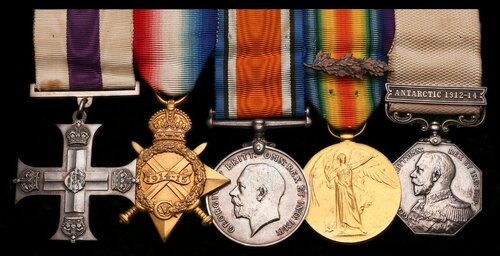
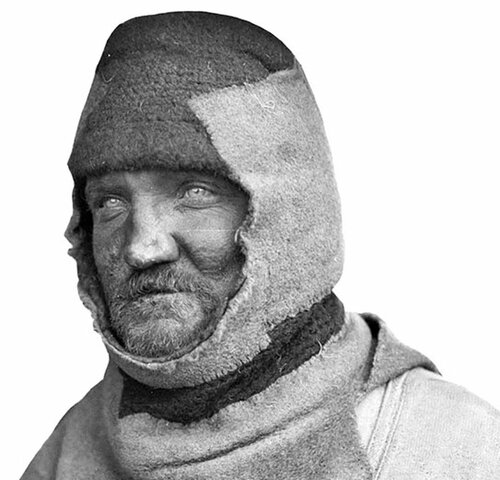
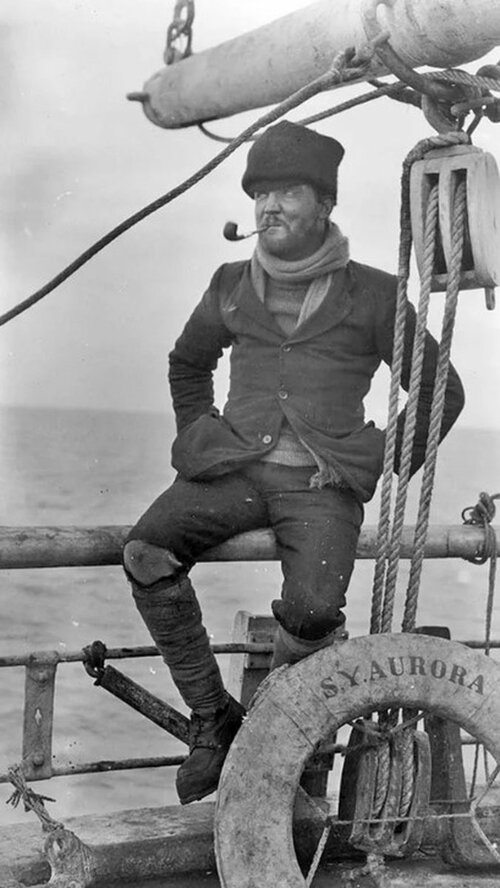
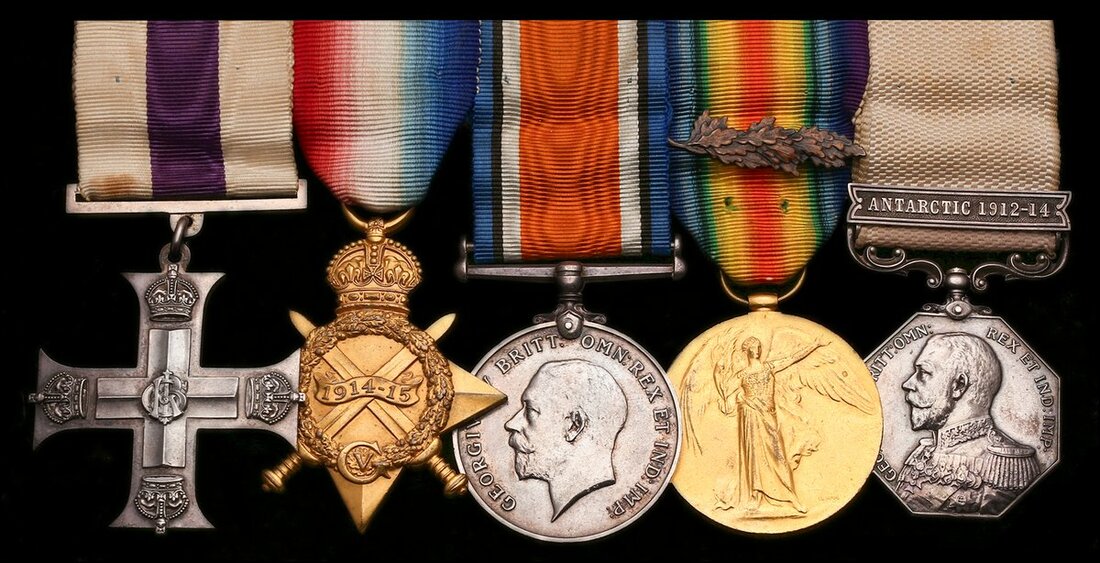
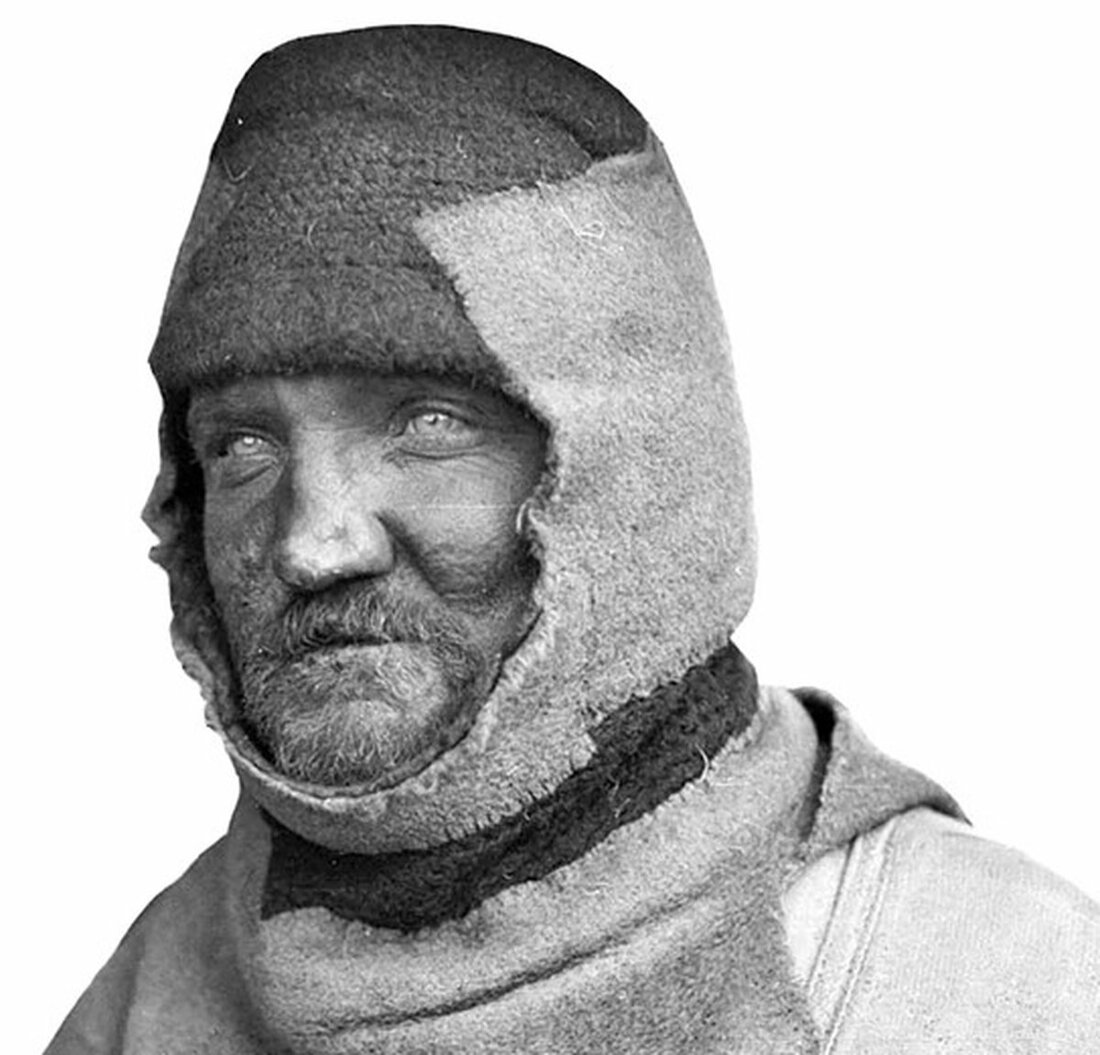
(x) The exceptional Great War M.C., Polar Medal group of five awarded to Captain A. L. 'Dad' McLean, Australian Army Medical Corps, late Royal Army Medical Corps, a notable participant in the 'Golden Age of Polar Exploration'
The popular Chief Medical Officer and Bacteriologist in Mawson's Australasian Antarctic Expedition in 1911-14, he volunteered to stay behind for a second winter when his boss's Far Eastern Party failed to return to base, a period in which he undertook selfless forays to affect their rescue
And when, at length, Mawson came upon some vital supplies left by McLean, he staggered on alone - for his two companions had perished - and finally reached base camp in a terrible state, frostbitten and emaciated, almost beyond recognition; thanks, however, to McLean's dedication and medical skills, the famous explorer was brought back from the brink
Luckily for posterity's sake - and over and above his major contribution to Mawson's The Home of the Blizzard - McLean's polar diary has since appeared in print, whilst in Antarctica itself, his name lives on in perpetuity in the 'McLean Nunataks'
On his premature death in May 1922 - partly caused by the effects of gas poisoning from the Great War - one obituarist was moved to observe that, 'Australia could well feel proud of her son'
Military Cross, G.V.R., the reverse privately engraved, 'Capt. A. L. McLean, A.A.M.C. Villers Bretonneux, 8th Aug 1918'; 1914-15 Star (Lieut. A. L. McLean, R.A.M.C.); British War and Victory Medals, with M.I.D. oak leaf (Capt. A. L. McLean); Polar Medal 1904, G.V.R., one clasp Antarctic 1912-14 (Dr. A. L. McLean, 'Aurora'), mounted as worn, generally good very fine (5)
Provenance:
Spink Medal Circular Number 12, June 1999 (Item 16).
M.C. London Gazette 31 January 1919 and Commonwealth of Australia Gazette 3 June 1919:
'For conspicuous gallantry and devotion to duty. During the attack on 8 August 1918, east of Villers Bretonneux, near Amiens, he followed the attacking troops with his section, tending and dressing wounded under fire on the way. Almost immediately after the objective had been taken, he established his R.A.P. [Regimental Aid Post] in the village of Warfusee, where he worked continuously under great difficulties. Later, during the advance on the following day, he established his R.A.P. almost on the jumping-offline, where he tended and cared for wounded under heavy artillery fire. His energy and zeal saved many lives.'
Archibald Lang McLean was born at Balmain, Sydney, on 27 March 1885 and was educated at the Leichardt Public School, Fort Street High School and the University of Sydney, where he graduated in Arts (BA in 1906) and Medicine (MB in 1910 and ChM in 1911), and was a noted football player.
He briefly practiced as a Resident Medical Officer at the Lewisham Hospital and then at the Coast Hospital, prior to applying for the post of Chief Medical Officer and Bacteriologist to Mawson's Australasian Antarctic Expedition in 1911. Duly selected, part of his role on the expedition was to study the effects of the Antarctic environment on other members of the expedition, by taking regular blood samples and skin swabs.
Polar explorer - Mawson's saviour
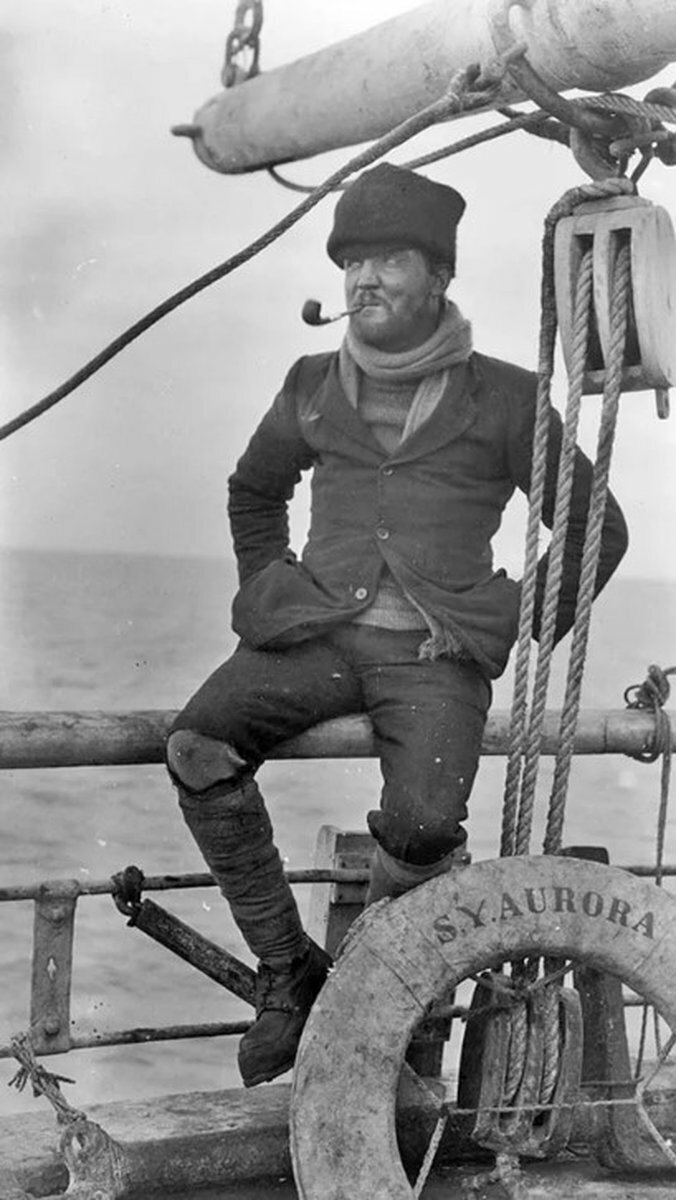
On being dropped off by the Aurora in early January 1912, McLean and his team set up camp in Adelie Land. The most urgent task on landing was to build the huts for their quarters, a period in which he attended to minor injuries, such as cut fingers and hands.
But undertaking research in Antarctica proved challenging, McLean offering a glimpse of such tribulations in his diary:
'A small corner of the hut was reserved for bacteriology. Here, a few shelves and a table accommodated stains and other reagents, slides, a spirit lamp, a centrifuge, a microscope, a steriliser and other miscellaneous apparatus. For more than four months I was unable to make up Gram's iodine, owing to the potassium iodide and the iodine having been misplaced … Boxes containing my stock of materials were buried in snow outside the Hut and were only accessible on the rare fine days, when they had to be dug out, opened and re-packed.'
An article by Lise Mellor, which appears on the University of Sydney School of Medicine's online museum, continues:
'Regardless, McLean's work went well for this first year, and he amassed a substantial collection of bacteriological specimens of Antarctic ice, soil, mud, sea, mammals, birds and fishes. He also analysed regular swabs of the expedition team.
In December 1912, McLean and the expedition team were due to be collected and sail back to Australia but Mawson, Ninnis and Mertz had set out on a sledge expedition to the eastern coast and were well overdue for their return. The Aurora and crew waited as long as possible but after their anchor chain broke, they were forced to sail or risk being trapped in the ice for winter. McLean and five others requested to wait behind and search for Mawson even though it meant remaining in Antarctica for another year. Supplies were unloaded from the ship so that the volunteers had sustenance and materials for yet another winter.
Immediately, McLean, Hodgson and Hurley began searching for Mawson, leaving food parcels and notes outlining the location with compass directions for his return to base. On January 29, 1913, a near-dead Mawson found their food and notes and filled once again with the will for his own survival, began navigating himself back to base.
Tragically, Mertz and Ninnis had perished on the expedition. Mawson himself arrived back on February 8th in a desperate state with multiple internal and external injuries, including his skin and hair having come off much of his body from starvation and frostbite, but McLean was slowly able to nurse him back to more reasonable health and repair.
These sorry events meant that Mawson, McLean and the others remained at Main Base for another year until the Aurora was able to return through the ice. In this second year, McLean also took part in a sledging expedition and a group of three nunataks discovered within the western part of Mertz Glacier were named the McLean Nunataks in his honour.
In Antarctica, McLean established and edited a monthly newspaper, the Adelie Blizzard, to occupy idle hours and to encourage a healthy stimulation of literary enjoyment. Mawson saw the writing of creative pieces and newsworthy articles for the Adelie Blizzard as part of his men's duty and McLean took to it with fervour.
In December 1913, the Aurora returned to collect the expedition team and set sail yet again, this time with all onboard. They arrived back in Australia in March 1914. On his return, McLean accompanied Mawson to England to continue their scientific research and to "revise and amplify" his journals towards Home of the Blizzard, the published account of their Antarctic travails.'
McLean also looked after Sydney Jefferys, the replacement radio officer, who was suffering from paranoia. In consequence, he was admitted to an asylum on his return from the Antarctic.
The Great War
With the advent of the Great War, and still in England, Mclean was commissioned in the Royal Army Medical Corps and proceeded to France on attachment to the 8th Battalion of the Black Watch (Royal Highlanders). Subsequently invalided to England with an infected hand, he worked in the Royal Hospital, Woolwich before being discharged and returning to Australia in early 1917.
Here, he continued his scientific research before enlisting with the Australian Imperial Force in September 1917. And prior to departing on active service, he submitted his Medical Doctorate to the University of Sydney - Bacteriological and Other Researches in Antarctica - for which he received the University Medal.
Proceeding to France, via New Guinea and Egypt, McLean served in the 17th Battalion A.I.F. and in the 5th Field Ambulance and was twice gassed. Awarded the M.C., he was also mentioned in Sir Douglas Haig's despatch of 16 March 1919 (Commonwealth of Australia Gazette 30 October 1919, refers).
Back in Australia, he returned to medical practice at the Red Cross War Chest Farm Colony in Beelbangara, New South Wales, but he died in Sydney on 13 May 1922, himself a victim of respiratory problems exacerbated by his being gassed.
He was laid to rest in the Gore Hill Cemetery, where, in his address, the Reverend Maynard Riley, an old comrade of McLean's, said, 'Australia could well feel proud of her son. When his research work was taken and considered, many in the future would thank God that he lived.'
Just 37 years old, he left a widow, Eva, whom he had married in England in April 1915; she was the stenographer who had typed the manuscript of The Home of the Blizzard.
Sold with an original post-Great War portrait photograph, together with a copy of The Antarctic Diary of Archibald Lang McLean, edited and with an introduction by Beau Riffenburgh (The Erskine Press, 2020).
Subject to 5% tax on Hammer Price in addition to 20% VAT on Buyer’s Premium.
Sold for
£26,000
Starting price
£9000
Watch, listen and bid as if you were in the room. Now available for auctions worldwide.
Click here to bid live
An exclusive and confidential service for the discerning collector or vendor.
View the Gallery
Download every Spink catalogue on your iPad, iPod or iPhone using free Spink app.
Download From iTunes© 2026 Spink & Son. All rights reserved.