
Auction: 26001 - Orders, Decorations and Medals
Lot: 209
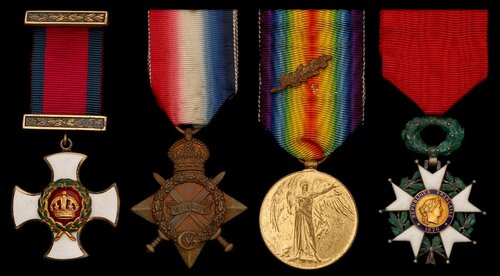
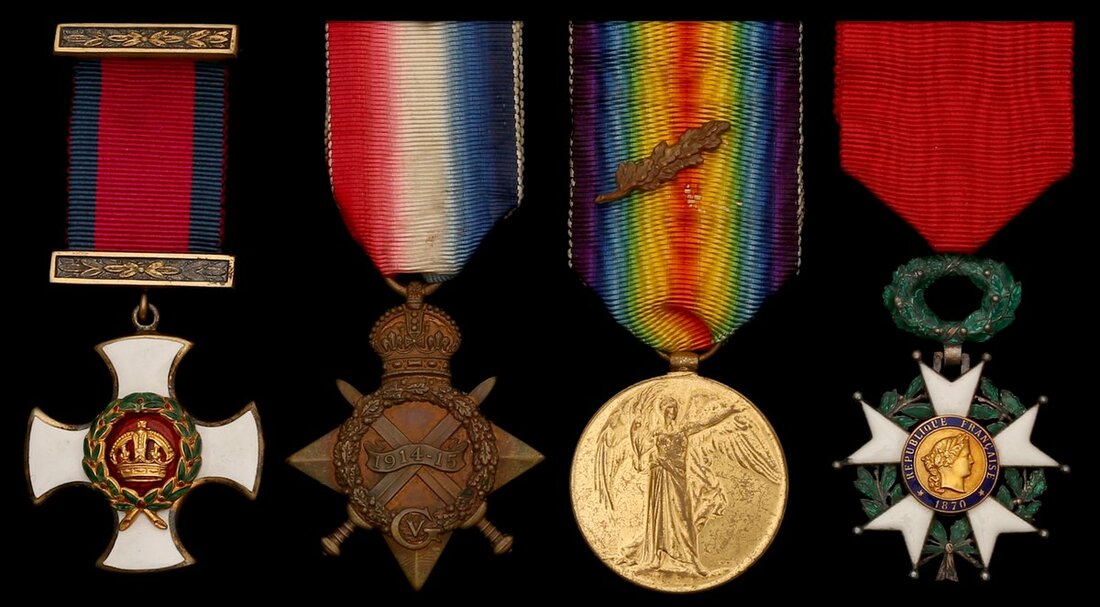
(x) A notable Great War D.S.O. group of four awarded to Engineer Commander T. G. Coomber, Royal Navy, who was decorated for his deeds in H.M.S. Galatea at Heligoland Bight in November 1917 and the recipient of a memorable 'mention' for H.M.S. Broke's famous duel in the Dover Straits in April 1917
On the latter occasion, after ramming the enemy destroyer G-42 and almost turning her over on her beam-ends, Broke repulsed a German boarding party, prior to being towed back to Dover a 'smoking shambles', her decks 'literally running with blood'
Distinguished Service Order, G.V.R., silver-gilt and enamel, in its Garrard & Co. case of issue; 1914-15 Star (Eng Lt. Cr. T. G. Coomber, R.N.); Victory Medal 1914-1919 (Eng. Commr. T. G. Coomber, R.N.) with M.I.D. oak leaves; France, Legion of Honour, Chevalier's breast badge, in silver, gold and enamel, in its Louis and George Aucoc, Paris case of issue, the obverse centre of the first somewhat depressed, but otherwise very fine and better (4)
D.S.O. London Gazette 27 June 1919. The original recommendation states:
'The exceptional steaming qualities shown by the ship since I assumed command are in great measure to Engineer Commander Coomber. I would specially mention the action of 17 November 1917, when I was enabled to keep station on Ceres going at full speed, although 4th ship in line. In some of the light cruiser operations in 1917 and 1918, the Engine Room Department has never failed to answer any call made on it.'
Legion of Honour London Gazette 21 June 1918.
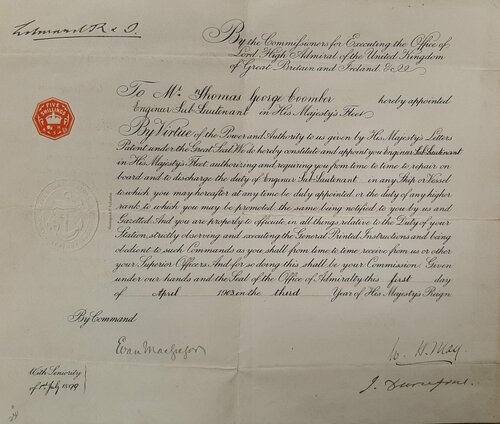
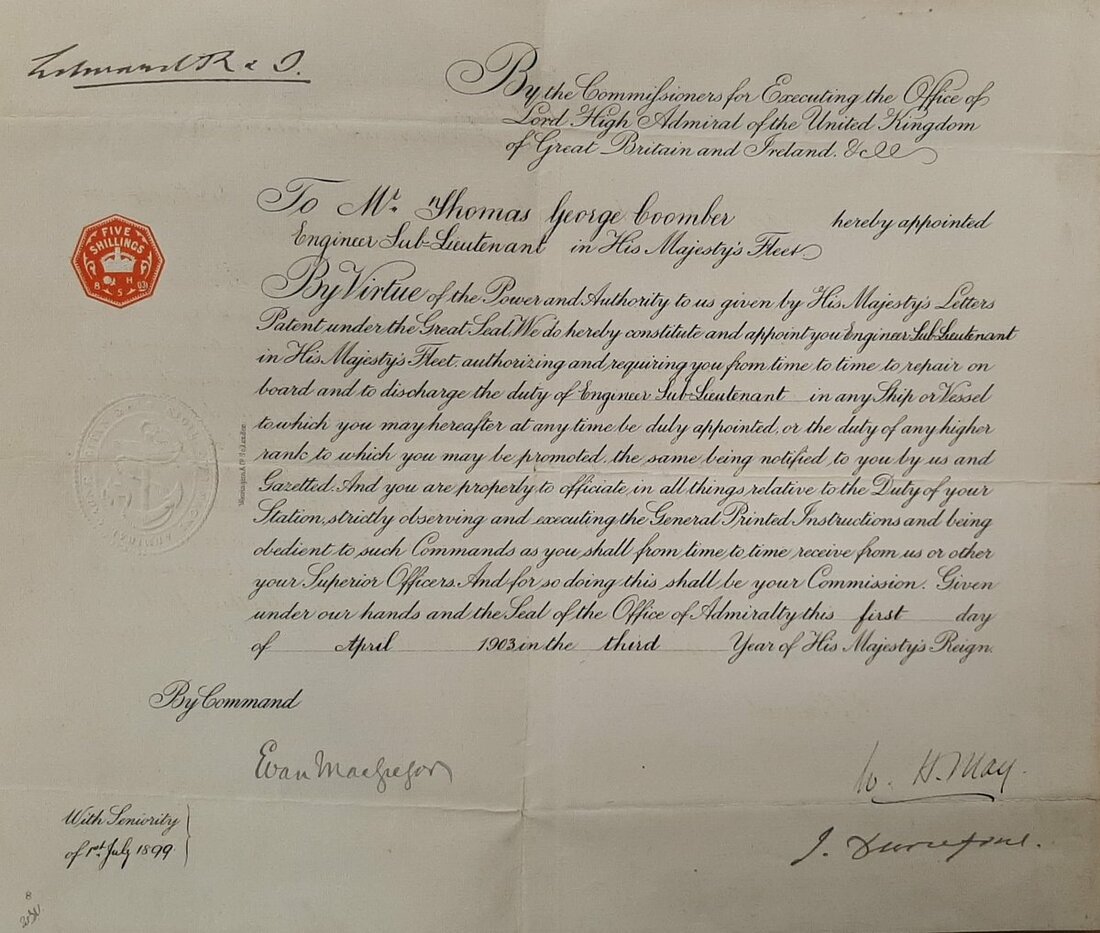
Thomas George Coomber was born in Portsmouth on 18 April 1878 and commenced his engineering studies at the Training College, Devonport. Appointed an Engineer Sub. Lieutenant in April 1903, he enjoyed a spate of seagoing appointments in the period leading up to the Great War, a tour of duty in the royal yacht Victoria & Albert among them.
An Engineer Lieutenant-Commander in the destroyer H.M.S. Tigress on the outbreak of hostilities in August 1914, he transferred to another destroyer, the Mystic, in February 1915, in which he was present at the battle of Jutland.
In March 1917, Coomber removed to the Broke in the 11th Destroyer Flotilla, and he was similarly employed at the time of her celebrated action in the Dover Straits on the night of 20-21 April 1917, when she - and her consort Swift - took-on six German destroyers. One of the most celebrated naval actions of the Great War, it has been much written about, a lively account appearing in Taffrails' Endless Story.
Of the moment Broke rammed the enemy destroyer G-42, Taffrail wrote:
'Under heavy fire, and in a coruscation of gun-flashes and the sparkle and smoke of exploding shells, Evans put his helm over and drove straight for his enemy at 27 knots. There was hardly time to breathe, let alone to think coherently.
The German, G. 42, increased speed, smoke and showers of sparks pouring from her funnels as she strove to escape. But it was too late. With a grinding thud, and the screech of tearing steel, the Broke's bow crashed into her opponent's port side abreast the after funnel. The terrific impact hurled the German practically over on her beam-ends as the Broke's ram pushed her bodily through the water. It is impossible to describe the sensations of those on board both these ships as the collision occurred - the Broke's grimly triumphant; the Germans filled with terror-stricken amazement and horror. It was a dreadful moment; but worse was yet to come.
Many were screaming and shouting for help as the Broke's guns, at their maximum depression, pumped shell after shell at a few yards' range into the mass of men huddled on the deck of her stricken enemy. One of the German's torpedo-tubes had stuck into the Broke's side and was torn off its mounting. The anti-aircraft 2-pounders added to the din with their stuttering uproar, while the British seamen that remained alive in the forepart of the ship, with rifles and fixed bayonets, and revolvers and naked cutlasses, headed by Mr. Midshipman Donald Gyles, R.N.R., already wounded by a shell splinter in the eye, swarmed forward on to the Broke's forecastle to repel boarders. They were taking no chances. No quarter was given. Every German who clambered over the bows was shot or bayoneted. A deadly small-arms fire was poured from the forecastle into the terrified men on G. 42's deck. Even the officers on the Broke's bridge used their automatic pistols. Few of their enemies survived the storm of lead and nickel … '
And of damaged sustained, Taffrail continues:
'In the space of a few moments the Broke was converted into a smoking-shambles. In places, her decks were literally running in blood. She sustained 57 casualties, of whom 21 were killed outright, and no part of the ship was immune. Two shells had hit the bridge structure, to kill a signalman, and seriously to wound the helmsman and a man at the engine-room telegraphs … Many casualties had occurred among the guns' crews of the forecastle through two enemy shells, one of which had detonated projectiles in a ready rack. All the electric cables and voice-pipes from the bridge had been shot away, while the after compass, after wireless-room, and searchlight were demolished. The foremost funnel was pierced through and through by splinters until it resembled a huge nutmeg-grater. A shell passing in through the side above the waterline had penetrated a coal-bunker, to explode in the boiler-room beyond, killing or wounding every man in the compartment and severing the main steam-pipe, from which the steam escaped with a deafening roar. And, besides the damage from enemy shell, the British flotilla-leader had a badly bent and crumpled bow, and two huge gashes forward above the waterline. Dead and wounded lay everywhere … '
And finally, as Broke closed the crippled enemy destroyer G-85:
'The Broke then closed one of the sinking Germans, G. 85, which was badly holed forward and was ablaze amidships. Men on her battered forecastle shouted "Kamerad! Kamerad!" and Evans replied through a megaphone, "All right. We will pick you up!"
But other Germans in the stern of G. 85 thought otherwise and opened fire with the after 4.1-inch gun, a shell from which passed through the Broke's bridge. She instantly retaliated with four rounds of 4-inch shell, while Acting-Sub-Lieutenant L. W. Peppe fired a torpedo from aft at a range of 200 yards. Set to run at six feet, it struck G. 85 near the stern.
The Broke was then compelled to stop through the damage to her boilers. She was gradually drifting nearer G. 85, which was still blazing. It was a matter of uncertainty whether the German would sink before the flames reached her magazine. If she blew up with the Broke close alongside, the latter might also be sunk by the explosion. By the efforts of those in the engine-room [under the gallant Coomber], however, she was able to go astern sufficiently to prevent collision. It was 1. 20 a.m., thirty-five minutes from the time when the enemy had first been sighted, and a few moments later the destroyer Mentor, Lieutenant-Commander A. J. Landon, came alongside, and managed by good seamanship to take her in tow.'
It was for this latter episode that Coomber was credited by Evans with providing sufficient steam to escape the blazing wreck of the G-85, which may have blown her magazine at great cost to Broke. 'He acted,' wrote Evans, 'with resource and coolness when a shell exploded in the Boiler Room and by doing enabled Broke to continue the action'.
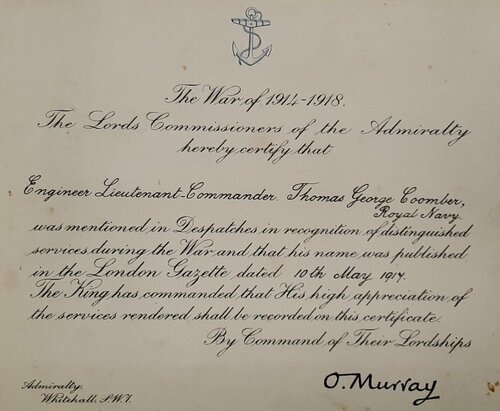
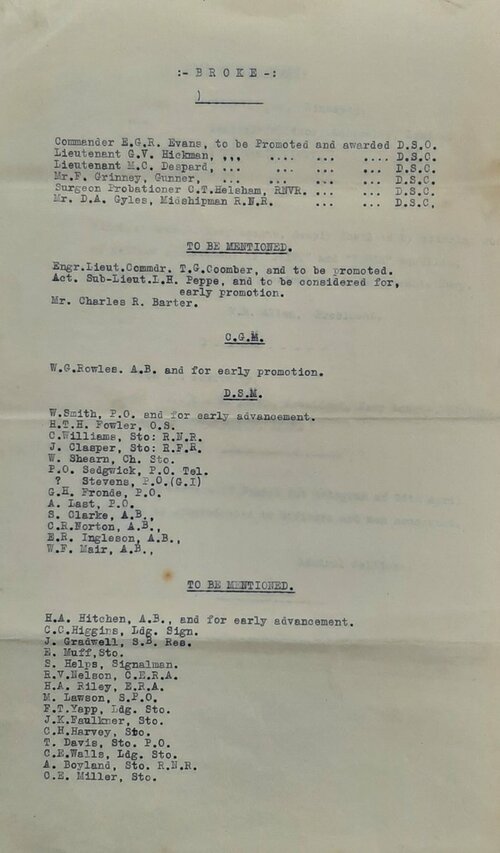
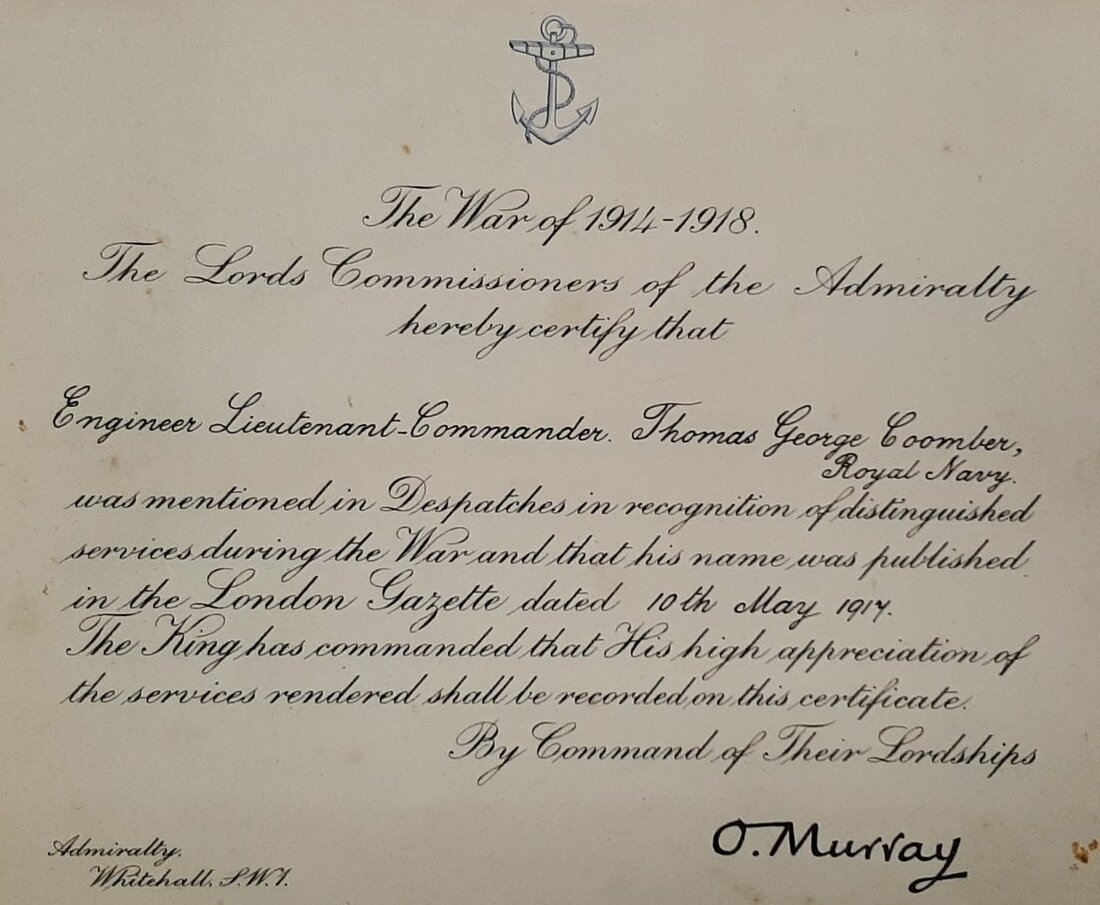
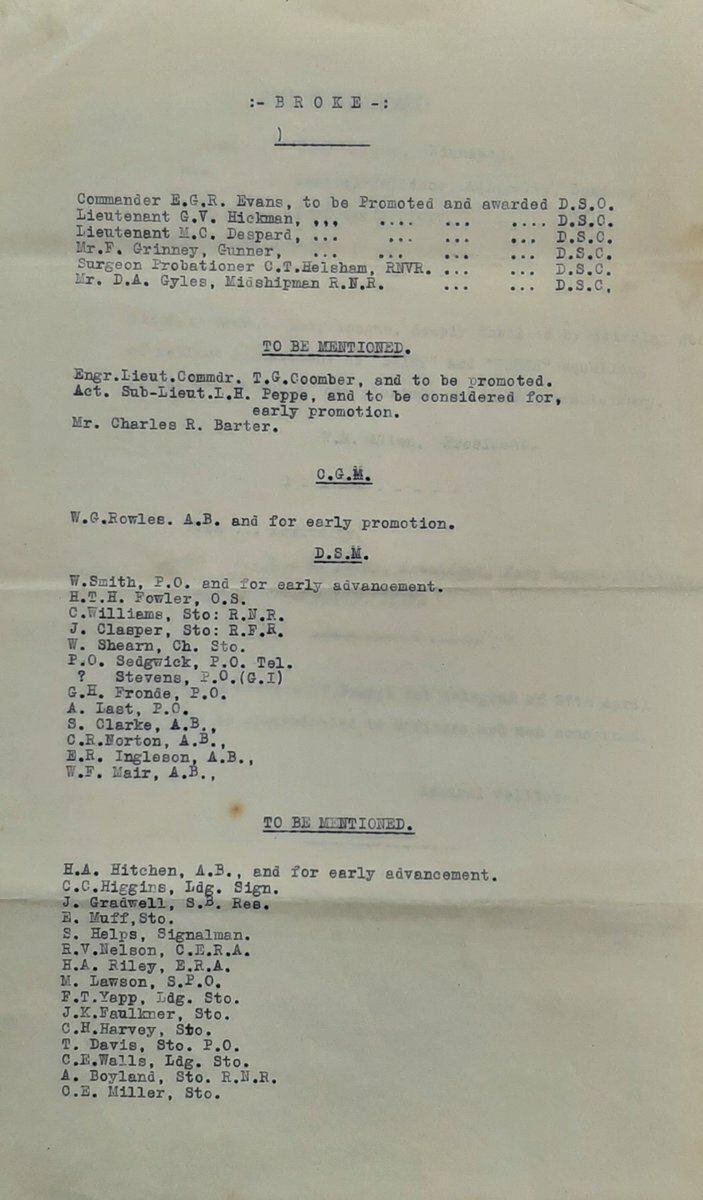
Coomber was specially promoted to Engineer Commander and mentioned in despatches (London Gazette 10 May 1917, refers), a well-merited 'mention' given the damage caused his department.
Removing to the light cruiser Galatea in June 1917, Coomber remained likewise employed until the war's end, and saw further action at the Second Battle of Heligoland Bight on 17 November 1917, the catalyst for his award of the D.S.O. That distinction and his 'mention' aside, Coomber was also appointed a Chevalier of the Legion of Honour.
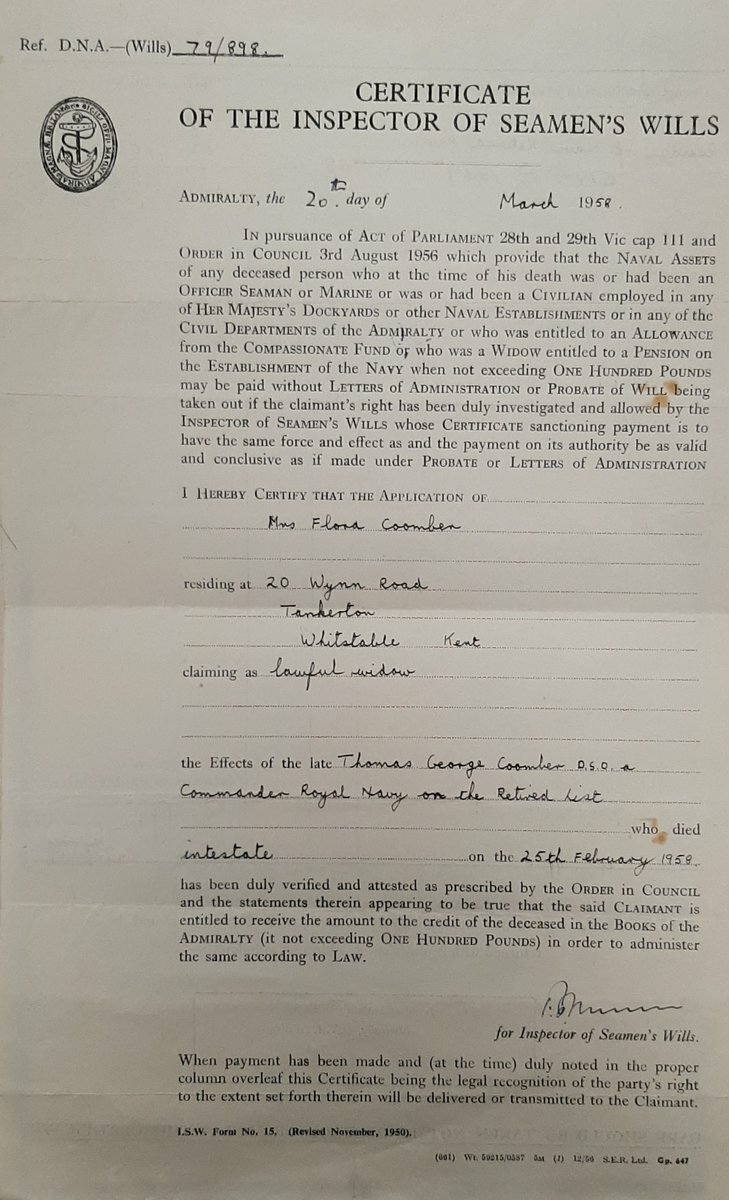
He ended his career with an appointment at the Wallsend Slipway and Engineering Company and was placed on the Retired List in April 1928. Having then settled in Tankerton, Kent, he died there in February 1958.
Sold together with a quantity of original documentation, comprising:
i)
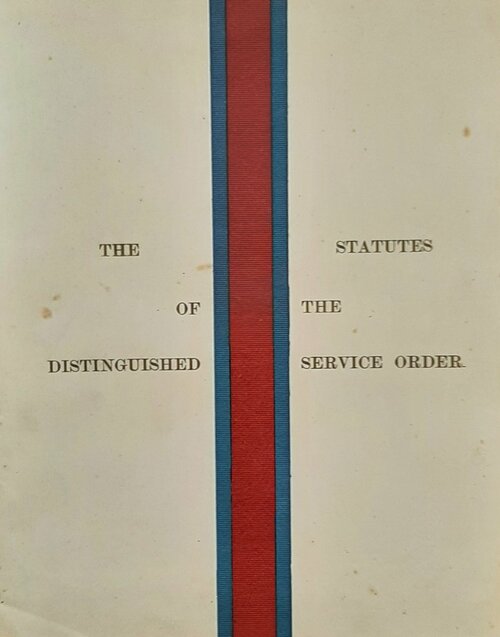
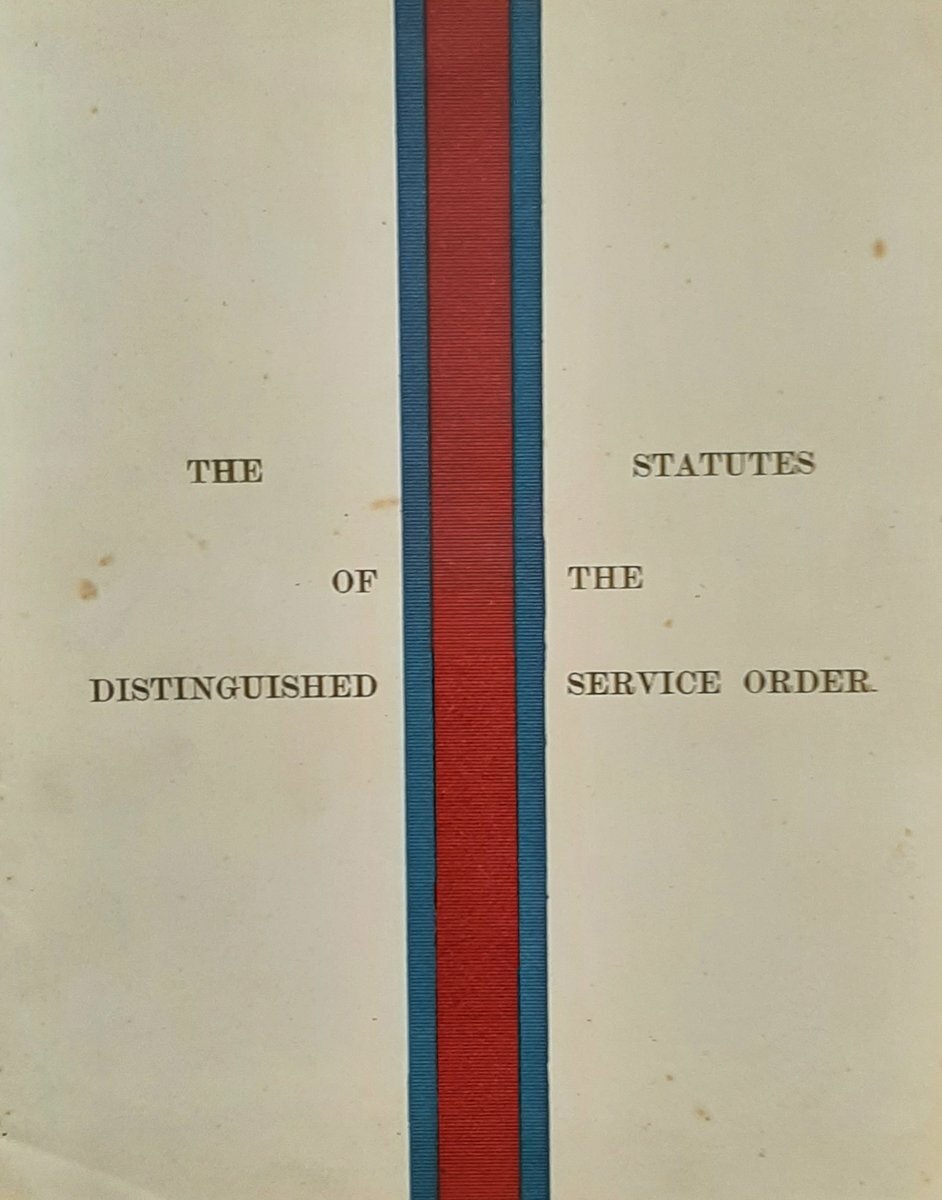
The recipient's M.I.D. certificate in the name of 'Engineer Lieutenant-Commander Thomas George Coomber, Royal Navy, dated 10 May 1917, together with Admiralty letter notifying him of the distinction, and a copy of the Statutes for the D.S.O.
ii)
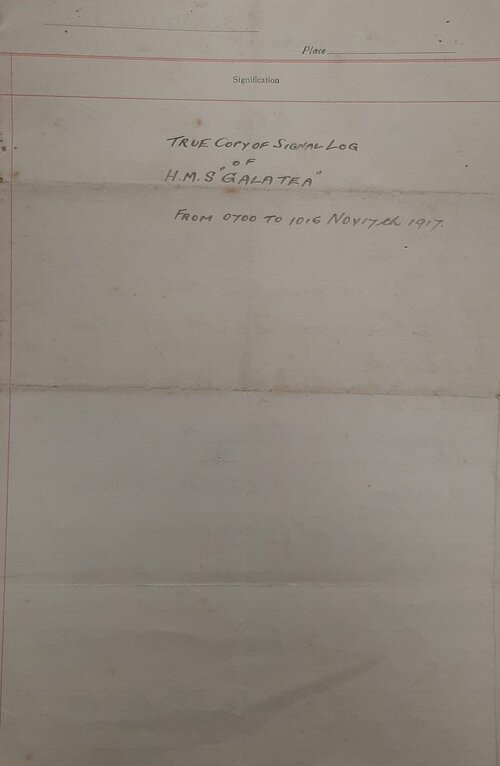
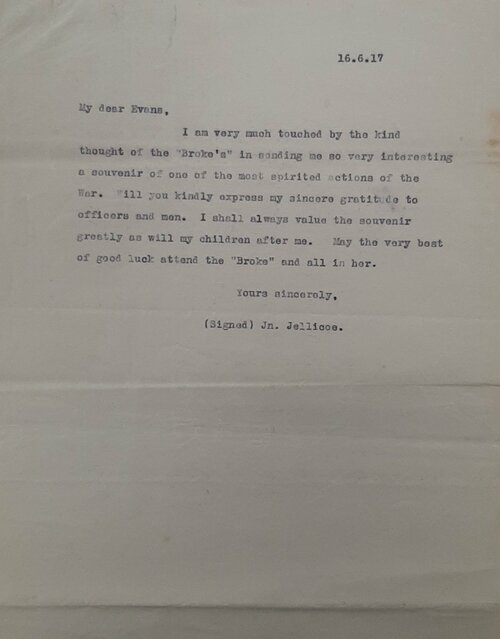
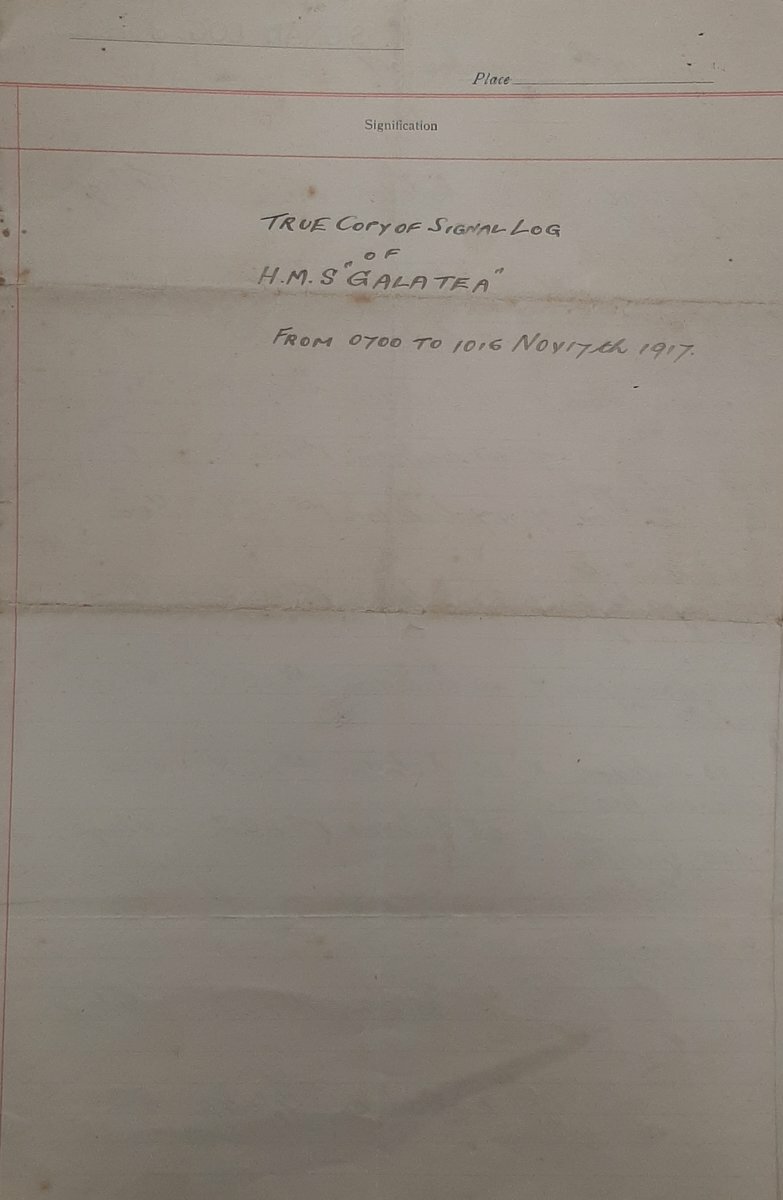
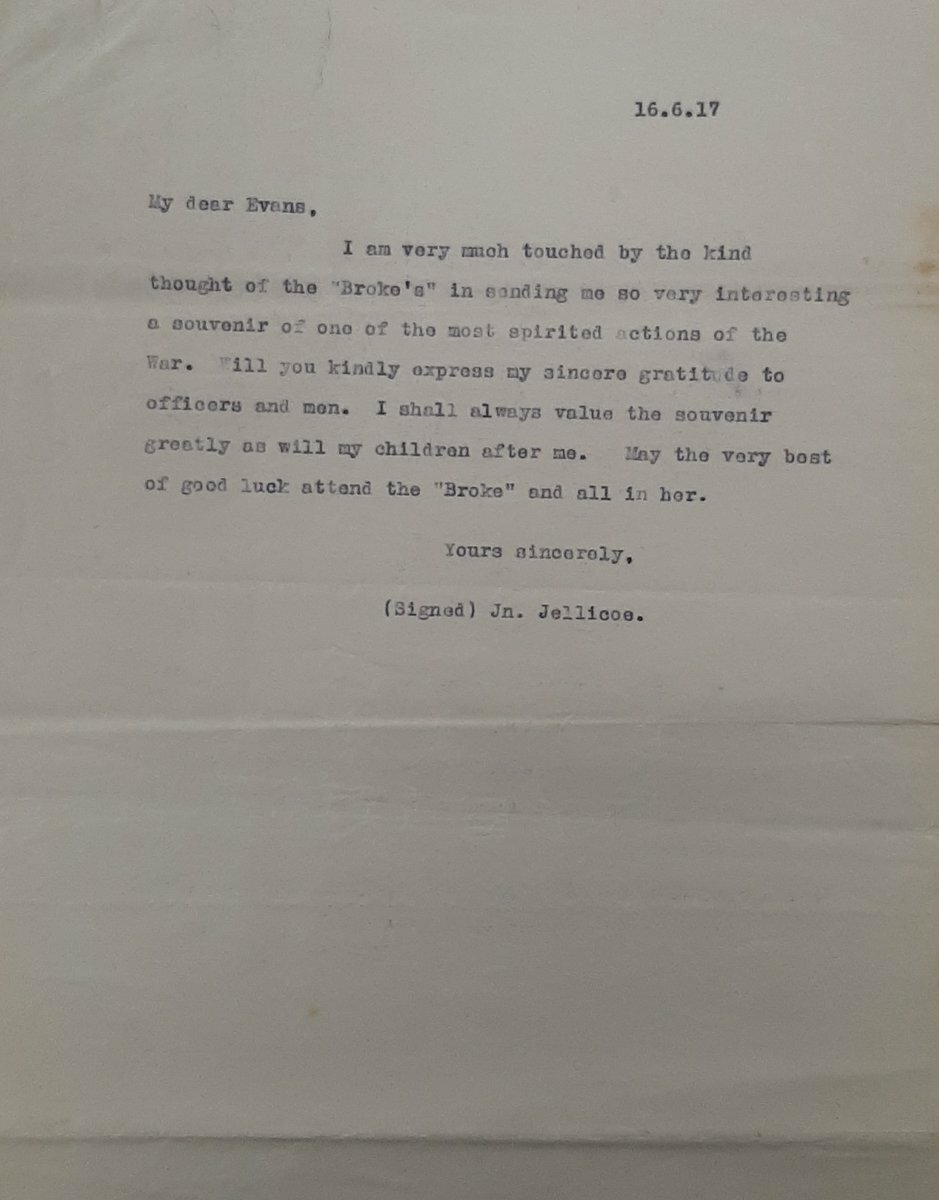
A quantity of Great War carbon copy memos in respect of the Broke action, and a handwritten copy of the signal log of Galatea for the action of 17 November 1917.
iii)
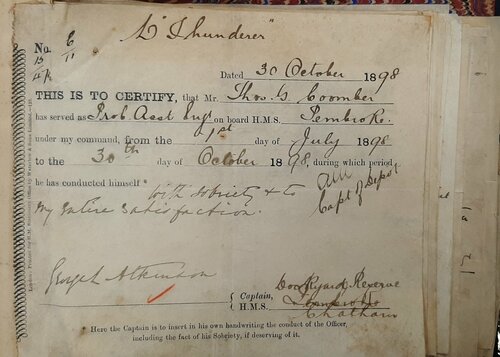
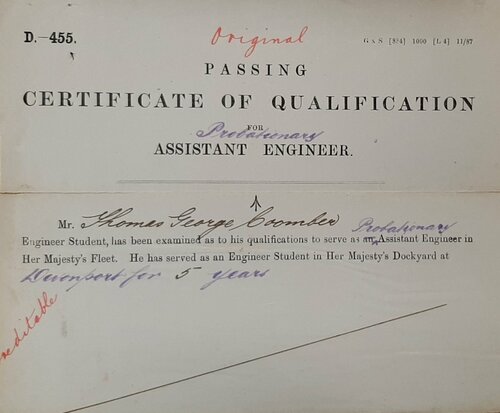
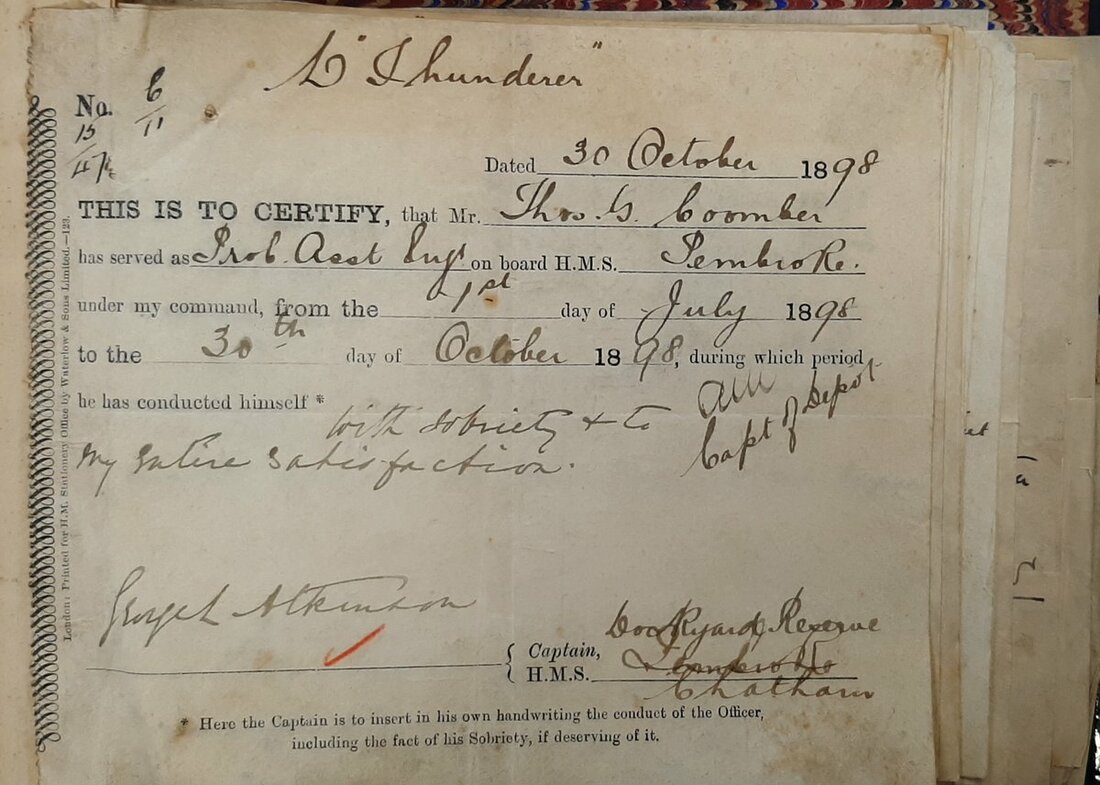
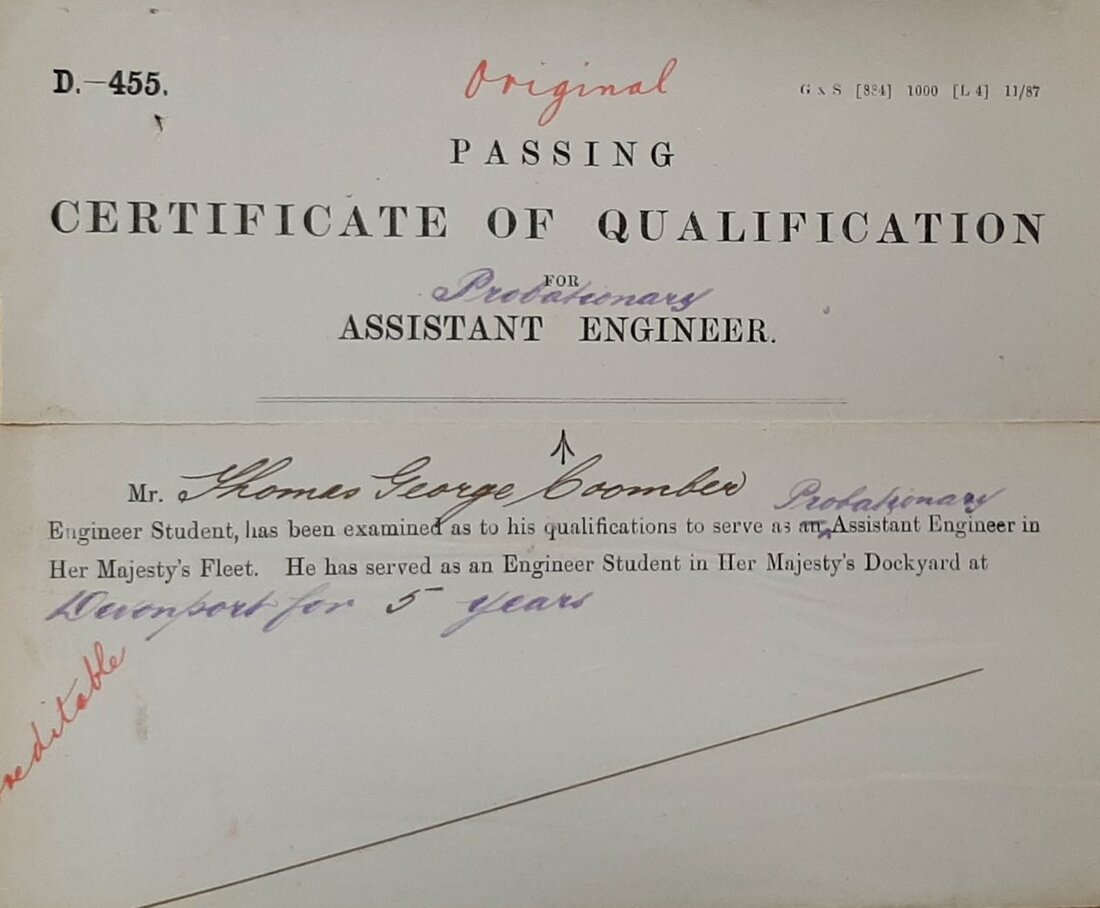
An old album containing a quantity of certificates, including those for qualifying in the ranks of Assistant Engineer, dated May 1898, and Engineer Lieutenant, dated June 1904; his career 'flimsies' (approximately 50), covering the period July 1898 to November 1927, including one signed by Admiral Lord Mountevans of the Broke.
iv)
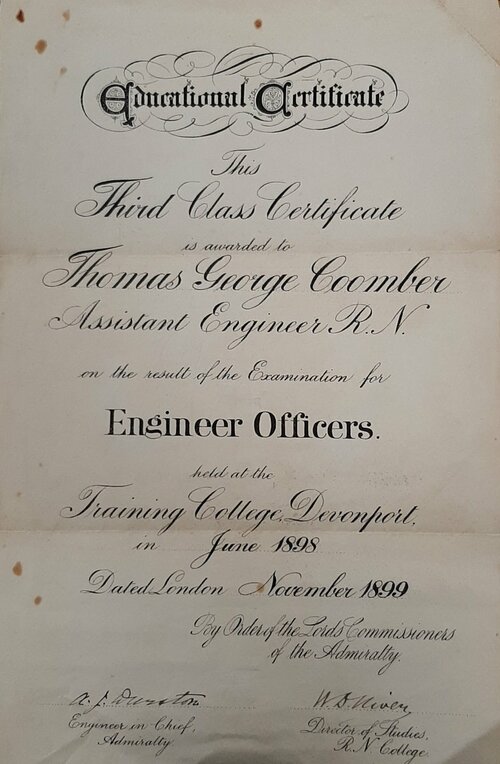
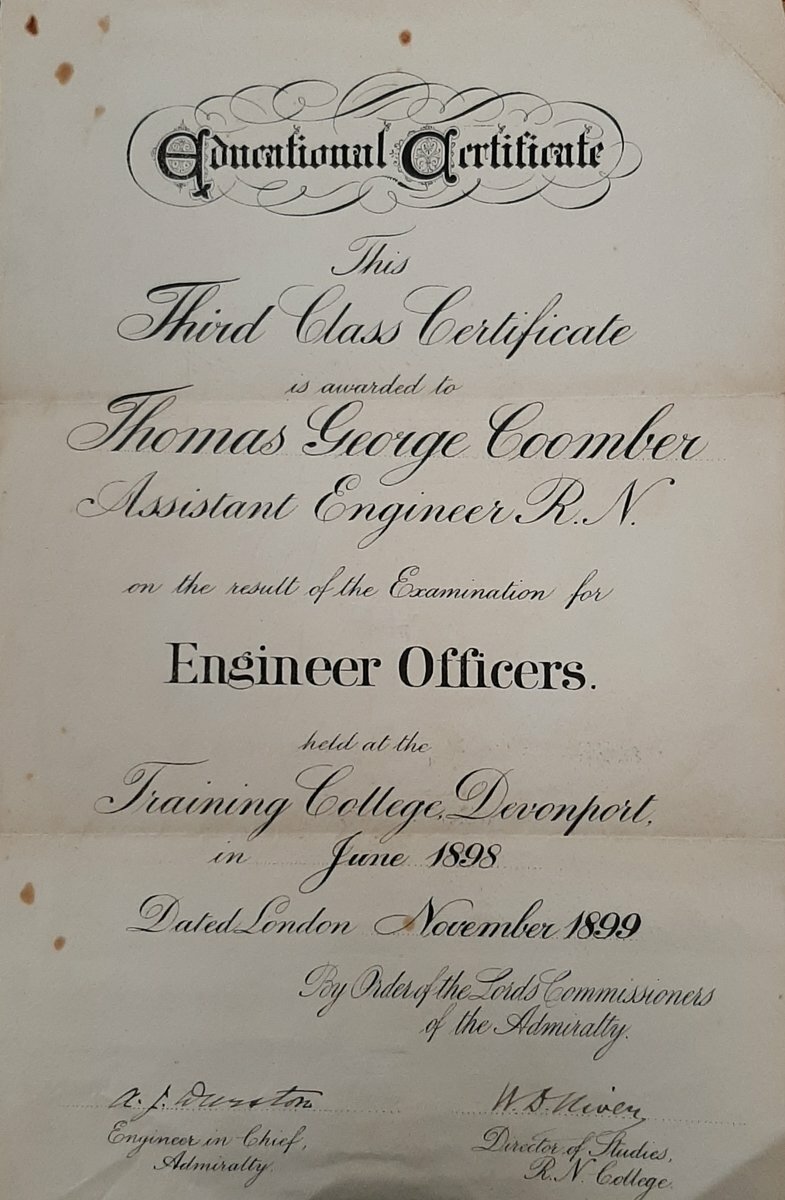
His Third-Class Educational Certificate for Engineer Officers, as issued at the Training College, Devonport in June 1898, together with his commission warrant for the rank of Engineer Sub. Lieutenant, dated 1 April 1903.
v)
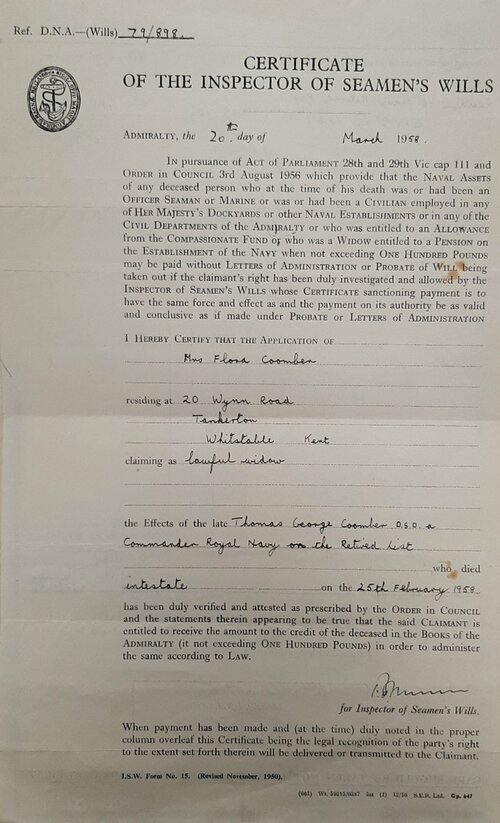
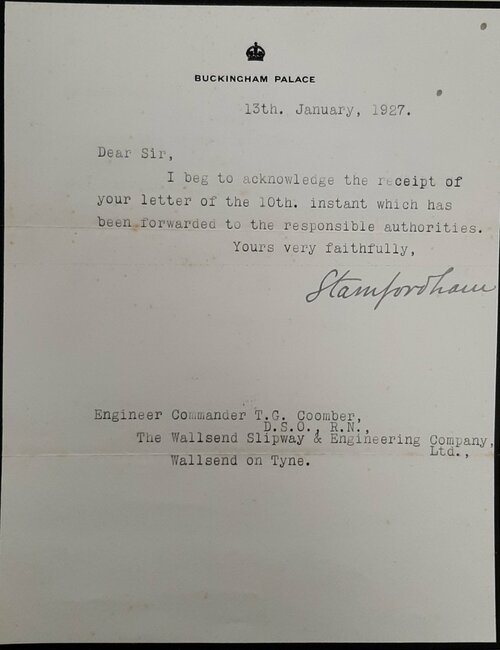
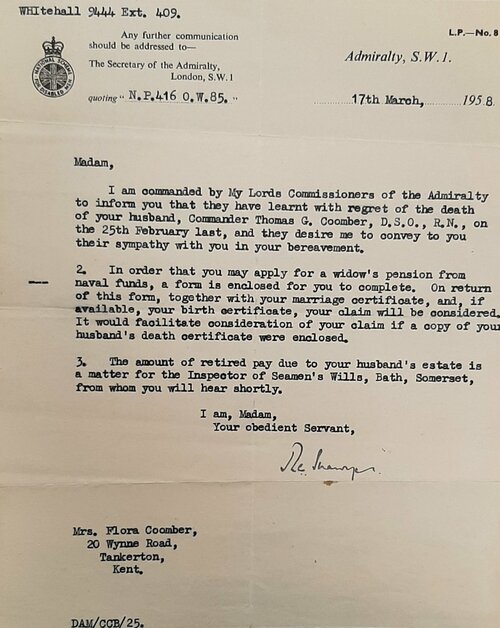
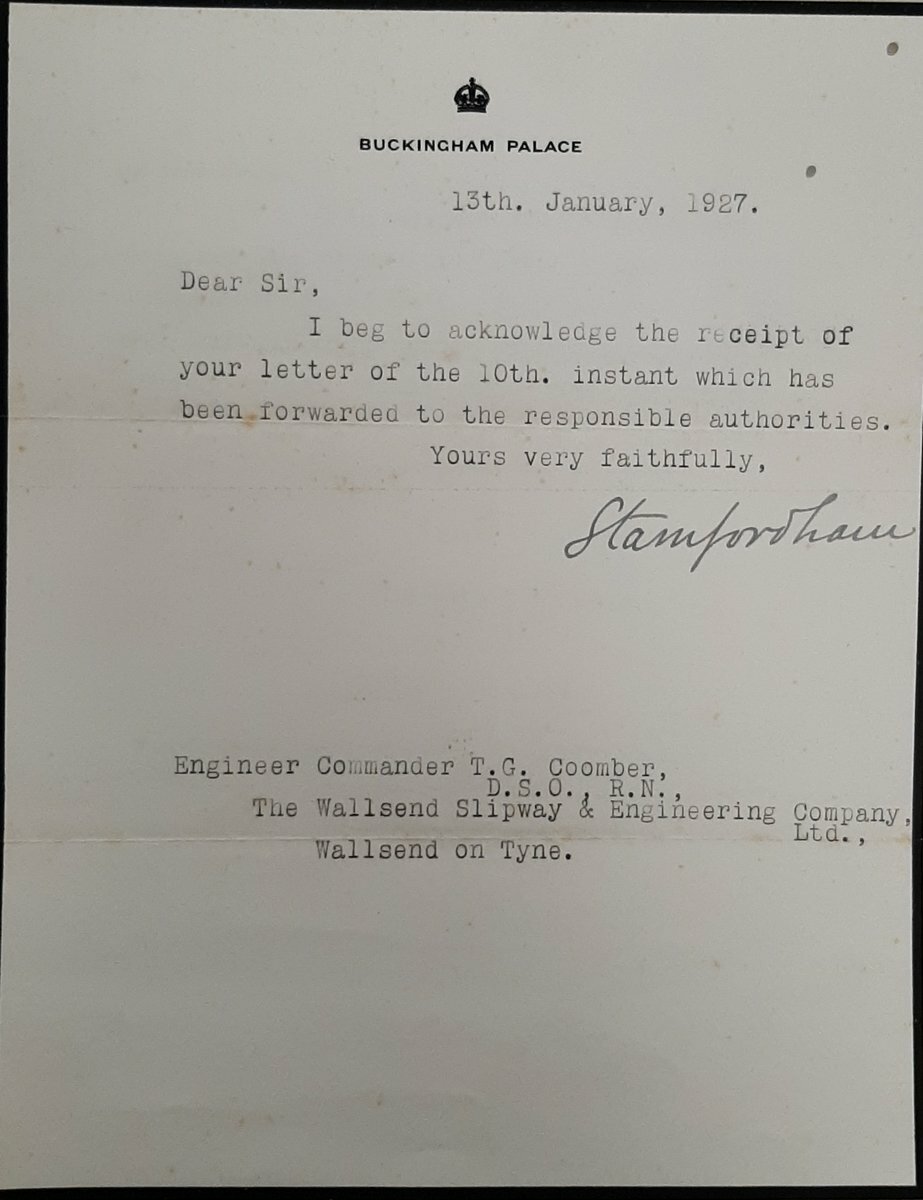
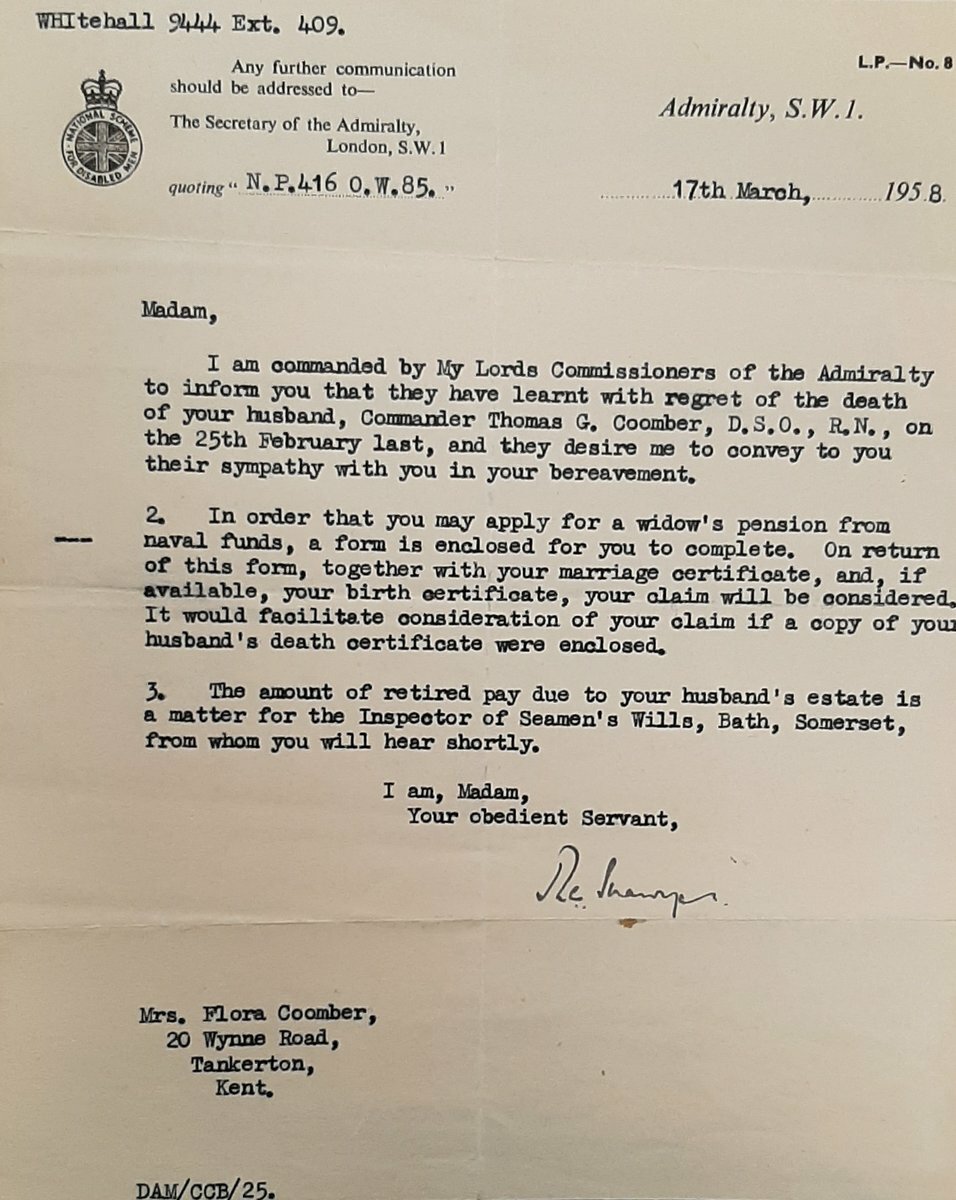
A Letter from Buckingham Palace, acknowledging receipt of a letter sent by the recipient, dated 13 January 1927, together with Admiralty letter and certificate in respect of his widow's application for a pension.
vi)
A copy of Adventurous Life, by Admiral Lord Mountevans, K.C.B., D.S.O., in which he praises Coomber's efforts in the Broke action.
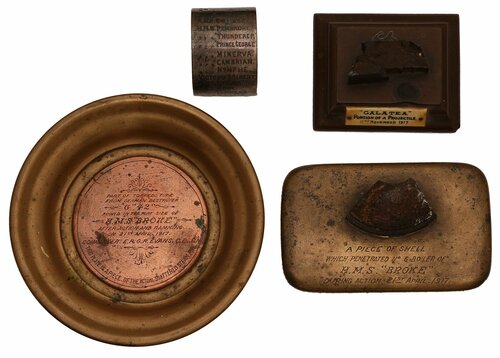
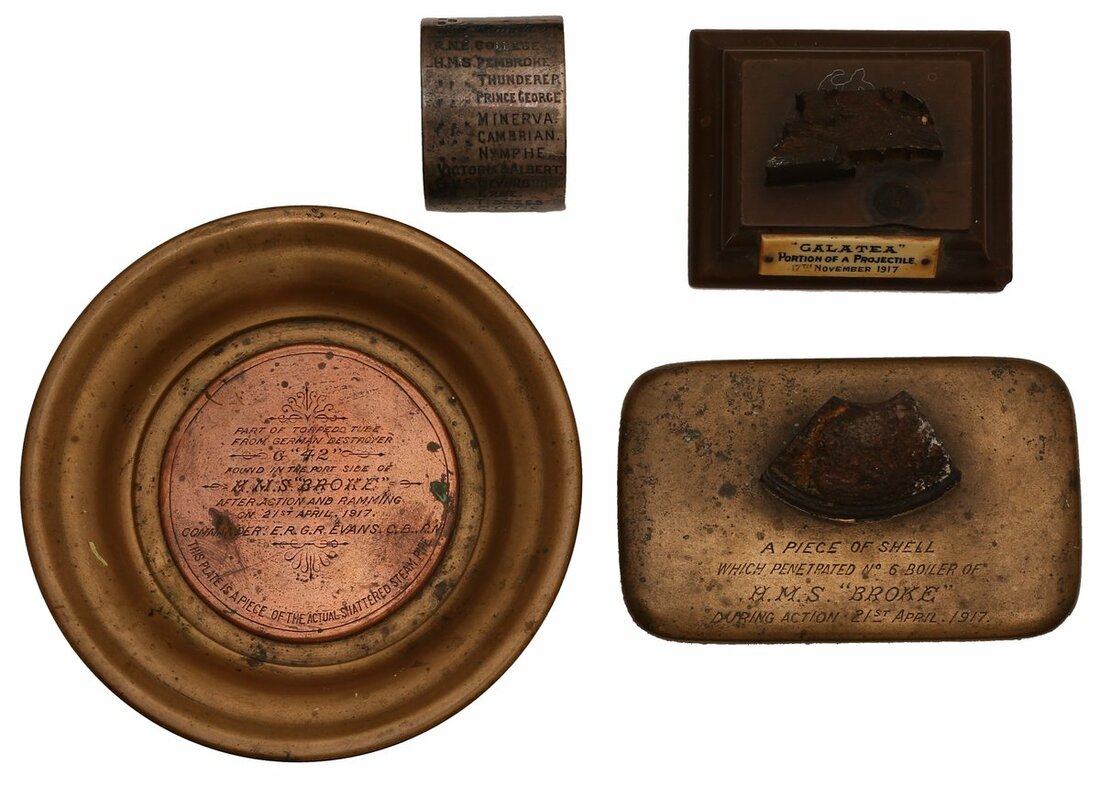
Also sold with a napkin-holder and assorted battle relics, comprising:
i)
A silver napkin-holder, hallmarks for London, 1900, the outer band engraved with 13 career ship / shore appointments, ranging from the Royal Naval Engineering College to H.M.S. Galatea, via the Royal Yacht and the Broke.
ii)
A brass paperweight, surmounted by a shell fragment 'which penetrated No. 6 Boiler Room of H.M.S. Broke during action 21st April 1917'; engraved inscription, refers.
iii)
A small wooden plinth, surmounted by a shell fragment, an explanatory label stating 'Galatea. Portion of a Projectile. 17th November 1917'.
iv)
A circular brass ash tray, with inserted copper disc, the whole fashioned from 'Part of the Torpedo Tube from the German Destroyer G '42', Found in the Port Side of H.M.S. Broke after Action and Ramming on 21st April 1917', and a piece of 'shattered steam pipe' from Broke's engine room; engraved inscriptions, refer.
Subject to 5% tax on Hammer Price in addition to 20% VAT on Buyer’s Premium.
Sold for
£1,200
Starting price
£800

Watch, listen and bid as if you were in the room. Now available for auctions worldwide.
Click here to bid live
An exclusive and confidential service for the discerning collector or vendor.
View the Gallery
Download every Spink catalogue on your iPad, iPod or iPhone using free Spink app.
Download From iTunes© 2026 Spink & Son. All rights reserved.